EU to Mandate User-Replaceable Smartphone Batteries from Next Year, Industry May Circumvent Regulation with High-Performance Cells Instead of Removable Designs

Siobhán Delaney is a Dublin-based writer for The Economy, focusing on culture, education, and international affairs. With a background in media and communication from University College Dublin, she contributes to cross-regional coverage and translation-based commentary. Her work emphasizes clarity and balance, especially in contexts shaped by cultural difference and policy translation.
Authored On
Modified
Strategic Push to Address E-Waste
Limited Industry Impact Due to 1,000-Cycle Exemption Clause
Regulation Could Be Leveraged to Refine Business Models
The European Union (EU) will mandate that smartphones and tablets adopt user-replaceable battery designs starting next year. The stringent requirement for direct user replacement is emerging as a critical variable that simultaneously pressures manufacturers’ design strategies and cost structures. However, considering exemption clauses and technological workarounds, the actual market shift is likely to converge not on the expansion of removable batteries but on a price uptrend driven by enhanced battery performance.
Full Implementation of Mandatory Battery Self-Replacement by 2027
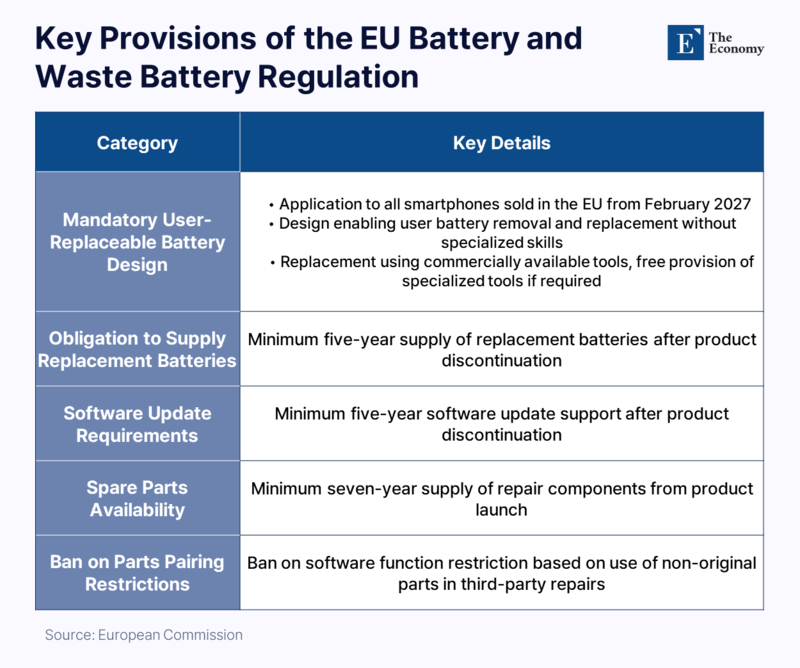
According to the European Commission on April 23 (local time), under the ‘Battery and Waste Battery Regulation (Regulation 2023/1,542),’ all smartphones sold in Europe must incorporate a ‘user-replaceable battery’ design starting February 2027. The regulation serves as a follow-up measure to the EU’s broader legislative push for mandatory removable batteries as part of its environmental policy agenda. The EU had attempted similar legislation five years ago, but it failed to pass at the time. However, discussions resumed in December 2023, and the bill was approved in plenary within six months, paving the way for the commercialization of removable-battery smartphones.
The measure is aimed at fundamentally curbing the industry practice of artificially shortening device replacement cycles under the pretext of environmental protection and consumer rights enhancement. From the enforcement date, manufacturers must design products so that users can remove and replace batteries without specialized expertise. Replacement must be possible using only ‘commercially available tools,’ and if specialized tools are required, they must be provided free of charge.
Manufacturers will also be required to supply replacement batteries for at least five years after product discontinuation, alongside software updates over the same period. In addition, companies must provide repair parts for a minimum of seven years after product launch, while the practice of ‘parts serialization’—blocking software functionality due to the use of non-genuine components by third-party repair shops—will be prohibited. The EU estimates that extending device lifespans through battery replacement could generate cost savings of approximately $21.6 billion by 2030.
Currently, most smartphones are designed with batteries fixed inside the device, often requiring professional repair for replacement. This has led to frequent full-device replacements when battery performance deteriorates. Alongside this regulation, the EU is also advancing policies to strengthen battery durability and expand recycling. Global battery demand is projected to increase roughly 14-fold by 2030, with the EU expected to account for approximately 17% of the total. The EU reports annual sales of around 150 million smartphones and 24 million tablets, generating approximately 5 million tons of electronic waste.
Pressure to Reshape Smartphone Design
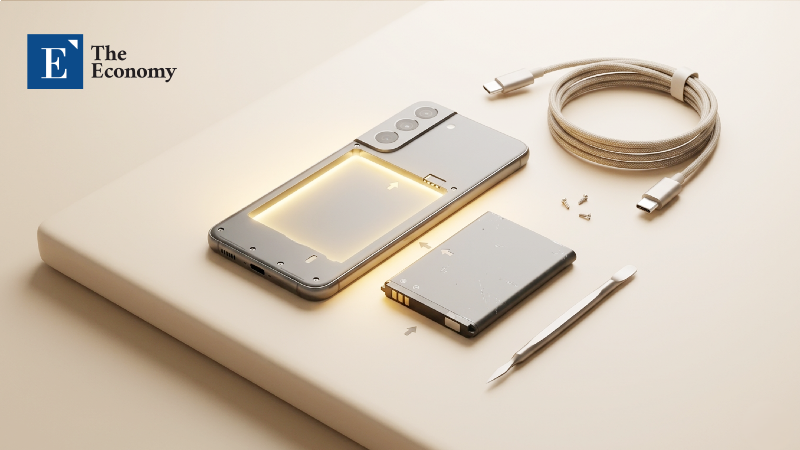
The measure represents a core provision of the battery regulation enacted in 2023, with Article 11—targeting built-in portable batteries—directly aimed at the smartphone industry. Samsung Electronics will be required to apply entirely new designs starting with the Galaxy S28 series, scheduled for release in 2027, while Apple faces similar pressure beginning with the iPhone 19 series. Removable designs allow users to replace aging batteries themselves, potentially extending device replacement cycles. Battery capacity could also increase, reducing the need for separate portable chargers.
Major smartphone manufacturers currently maintain integrated battery designs due to their advantages in achieving thinner and lighter devices. Such designs are also more effective for water and dust resistance. Adopting removable batteries introduces seams on the device’s rear, increasing the risk of water or dust ingress and complicating the implementation of robust waterproofing. Additionally, transitioning from integrated to removable designs increases design complexity, raises production costs, and could lengthen replacement cycles—ultimately weighing on manufacturers’ revenue.
For this reason, Apple has consistently adopted integrated battery designs across all iPhone models since the original launch in 2007. Samsung Electronics introduced a removable battery in last year’s Galaxy XCover5, but among flagship models, the last removable-battery device was the Galaxy S5 in 2014. Once the regulation takes effect, the majority of smartphones currently on the market would technically be in violation. According to global market research firm Omdia, Samsung and Apple held market shares of 35% and 27%, respectively, in the European smartphone market last year.
Battery Performance Upgrades as Justification for Price Increases
However, some in the industry believe the regulation’s impact may be limited. A key exemption exists: devices equipped with batteries that retain at least 80% capacity after 1,000 charge cycles are exempt from the requirement for user-replaceable designs. Apple has already met this benchmark for several years. Recent iPhone models officially guarantee 80% capacity retention after 1,000 cycles. Even during overnight charging, the device limits the charge to 80% before completing the remaining 20% after a delay, preventing prolonged exposure to full charge and extending battery lifespan.
Samsung Electronics is at a similar level. Moreover, Samsung has already introduced a ‘pull-tab’ battery pouch structure in recent Galaxy models, replacing strong adhesives. This enables battery removal without reverting to a fully detachable back cover, effectively meeting much of the regulatory requirement. As a result, premium smartphones are likely to avoid major design overhauls.
Some analysts argue that the regulation will serve less as a catalyst for a return to removable batteries and more as a trigger for industry-wide restructuring centered on ‘battery technology advancement.’ Market dynamics are expected to evolve toward a new competitive landscape combining technological capability with pricing strategy. One market expert noted, “Some expect manufacturers to revert to removable designs to comply with the regulation, but this overlooks the strategic direction of global tech firms. It is highly unlikely that leading companies like Apple would sacrifice design integrity for physical replaceability,” adding, “Instead, they are more likely to adopt top-tier batteries that meet regulatory standards while repositioning them as premium features reflected in higher product prices.”
There is also growing anticipation that research and development (R&D) investment will intensify across battery cell structures, materials technology, and charging algorithms. An industry insider explained, “This regulation is less about directly promoting removable designs and more about raising battery performance benchmarks, thereby stimulating technological competition among companies,” adding, “Ultimately, the competitive landscape will be determined by battery firms’ R&D capabilities and technological differentiation.”
Siobhán Delaney is a Dublin-based writer for The Economy, focusing on culture, education, and international affairs. With a background in media and communication from University College Dublin, she contributes to cross-regional coverage and translation-based commentary. Her work emphasizes clarity and balance, especially in contexts shaped by cultural difference and policy translation.
Similar Post