OpenAI, Jolted by Anthropic’s New Model, Unveils GPT-5.5 Just Six Weeks After GPT-5.4, Intensifying Technology Showcase Ahead of IPO

Anne-Marie Nicholson is a fearless reporter covering international markets and global economic shifts. With a background in international relations, she provides a nuanced perspective on trade policies, foreign investments, and macroeconomic developments. Quick-witted and always on the move, she delivers hard-hitting stories that connect the dots in an ever-changing global economy.
Authored On
Modified
Anthropic as the Technical Benchmark, Surprise Upgrade Executed
Agentic Coding Capabilities Enhanced to Regain Market Share
OpenAI vs. Anthropic, Intensifying Battle for Dominance
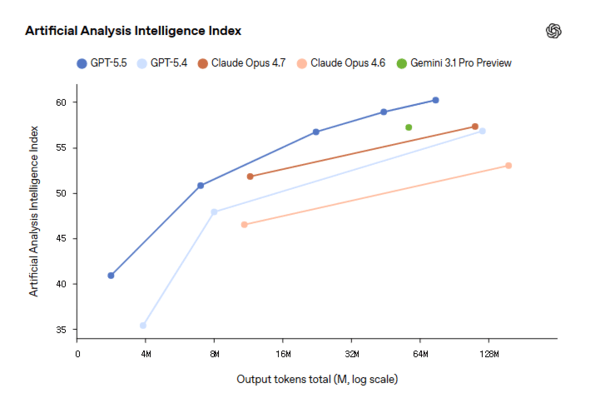
OpenAI has reignited the battle for leadership in the generative AI market with the release of a new artificial intelligence model. The unveiling of a new model just six weeks after the previous release underscores the accelerating pace of AI competition. In particular, the move to prove performance against rival Anthropic is being viewed as a sign of OpenAI’s urgency. Amid a multifaceted contest spanning technological capability and ethical standards, the struggle for supremacy between the two companies is becoming increasingly fierce.
OpenAI Counters Two Weeks After Anthropic’s Mythos Release
On the 23rd, OpenAI President Greg Brockman said at a briefing for the launch of the new AI model GPT-5.5 that “GPT-5.5 thinks faster and more sharply with fewer tokens than 5.4.” He stressed that “when measuring latency per token in real-world environments, GPT-5.5 delivers speed consistent with its predecessor while achieving far higher intelligence.” OpenAI described this as a major advance at a time when “performance per cost,” rather than raw performance alone, is becoming more important in AI model competition. “At a macro level, we are moving into a computing-resource economy,” Brockman said. “That means we can provide enterprise users with more access to advanced AI models.”
The industry is focusing on the fact that OpenAI released 5.5 just a month and a half after unveiling version 5.4, and that it used rival Anthropic’s flagship model as a technical benchmark. The release came shortly after Anthropic unveiled Claude Mythos Preview, a model equipped with advanced cybersecurity capabilities. According to OpenAI’s benchmark report, GPT-5.5 outperformed Anthropic’s Claude Opus 4.7 in many areas. In GDPval, which evaluates knowledge-work capabilities, GPT-5.5 scored 84.9%, surpassing Opus 4.7’s 80.3%. In Terminal-Bench 2.0, which measures terminal-environment task performance, it recorded 82.7%, more than 10 percentage points above Opus 4.7’s 69.4%. In Cybergym, which evaluates cybersecurity capabilities, GPT-5.5 scored 81.8%, exceeding Opus 4.7’s 73.1%.
However, in SWE-Bench Pro, the coding benchmark most in demand across the information technology industry, GPT-5.5 posted only 58.6%. That leaves it more than 5 percentage points behind Opus 4.7’s 64.3%. Moreover, GPT-5.5 failed to match the performance of Mythos, which Anthropic recently released on a limited basis to 40 partner companies. Mythos scored 92.1% on Terminal-Bench 2.0. In Humanity’s Last Exam, which measures general intelligence, GPT-5.5 also fell short of Mythos, recording 41.4% versus Mythos’s 56.8%. OpenAI responded by saying that “Anthropic’s model has shown signs of data memorization,” rejecting the benchmark results. It also emphasized that GPT-5.5 has improved autonomy and intuition to make it better suited for agentic computation. “What is truly special about this model is that it can do more with fewer instructions,” Brockman said. “It looks at an ambiguous problem and figures out what to do next on its own.”
Implications of GPT-5.5’s Enhanced Agentic Coding
Experts see the sharp improvement in GPT-5.5’s agentic coding capabilities as reflecting OpenAI’s strong intent to quickly shore up an area where it had been viewed as lagging Anthropic and regain leadership. On the 14th, Anthropic released an updated version of the Claude Code desktop app, designed to execute more tasks simultaneously. The update moves away from the conventional method of entering a single prompt and waiting for results, instead reflecting developers’ real-world workflow of handling multiple tasks across various repositories in parallel. It focuses on supporting an “orchestrator” role that can simultaneously conduct code refactoring, bug fixes and test writing, while allowing users to monitor progress and intervene when necessary.
The biggest change is multi-session management. A newly added sidebar allows users to view all ongoing or recently handled sessions at a glance. Sessions can be filtered or grouped by project, status and execution environment, while completed sessions are automatically archived to keep the workspace clean. When additional questions are needed during a task, users can also branch the conversation through a separate “side chat” without disrupting the existing workflow. The feature carries over the context of the main task but does not feed the result back into it, reducing workflow confusion. “For many developers, the way active work gets done has changed,” Anthropic said. “The new app is designed around what agent-based coding actually feels like: multiple things progressing at once, with the user overseeing them.”
Within this landscape, GPT-5.5’s strategy is clear: catch up with the user experience Claude has built while securing a higher level of automation. The industry is assessing that the release of GPT-5.5 marks the end of simple chatbot competition and the start of a full-scale agent war in which AI handles tasks on its own. As Anthropic rapidly encroaches on the enterprise market with its coding agent Claude Code and general-purpose work agent Claude Cowork, OpenAI has moved to respond head-on. According to venture capital firm Menlo Ventures, Anthropic has overtaken OpenAI in the enterprise AI market with a 40% share, compared with OpenAI’s 27%, while Claude Code alone is known to have generated $2.5 billion in annual recurring revenue.

IPO Race Acceleration, Technology Rather Than Revenue Determines Valuation
The competition between OpenAI and Anthropic is also unfolding fiercely in the initial public offering market. With both companies preparing for IPOs, listing timing and valuation have emerged as key market concerns. In this process, the yardstick for corporate value is also clearly shifting from revenue to technological capability. The fear that falling behind in model-performance competition could undermine overall enterprise value is fueling both companies’ race to upgrade their models.
At present, investment flows in the AI industry are moving toward Anthropic rather than OpenAI. In the secondary market, OpenAI is being valued at about $765 billion, roughly 10% below the $852 billion valuation recognized in its latest funding round. Anthropic, by contrast, is being valued at $600 billion, more than a 50% premium to the $380 billion valuation it secured in February. However, since neither company allows investors to freely trade shares in the secondary market, such transactions are being conducted indirectly through special purpose vehicles.
Ken Smith, founder of U.S. private-share trading platform NextRound Capital, said, “Demand for OpenAI shares is falling in the secondary market.” Smith said, “Large hedge funds and VCs put $600 million worth of OpenAI shares up for sale in the secondary market, but there were no interested investors,” adding, “By contrast, buyers seeking to invest in Anthropic have already gathered $2 billion in cash.” Adam Crawley, co-founder of another secondary trading platform, Augment, also assessed that investment demand for Anthropic is higher than for OpenAI. “People are betting that Anthropic’s value will catch up with OpenAI,” he said. “It is unclear what kind of short-term return investors can get by buying OpenAI shares.”
Anthropic also appears to be one step ahead in the ethical competition following the technology race. The starting point of that competition dates back to the Asilomar Conference held in January 2017. At the time, the U.S. nonprofit Future of Life Institute convened leading AI scholars and technology executives from around the world to reach consensus on the future development of AI and related ethical issues. At the conference, scholars and AI developers established principles requiring the creation of intelligence beneficial to humanity and the construction of ethically verified, stable systems.
But two years after those principles were established, OpenAI drew controversy in 2019 by creating a for-profit subsidiary, a move seen as violating the Asilomar principles, and when it launched ChatGPT in 2023, it refused to disclose the model. It later effectively parted ways with the Asilomar spirit through steps including conversion into a public-benefit corporation and the abolition of profit caps. Anthropic, by contrast, is viewed as upholding the principles of shared benefit and preparedness for intelligence explosion at the governance level. An independent body called the Long-Term Benefit Trust holds the right to appoint Anthropic’s board, and if major investors pressure the company to ignore safety principles and pursue profit-making businesses, the trust’s members can remove board directors. Anthropic has also announced a responsible scaling policy, pledging to halt training until safety measures are secured if an AI model becomes dangerous beyond a certain level.
Anne-Marie Nicholson is a fearless reporter covering international markets and global economic shifts. With a background in international relations, she provides a nuanced perspective on trade policies, foreign investments, and macroeconomic developments. Quick-witted and always on the move, she delivers hard-hitting stories that connect the dots in an ever-changing global economy.
- Previous EU to Mandate User-Replaceable Smartphone Batteries from Next Year, Industry May Circumvent Regulation with High-Performance Cells Instead of Removable Designs
- Next “Western Pacific as a Treasure Trove”: Japan Accelerates Deep-Sea Rare Earth Development, Signals Potential Cooperation With U.S.
Similar Post