"Naval Blockade as a Critical Blow" As Ceasefire Talks Stall, U.S. Secures ‘Temporal Advantage’ While Iran Buckles Under Economic Strain

Aoife Brennan is a contributing writer for The Economy, with a focus on education, youth, and societal change. Based in Limerick, she holds a degree in political communication from Queen’s University Belfast. Aoife’s work draws connections between cultural narratives and public discourse in Europe and Asia.
Authored On
Modified
U.S. Rejects Iran’s Three-Stage Proposal, Declares “Strait of Hormuz Is an International Waterway”
Iran’s Oil Exports Crippled by Naval Blockade, Struggles to Sustain Production Base
Prolonged Deadlock Turns Into ‘War of Time,’ With U.S. Holding Relative Advantage
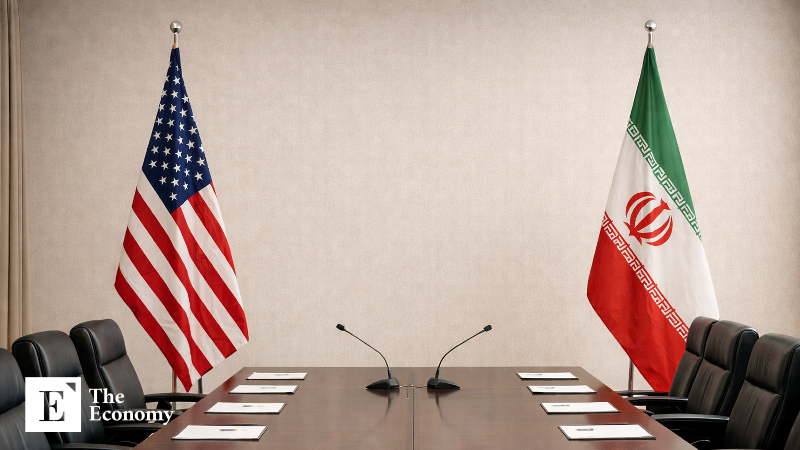
The U.S. government has firmly rejected Iran’s newly proposed three-stage ceasefire framework. Washington has made clear that it cannot accept any arrangement in which Iran exercises direct control over the Strait of Hormuz, a recognized international waterway. As negotiations between the two countries continue to stall, experts assess that Iran is increasingly positioned at a significant disadvantage. With U.S. naval blockades constraining Iran’s core economic lifeline—oil exports—the country’s financial burden is expected to intensify rapidly.
U.S.-Iran Ceasefire Talks Remain Deadlocked
According to a compilation of reports from international media outlets including The Times of Israel on the 28th (local time), U.S. Secretary of State Marco Rubio stated in a Fox News interview on the 27th that “Iran’s retention of control over the Strait of Hormuz and its pursuit of nuclear weapons are absolutely unacceptable.” Rubio added, “If Iran’s so-called ‘opening of the strait’ means that vessels must obtain its permission and pay tolls or face destruction, that is not openness,” emphasizing that “this is unequivocally an international waterway, and the United States cannot allow a system in which Iranian authorities decide who may pass through it to become normalized.”
Prior to these remarks, Iran had submitted a “three-stage proposal” to the White House through mediator Pakistan. The first stage calls for the conclusion of hostilities by the United States and Israel, accompanied by guarantees against renewed conflict with Iran. The second stage involves lifting the U.S. naval blockade of Iranian ports and initiating discussions over the “management” of the Strait of Hormuz. Only in the third stage would negotiations address the core issue of Iran’s nuclear program. Rubio interpreted this framework as predicated on a “conditional opening” of the strait and formally rejected it, demanding unconditional and complete freedom of navigation.
Rubio further warned about potential alternatives should ceasefire and denuclearization talks ultimately collapse, stating that “subsequent measures will be determined by the President,” while underscoring that “the current sanctions suffocating Iran are already lethal, and there remains ample room and means to intensify that pressure further.” Addressing Iran’s nuclear ambitions, he added, “Just as Iran threatens the global economy through oil, it seeks to hold the world hostage with nuclear weapons to impose its will,” concluding that “the United States will never tolerate the emergence of such a nuclear-armed state.”
Iran’s Oil Storage Capacity Reaches Limits
The United States’ ability to maintain a hardline stance at the negotiating table is underpinned by the mounting economic pressure confronting Iran. On the 13th at 10 a.m., the U.S. initiated a naval blockade against Iran. At the time, U.S. Central Command warned that “any vessel entering or departing the designated blockade zone without U.S. authorization will be subject to interception, diversion, or seizure.” Treasury Secretary Scott Bessent also stated via X (formerly Twitter) on the 21st that “within days, storage facilities at Kharg Island—Iran’s largest oil terminal—will be full, and vulnerable Iranian oil wells will inevitably be shut down,” expressing confidence that the counter-blockade effect would materialize swiftly.
In reality, with export routes effectively blocked, Iran is facing severe constraints in securing storage capacity. Daily exports of crude oil and condensates, which previously averaged 2.1 million barrels, have plunged to approximately 560,000 barrels following the blockade, while onshore inventories have surged to 49 million barrels. Under these conditions, Iran has been forced to reactivate aging infrastructure known as “junk storage facilities” and deploy temporary containers and offshore tankers to stockpile oil. Production cuts have also begun to take hold. Some forecasts suggest that if the blockade persists, Iran’s daily oil output could decline to between 1.2 million and 1.3 million barrels—less than half of its previous production level.
Despite mounting inventory pressures, Iran has been unable to halt production due to the continuous-operation design of oil extraction systems. High-pressure fluids and gases must constantly circulate within wells and pipelines to maintain pressure equilibrium. Abrupt shutdowns can trigger pressure imbalances and temperature fluctuations, leading to equipment damage, wax and water sedimentation, and pipeline blockages, significantly increasing restart costs. Given the prevalence of aging oil fields in Iran, there is also a risk that once production is halted, internal structural damage could prevent a return to previous output levels.
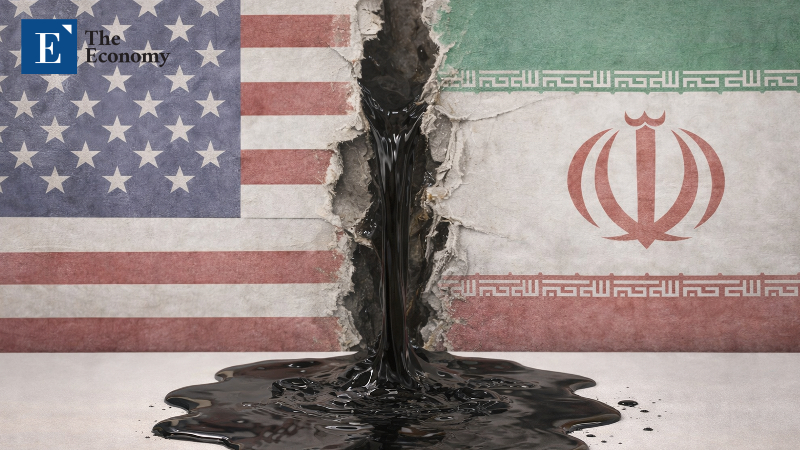
Iran More Vulnerable to Economic Shock Than U.S.
President Donald Trump has been leveraging these vulnerabilities as a pressure tactic against Iran. In a Fox News interview on the 26th, he stated, “When you have massive volumes of oil flowing through pipelines, if for any reason it cannot be loaded onto ships or containers and the line becomes blocked, the pipeline can explode internally due to mechanical causes,” adding that “there may be only about three days left before that happens in Iran.” While this may reflect Trump’s characteristic hyperbolic rhetoric, the possibility of explosions resulting from rapidly rising internal pressure when storage and processing facilities reach capacity cannot be entirely dismissed.
Nevertheless, Iran has entered a strategy of endurance, resisting such pressure while waiting for the United States to concede first. Tehran calculates that if global oil prices remain above $100 per barrel for an extended period, Trump—facing midterm elections in November—may opt for compromise in response to domestic political pressure. Iranian officials have publicly asserted their ability to neutralize the U.S. naval blockade, emphasizing their countermeasures, but experts contend that the country’s actual options remain limited. At present, Iran is effectively cornered from an economic standpoint.
The two countries also exhibit a stark disparity in their capacity to absorb short-term shocks. The United States can mitigate external disruptions to some extent through its shale-driven energy independence and dollar-centric financial system. Iran, by contrast, faces the prospect of severe economic damage if it fails to resume oil exports, given its heavy reliance on energy revenues for fiscal stability and foreign currency inflows. Additionally, the Central Bank of Iran operates under significant policy constraints, while confidence in the national currency remains weak. This raises the risk that exchange rate instability could rapidly translate into inflationary pressure. Indeed, Iran’s economy has repeatedly experienced episodes of hyperinflation in the past, accompanied by sharp currency depreciation, capital controls, and the expansion of informal markets.
Aoife Brennan is a contributing writer for The Economy, with a focus on education, youth, and societal change. Based in Limerick, she holds a degree in political communication from Queen’s University Belfast. Aoife’s work draws connections between cultural narratives and public discourse in Europe and Asia.
Similar Post