China’s Overwhelming Dominance in Electric Vehicles, Conquering Global Markets with Price Competitiveness and Technological Prowess

Authored On
Modified
Expansion of China’s EV Footprint in Global Markets
BYD, Chery Set Record High Overseas Sales
Reshaping the Landscape on the Back of a Fully Integrated Supply Chain
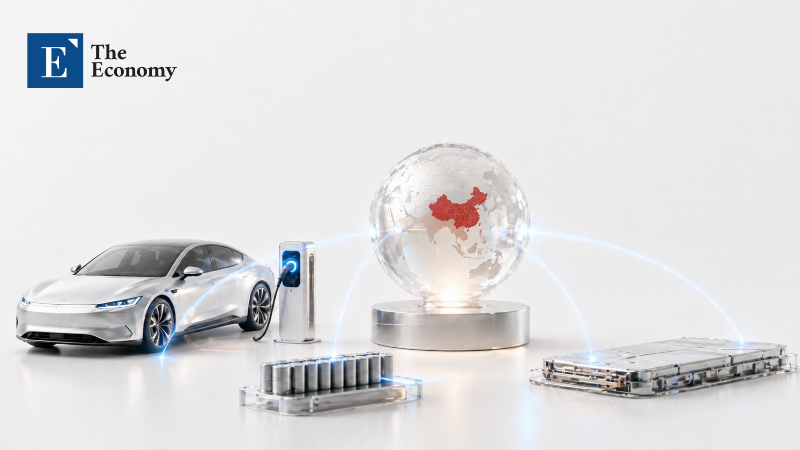
Chinese electric vehicles are rapidly reshaping the global automotive landscape. Armed with compelling price-to-performance ratios and advanced smart features, Chinese brands are establishing themselves as a dominant force in the global EV market, capturing significant market share not only in developed regions such as Europe and the United States but also across emerging markets including South America and the Middle East. Their influence is now extending into future mobility domains such as autonomous driving and software-defined vehicles (SDVs), prompting even global automakers to increasingly adopt elements of China’s technological ecosystem.
Surging Market Share Across Europe, Australia, South America, and Southeast Asia
According to the European Automobile Manufacturers’ Association (ACEA) on April 27 (local time), total vehicle sales in the European market reached 3,521,110 units in the first quarter, marking a 4.1% year-on-year increase. Government subsidies and tax incentives for eco-friendly vehicles stimulated demand, supporting an overall market recovery. Electrification served as the primary growth driver. Battery electric vehicles (BEVs) accounted for 19.4% of total sales, a notable rise from 15.2% a year earlier, while hybrid electric vehicles (HEVs) led with a 38.6% share. In contrast, the combined share of gasoline and diesel vehicles declined to 30.3%, continuing its downward trajectory.
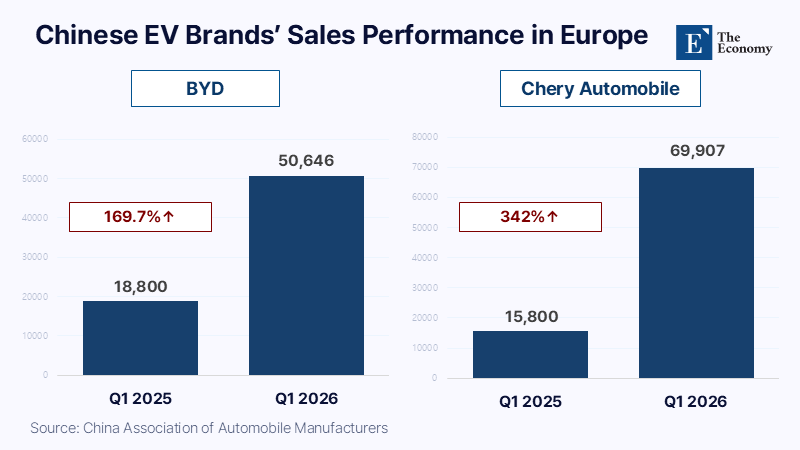
Chinese brands have taken the lead in Europe’s EV market. BYD sold 50,646 units in the European Union in the first quarter, surging 169.7% year-on-year. Including the United Kingdom and the European Free Trade Association (EFTA), total European sales reached approximately 73,800 units, lifting its market share to around 2%. Chery is also rapidly expanding its presence, selling 69,907 units in Europe during the same period, a 342% increase year-on-year. Through its Omoda and Jaecoo brands, Chery has entered the top three among Chinese automakers in key markets such as the UK, Italy, and Spain. With the addition of Chery and other Chinese brands, total Chinese vehicle sales in Europe surpassed 140,000 units in March, marking an all-time high.
A shift is also underway in Australia, where Japanese automakers had dominated for nearly three decades. According to the China Association of Automobile Manufacturers, Chinese brands have captured a 25% market share. Their cost efficiency—allowing savings of approximately $1,300 annually in fuel and maintenance for comparable models—has positioned them as a primary choice for households.
In South America and Southeast Asia, demand is outpacing supply. In Brazil, BYD accounted for 78% of the pure electric vehicle market in the first two months of the year, securing the top position in retail sales. Market share in emerging economies such as Mexico and Chile doubled within three months, while supply shortages have led to delivery backlogs stretching several months. In Thailand, Chinese EVs led by BYD have captured 86% of the market. Production facilities are operating at full capacity, and order volumes in neighboring countries such as the Philippines have surged month-on-month, effectively saturating the Southeast Asian market with Chinese electric vehicles.
U.S. Consumers Question Barriers to Chinese EVs
Momentum surrounding Chinese EVs is also building in the United States. Currently, American consumers face significant barriers to purchasing Chinese vehicles, as the U.S. government has effectively restricted their entry on grounds of national security and industrial protection. In 2024, tariffs of 100% were imposed on Chinese EVs, alongside bans on imports of vehicles containing Chinese software or components. Additional hurdles include stringent safety and environmental standards, which complicate vehicle registration and insurance eligibility.
Despite these restrictions, consumer perception is shifting rapidly. In Cox Automotive’s “2024 U.S. New Car Buyer Study” released in February, 33% of respondents indicated willingness to consider purchasing a Chinese vehicle, nearly doubling from 18% in 2021. A similar survey conducted in Canada by Nanos Research Group found that a majority of respondents stated that a vehicle’s Chinese origin had little impact on their purchasing decisions.
This shift is also evident on social media platforms such as TikTok. Recently, prominent U.S. automotive YouTuber Richard Benoit posted a review of the Chinese electric SUV “iCar 03,” which quickly surpassed 2 million views. In the video, Benoit remarked, “I now understand why the U.S. government is blocking these cars,” adding that “the price-to-performance ratio is unbelievable.” The vehicle is priced at $24,000.
Price competitiveness remains a central driver of the Chinese EV boom. The average price of a new car in the United States has risen 26% since 2020, reaching approximately $50,000. In contrast, BYD’s compact EV “Seagull” is priced at around $13,000. One consumer in North Carolina noted, “I wanted to purchase a vehicle I saw on social media, but it was not possible,” adding, “It’s difficult to understand why better-performing, more affordable cars are being blocked.”
Mercedes-Benz and BMW Turn to Chinese Technology
This price advantage is the result of long-term industrial policy and ecosystem development dating back to the early 2000s. Sustained support from central and local governments, combined with intense competition among numerous firms, has driven cost efficiency to extreme levels. High-quality intelligent features and refined design further reinforce competitiveness. The Economist noted that “China has achieved self-sufficiency in key technologies such as batteries and infotainment, enabling economies of scale,” adding that “this technological advantage and pace of innovation have become irreversible trends.”
The influence of Chinese EVs is now extending into advanced sectors such as autonomous driving and SDVs. By developing their own technologies, components, and systems, Chinese firms have reached or even surpassed global competitors in certain areas. Adoption of artificial intelligence is also accelerating. Last year, Geely Automobile Group unveiled the industry’s first comprehensive “full-domain AI” system, applying AI across all aspects of vehicle operation. The company has since built an open AI ecosystem in collaboration with partners including StepFun, Zspace, SI Engine, Xingji Meizu, and Apare Technology.
A notable shift is also emerging among European automakers that once dominated the global market. Volkswagen has introduced four new models, including the “ID.AURA T6,” incorporating the China-specific electronic architecture “CEA” co-developed with Xpeng. Mercedes-Benz has unveiled a new S-Class developed in partnership with Chinese autonomous driving firm Momenta, while BMW has launched the China-exclusive SUV “iX3” in collaboration with Momenta and Huawei. European automakers have effectively transitioned from technology exporters to technology adopters in the Chinese market.
Similar Post