“Technology Leakage Risks” China Blocks Meta’s Acquisition of Manus, Signaling Expanding Economic Security-Driven Regulatory Clampdown

Matthew Reuter is a senior economic correspondent at The Economy, where he covers global financial markets, emerging technologies, and cross-border trade dynamics. With over a decade of experience reporting from major financial hubs—including London, New York, and Hong Kong—Matthew has developed a reputation for breaking complex economic stories into sharp, accessible narratives. Before joining The Economy, he worked at a leading European financial daily, where his investigative reporting on post-crisis banking reforms earned him recognition from the European Press Association. A graduate of the London School of Economics, Matthew holds dual degrees in economics and international relations. He is particularly interested in how data science and AI are reshaping market analysis and policymaking, often blending quantitative insights into his articles. Outside journalism, Matthew frequently moderates panels at global finance summits and guest lectures on financial journalism at top universities.
Authored On
Modified
China’s NDRC Orders Withdrawal of Meta–Manus Deal
Manus Remains Within China’s Regulatory Reach Despite ‘De-China’ Moves
Global Trend of Intervention to Prevent Technology Outflows Gains Momentum
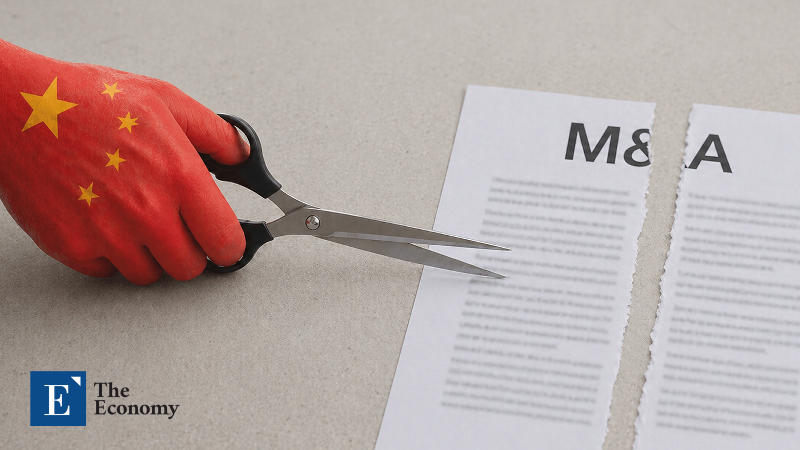
Meta Platforms (hereafter Meta) has encountered a major setback in its planned acquisition of artificial intelligence (AI) firm Manus. China, which has been tightening controls over the transfer of domestic technologies, has ordered the withdrawal of the deal. Although Manus has already relocated its headquarters to Singapore, Chinese authorities reportedly took issue with the company’s underlying roots in China. Market observers view Beijing’s move as a clear indication of the accelerating global shift toward economic security-driven regulatory tightening.
Meta Faces Collapse of Manus Acquisition
According to Reuters on the 27th (local time), China’s National Development and Reform Commission (NDRC) recently instructed both Meta and Manus to abandon the acquisition. Without disclosing specific reasons, the regulator cited relevant laws to prohibit foreign capital investment and demanded that both parties immediately withdraw from the transaction. Direct government intervention to reverse a near-completed private merger and acquisition (M&A) deal is highly unusual. Meta’s acquisition of Manus, valued at $2 billion (approximately $2.1 billion), had been announced in December last year and had effectively reached the final stages before closing.
At the center of the controversy, Manus is an AI agent company developed and operated by Chinese startup Butterfly Effect. Its core offering is an autonomous AI agent capable of executing tasks independently based on user instructions. According to multiple foreign media reports, Manus’ AI agents are positioned as “action-oriented AI,” capable of autonomously handling tasks such as data analysis, report generation, and schedule management. The company has posted meaningful growth across markets including the United States, Japan, and the Middle East, with annual recurring revenue (ARR) nearing $100 million (approximately $107 million).
The acquisition was a strategic move by Meta to secure a leading position in the AI agent sector. The company aimed to rapidly accelerate commercialization efforts, which have lagged behind competitors such as OpenAI, Google, and Microsoft (MS). However, the NDRC’s intervention has effectively derailed these plans. It remains unclear how Meta will respond to the regulatory decision. Manus employees have already relocated to Meta’s Singapore office, and existing investors—including Tencent and ZhenFund—are reportedly said to have exited their investments through the deal.
China’s Determination to Curb Technology Outflows
Market attention has focused on the fact that Manus, despite being headquartered in Singapore, remains subject to Chinese regulatory authority. Butterfly Effect had previously pushed aggressively to distance Manus from China. The company declined investment offers from Chinese local governments and proposals from Alibaba to launch a China-specific version, while relocating its headquarters to Singapore to mitigate Western regulatory risks and facilitate foreign capital inflows. Since then, Manus has expanded its global footprint through partnerships with companies such as Microsoft and Stripe. Meta had also planned to fully divest Manus’ Chinese equity and discontinue its China-based services following the acquisition.
The issue, however, lies in the fact that these efforts proved insufficient to evade Beijing’s regulatory scrutiny. Earlier this year, China’s Ministry of Commerce notified that it would “evaluate and investigate whether the Meta–Manus acquisition complies with regulations on export controls, technology import and export, and outbound investment.” Given that Manus’ R&D workforce and core algorithms were developed within China, authorities determined that even the sale of its Singapore entity could constitute a form of technology export. Under the Export Control Law enacted in 2020 and the recently revised Foreign Trade Law, China has been rigorously restricting overseas transfers of technologies deemed to pose risks to national security.
Last month, Manus CEO Xiao Hong and Chief Scientific Officer (CSO) Ji Yiqiao were summoned to an NDRC meeting overseeing China’s economic planning and were investigated for potential violations of foreign direct investment (FDI) regulations. They were subsequently subjected to exit bans. With two of the three co-founders responsible for technology development effectively barred from leaving the country, the move underscores the seriousness of the case. Given the immediacy of the travel restrictions following the investigation, authorities appear to be treating the matter not as a routine administrative review but as part of a broader strategic industry control framework.

Accumulating Global Precedents of Similar Interventions
Cases in which governments intervene in M&A transactions to prevent the outflow of critical technologies have steadily accumulated worldwide. For instance, in 2016, Chinese-backed private equity firm Canyon Bridge was blocked by the U.S. government from acquiring fabless semiconductor company Lattice Semiconductor. At the time, the first Trump administration raised concerns that Lattice’s low-power programmable logic semiconductor (FPGA) technology could be applied in military, AI, and cryptographic domains, classifying it as a dual-use critical technology. The administration concluded that the acquisition posed a risk of transferring such technology to China. The case later became a catalyst for strengthening U.S. scrutiny over Chinese technology investments.
German semiconductor firm Elmos and Swedish foundry company Silex also faced similar challenges. In late 2021, Elmos agreed to sell its Dortmund wafer fabrication plant to Silex. Following approximately one year of investment review, the German government ultimately blocked the deal in November 2022 through a cabinet decision. Authorities cited concerns that the facility’s automotive semiconductor production base, along with its process technologies and manufacturing know-how, could be transferred to China. Silex’s parent company is China-owned Sai Microelectronics. On the same day, the German government also blocked Chinese investment in domestic semiconductor equipment firm ERS Electronic, making clear its intent to prevent the outward transfer of semiconductor manufacturing technologies altogether.
This global trend toward tightening investment regulations centered on economic security has become increasingly pronounced in recent years. Japan’s recent intervention in the acquisition of machine tool manufacturer Makino Milling Machine Co. (hereafter Makino) illustrates this shift. According to a report by Nikkei on the 23rd, the Japanese government sent a letter to MM Holdings—a local special purpose company (SPC) established by MBK Partners for the acquisition—requesting that “non-Japanese entities refrain from acquiring domestic defense-related companies.” The government classified MBK as a non-Japanese entity on the grounds that MM Holdings was established in the Cayman Islands, a tax haven. Japanese Finance Minister Katsuyama Satsuki explained during a press briefing, “We considered that Makino manufactures world-class machine tools and supplies them extensively to Japan’s defense equipment manufacturers,” adding that “we determined that the investment could potentially undermine national security.”
Matthew Reuter is a senior economic correspondent at The Economy, where he covers global financial markets, emerging technologies, and cross-border trade dynamics. With over a decade of experience reporting from major financial hubs—including London, New York, and Hong Kong—Matthew has developed a reputation for breaking complex economic stories into sharp, accessible narratives. Before joining The Economy, he worked at a leading European financial daily, where his investigative reporting on post-crisis banking reforms earned him recognition from the European Press Association. A graduate of the London School of Economics, Matthew holds dual degrees in economics and international relations. He is particularly interested in how data science and AI are reshaping market analysis and policymaking, often blending quantitative insights into his articles. Outside journalism, Matthew frequently moderates panels at global finance summits and guest lectures on financial journalism at top universities.
Similar Post
















