British Local Elections Deliver Landslide for Anti-Immigration Right-Wing Party, European Politics Recast Around Immigration-versus-Anti-Immigration Divide Beyond Traditional Left-Right Alignment

Anne-Marie Nicholson is a fearless reporter covering international markets and global economic shifts. With a background in international relations, she provides a nuanced perspective on trade policies, foreign investments, and macroeconomic developments. Quick-witted and always on the move, she delivers hard-hitting stories that connect the dots in an ever-changing global economy.
Authored On
Modified
Right-Wing Reform UK Surge, Labour Collapse
Rightward Shift Across Europe
Working-Class Alienation Driven by Surging Immigration
In Britain’s local elections, the hard-right Reform UK, founded in 2019, emerged as the largest party, breaking the two-party dominance of the Conservative Party, founded in 1834, and the Labour Party, founded in 1900. Labour and the Conservatives, which have divided British politics between them for more than a century, suffered crushing defeats, losing more than 1,400 seats and more than 500 seats, respectively, and even surrendering their traditional strongholds. The result was more than a verdict on the governing party’s economic missteps. It marked the eruption of accumulated voter anger over immigration policy that has fallen into a state of uncontrolled dysfunction. As parties putting anti-immigration and border control at the forefront rise rapidly across major European countries, the central axis of European politics appears to be shifting from the traditional left-right ideological confrontation to a divide between immigration acceptance and anti-immigration control.
Right-Wing Surge, Governing Labour Loses Its Strongholds
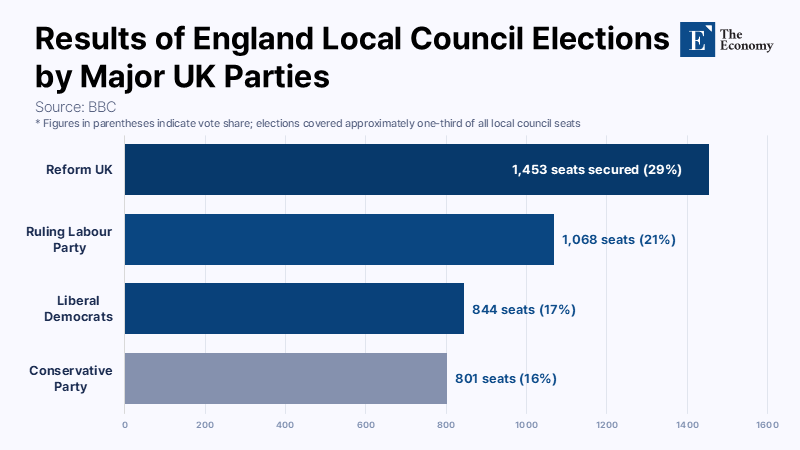
According to the BBC on the 10th local time, Reform UK secured 1,453 seats, or 29%, the largest share among 5,036 seats in English local councils in the British local elections held on the 7th. The party previously held only two seats, but added 1,451 this time, emerging as a national party. Reform UK also won majorities in 14 local councils. Nigel Farage, leader of Reform UK, told reporters in London on the 8th, “You are witnessing a historic turning point in British politics,” stressing that “Reform UK is now the most national party of all parties.”
By contrast, the center-left governing Labour Party fell to 1,068 seats, ceding the top position to Reform UK. Labour lost 1,496 seats from its previous 2,564, well over half its total. In particular, Labour suffered a crushing defeat in the so-called “Red Wall,” a stronghold named after the party’s color because of its solid base among working-class and labor voters, losing all 20 seats there to Reform UK. The Conservatives also sank to the level of the fourth-largest party by seat count. The party lost 563 seats from its previous 1,364, leaving it with only 801.
Labour and the Conservatives also struggled in the Welsh and Scottish devolved parliament elections held alongside the local elections. These regions have traditionally seen regional parties seeking differentiation from England lead their parliaments, with Labour and the Conservatives following behind. Labour, in particular, had never lost its status as the largest party in the Welsh parliament since the establishment of devolution in 1999, but this time lost that position for the first time after being pushed behind the nationalist Plaid Cymru and Reform UK. In the Scottish Parliament as well, the nationalist Scottish National Party came first, while Labour fell to joint second place with Reform UK after securing 17 seats.

The Dilemma of Cheap Immigrant Labor
The election result reflected a backlash against Prime Minister Keir Starmer. The Red Wall was the region that drove Britain’s industrialization and corresponds to the Rust Belt in the United States. Analysts say voters ultimately deserted the governing Labour Party because it failed to solve the bread-and-butter issues central to workers and the lower-income public. Indeed, Labour’s economic policy has drawn considerable criticism for being disconnected from the hardship faced by ordinary people. Electricity and gas bills rose sharply under the carbon tax policy actively pursued by the Starmer government, while inflation increased by 5% to 10% annually. Starmer is currently recording low approval ratings in the 20% range in opinion polls amid slowing growth and high inflation.
The larger factor behind the electoral debacle was the spread of anti-immigration sentiment. The Wall Street Journal analyzed that British voters expressed deep fatigue over rising immigration, failed border control, and growing pressure on public services. Reform UK, in effect, absorbed both parts of Labour’s support base and defectors from the Conservatives by foregrounding immigration curbs, stronger border controls, and welfare cuts. Analysts say conservative-leaning voters were drawn to Reform UK’s concise slogans, including “punish the political elites,” “net zero immigration,” and “British First.”
Reform UK’s roots lie in the Brexit Party, founded by Farage, and it advocates anti-immigration, tax cuts, anti-European Union policies, anti-elitism, and a rejection of political correctness. Although it is a hard-right party with strong populist tendencies, it is distinct from far-right parties that deny the democratic system or pursue racial or ethnic supremacy. Farage is now regarded as a politician who has completed a long march from championing fringe issues in the 1990s to dominating the national conversation today. Party policies reflecting his convictions, including the deportation of illegal immigrants, stronger border control, and the scrapping of net zero, have finally penetrated voters weary of the cost-of-living crisis and high immigration inflows.
At present, Britain’s immigration policy has lost its way between the economic objective of addressing labor shortages and the political imperative of border control, producing serious social side effects. Within British society, discontent has accumulated over the burden generated by policies expanding immigration. According to the Office for National Statistics, net migration has reached record levels over the past five years, with housing shortages, longer waiting times for public health care, and pressure on local government finances emerging simultaneously. In small and midsize cities and low-income areas in particular, resentment has widened over intensifying low-wage competition and rising rents. Among voters who expected Brexit to restore border control, the perception has strengthened that immigration has instead expanded further, while distrust has accumulated toward both established parties for failing to resolve the issue.
Anti-Immigration Sentiment as a Core Variable in European Politics
The more serious problem is public insecurity and cultural conflict caused by a lack of social integration. As emotional distance grows between migrant communities concentrated in certain areas and local residents, years of reporting on immigrant-related crimes have fueled anti-immigration sentiment. The knife attack by Axel Rudakubana is a representative case. On July 29, 2024, when he was just short of turning 18, Rudakubana stormed into a children’s dance class in Southport in northern England and indiscriminately wielded a knife, killing three children aged six to nine and injuring 10 others. After it became known that Rudakubana was an asylum seeker, nationwide anti-immigration violent protests were triggered. He is now serving a life sentence with a minimum term of 52 years, and the trial revealed that he had long shown a fixation on brutal violence.
The Southport knife-attack inquiry, led by former judge Adrian Fulford, said in its first investigative report released last month that multiple agencies failed to share crucial information and manage the case in an integrated manner despite numerous problematic behaviors and warning signs, including Rudakubana bringing a knife to school, attacking peers and his father, disappearing for several days and then being found on a bus carrying a knife, and telling police that he had “wanted to stab someone.” In fact, Rudakubana showed signs of an obsession with brutality online as well, downloading academic documents containing al-Qaeda training manual content and violent images related to international conflicts. He had also been referred three times to Prevent, the authorities’ anti-radicalization program, but there was no proper monitoring or intervention. Local media including The Guardian and the Financial Times criticized the government for being preoccupied only with numerical limits on immigration while neglecting the real social integration of incoming populations and the construction of crime-prevention systems. That policy vacuum ultimately served as fertile ground for far-right parties to expand their influence under the banner of “law and order.”
What warrants attention is that Britain’s election result is not confined to domestic issues. Across Europe, established centrist parties have recently continued to falter while hard-right and populist parties have risen. In Germany’s February general election, the far-right Alternative for Germany, or AfD, became the largest opposition party with 20.8% of the vote. In France, the far-right National Rally, led by Marine Le Pen, won a sweeping victory over the governing party in the June 2024 European Parliament election. In the Netherlands, the far-right Party for Freedom, led by Geert Wilders, became the largest party in the November 2013 general election.
Bloomberg News recently analyzed Europe’s political landscape, saying that “border control and cultural identity have emerged as the core variables determining elections, ahead of economic, welfare, and tax policies.” In practice, hard-right parties across major European countries, including Germany’s AfD, France’s National Rally, the Netherlands’ Party for Freedom, Austria’s Freedom Party, and Italian Prime Minister Giorgia Meloni’s Brothers of Italy, are commonly expanding their support bases by placing anti-immigration, stronger policing, and nationals-first policies at the forefront.
By contrast, Europe’s established center-left parties have fallen into the dilemma of maintaining labor and welfare agendas while simultaneously defending policies of expanded immigration, while center-right parties have responded by partially absorbing hard-right agendas, blurring the political dividing lines themselves. The Financial Times assessed that “the new dividing line in European politics is not tax or welfare but border and identity.” In particular, as the expansion of refugee inflows after the Ukraine war, the increase in illegal migration from the Middle East and Africa, and concerns over terrorism and public insecurity have converged, anti-immigration sentiment has moved beyond far-right discourse and settled as a core agenda in European mass politics.
Anne-Marie Nicholson is a fearless reporter covering international markets and global economic shifts. With a background in international relations, she provides a nuanced perspective on trade policies, foreign investments, and macroeconomic developments. Quick-witted and always on the move, she delivers hard-hitting stories that connect the dots in an ever-changing global economy.
Similar Post