"Core Functions to Major Cities, Infrastructure to the Provinces": China’s AI Industrial Reallocation Gains Momentum, Similar Trends Detected Across Other Sectors

Aoife Brennan is a contributing writer for The Economy, with a focus on education, youth, and societal change. Based in Limerick, she holds a degree in political communication from Queen’s University Belfast. Aoife’s work draws connections between cultural narratives and public discourse in Europe and Asia.
Authored On
Modified
China Mobilizes Full Force to Foster Related Industries Under AI Plus Strategy
Regional Role Differentiation Accelerates, Data Center Infrastructure Concentrated in Provincial Areas
"We Cannot Withstand Big-City Competition": Influence of Lower-Tier Markets Gains Prominence Across Industry
China’s determination to position artificial intelligence (AI) as a national growth engine is prompting a rapid reshaping of regional industrial strategies. Major eastern cities such as Shanghai, Shenzhen and Beijing are serving as hubs for AI research and development (R&D) and advanced industries, while western provincial cities are increasingly hosting computing infrastructure, including AI data centers. This trend toward industrial dispersion is becoming increasingly pronounced not only in the AI sector but across China’s broader industrial landscape.
China’s Commitment to Fostering the AI Industry
According to the IT industry on the 11th, the Chinese government has in recent years placed AI at the forefront of its national growth strategy by formally launching its “AI Plus (AI+)” initiative. The strategy was first mentioned in the government work report at the 2024 National People’s Congress, or the Two Sessions, and entered the stage of government-wide implementation after the State Council executive meeting approved the “Implementation Opinions on Deepening AI+ Actions” in July last year. Official guidelines released by the State Council in September of the same year laid out plans to integrate AI across six major fields: science and technology, industry, consumption, public welfare, administration and international cooperation. The specific target is to raise the adoption rate of next-generation AI terminals and AI agents to more than 70% by 2027 and expand it to around 90% by 2030.
This policy direction was also confirmed in China’s 15th Five-Year Plan (2026–2030), approved at the Two Sessions in March. The plan is characterized by its designation of AI, semiconductors, quantum technology, robotics and aerospace as core national growth pillars. In the 141-page blueprint, the Chinese government mentioned AI more than 50 times, placing the AI+ action plan at the forefront and again emphasizing its goal of applying AI to manufacturing, healthcare, logistics, administration and education. At the same time, in response to U.S. restrictions, it identified self-reliance and localization in strategic technologies such as high-performance AI chips, computing infrastructure, large language models (LLMs), humanoid robots and next-generation communications networks as core tasks.
Some experts point out that the Chinese government’s forceful AI promotion policy is widening regional disparities. Their concern is that the economic gains from technological innovation are being concentrated in major cities and coastal areas rich in talent and capital, deepening inequality with smaller cities and rural regions with weak technological foundations. In reality, China’s major cities are absorbing talent and innovative companies through agglomeration effects, while rural and industrial regions with weaker technological bases are seeing highly limited benefits from AI adoption. Some analyses even suggest that AI could automate routine manufacturing or agricultural labor in these regions, threatening existing jobs.
AI Infrastructure Concentrated in the Western Interior
There is also a view, however, that the emergence of such disparities is a natural progression. China, like other countries, is seeing a spatial division of labor between advanced industries and data infrastructure. Major eastern Chinese cities represented by Shanghai, Shenzhen and Beijing are actively leveraging strong technology clusters, universities and capital to serve as hubs for advanced industries such as R&D, semiconductors, robotics and smart manufacturing. Specifically, Shanghai is focusing on building AI finance and industrial AI platforms, while Shenzhen has emerged as a manufacturing-oriented AI city by advancing AI clusters based on Huawei Ascend chips and its robotics industry. Beijing is placing weight behind basic research and LLM development.
By contrast, computing infrastructure, including hyperscale data centers, is moving to the western interior. This reflects the impact of the Chinese government’s “Eastern Data, Western Computing” policy. The essence of the policy is to connect AI demand in eastern megacities with data centers in western regions such as Guizhou, Ningxia, Gansu and Inner Mongolia. The plan is to strengthen the country’s overall computing capacity by concentrating graphics processing unit (GPU) farms and cloud infrastructure in the west, where electricity and land are relatively inexpensive.
In fact, since 2022, China has approved or begun construction on more than 100 new data center projects in western regions. Guizhou, long classified as one of the poorest areas in China, has transformed into an AI computing hub operating more than 30 large-scale data centers. According to local government data, Guizhou currently provides about 23% of China’s total computing capacity. In the 15th Five-Year Plan, the Chinese government has also specified its direction of continuing to develop Guizhou as a hub for computing capacity, data and AI applications.
Lower-Tier Markets Rise Amid Excessive Big-City Competition
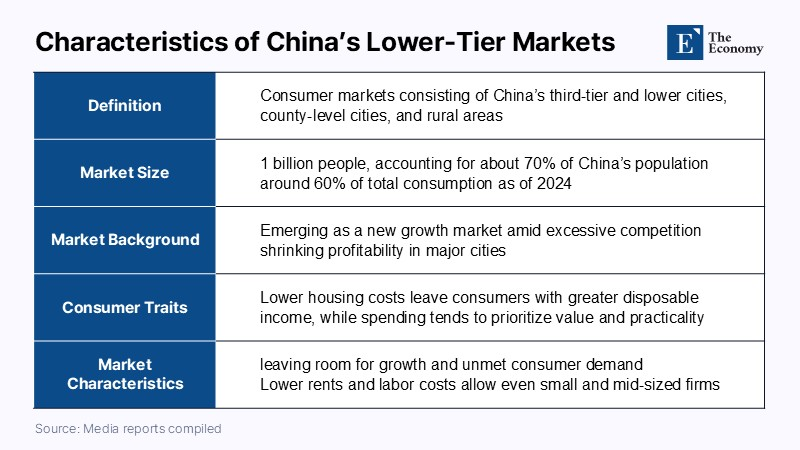
This industrial restructuring trend is also visible in sectors beyond AI. China’s big-city consumer markets are currently mired in intense overcompetition. As marketing costs rise and product prices fall, a structure has become entrenched in which profits decline even when companies invest costs and manpower. Locally, some even assess that big-city markets now stand at the center of so-called “neijuan” — a state of exhausting competition that repeats without meaningful results. As a result, companies have begun turning their attention to the “lower-tier market.” In China, cities are classified from first-tier to fifth-tier according to economic scale, population, and the concentration of industrial and consumer infrastructure; among them, third-tier provincial cities, county-level cities and rural areas are collectively referred to as the lower-tier market. The lower-tier market consists of 300 prefecture-level cities, 2,800 county-level cities and tens of thousands of townships and villages, with a population of about 1 billion, or 70% of China’s total.
As of 2024, the lower-tier market accounts for nearly 60% of China’s total consumption. This is attributable to the market’s characteristics of relatively ample disposable income and leisure time. Most residents of lower-tier markets already own homes and face limited rent or mortgage burdens. Their consumption structure is fundamentally different from that of big-city consumers, who must spend a substantial share of their monthly income on housing. For companies, another advantage is that many areas still have insufficient supply relative to demand, and unlike major cities, there remains ample room for growth. Rent and labor costs are also comparatively low, enabling companies that struggle to survive in big cities to accumulate consumer responses and develop long-term businesses in lower-tier markets.
Companies that have grown around lower-tier markets are also emerging one after another. A representative example is local e-commerce company Pinduoduo. While existing e-commerce powerhouses Alibaba and JD.com grew by targeting the urban middle class, Pinduoduo focused on low-income and rural consumers through group-buying and ultra-low-price strategies. By combining direct farm-product transactions with WeChat-based group buying, it transformed the rural consumer market neglected by existing platforms into a large-scale online consumer market. To this day, a significant share of Pinduoduo’s users are understood to reside in lower-tier cities and rural areas.
Aoife Brennan is a contributing writer for The Economy, with a focus on education, youth, and societal change. Based in Limerick, she holds a degree in political communication from Queen’s University Belfast. Aoife’s work draws connections between cultural narratives and public discourse in Europe and Asia.
Similar Post