The End of the Cheap China Joke: Why Frontier Science May Redefine “Made in China”

Working across research, policy, and data-driven analysis, the Editorial Board ensures that published pieces reflect a consistent institutional perspective grounded in quantitative reasoning and long-term structural assessment.
Authored On
Modified
China is turning frontier science into a new quality strategy
The real test is whether research depth can build global trust
“Made in China” may soon mean reliability, not just low cost
In 2024, China hit a line that redefined what Made in China means: on purchasing power parity terms, it spent slightly more on R&D than the United States. This fact proves nothing about who is winning the technology race. This fact proves something more useful: China now treats frontier science as the root of industrial quality and not as a luxury product after factories, exports and scale. In the last few years, the world has interpreted Chinese manufacturing using the simple story of 'fast, cheap, getting better, but still not fully trustworthy.' This story has begun to grow old. China is not just now copying the final product. It is now trying to build the underlying science, testing discipline, human capital and patient standards to make the final product reliable enough to command a premium price. If frontier science continues to move from motto to system, the joke about fragile Chinese goods may not age well.
Frontier science is becoming China's quality policy
The most interesting shift is not the amount of spending; large budgets can still breed inefficiency. The more important shift is China's attempt to bridge the gap between basic science and industrial trust. This is a qualitatively different form of catch-up than the old models, where the targets were tangible outcomes like cars, phones, solar panels, batteries, ships, or apps. This new model is more likely to take hold because the old one only proved it could mimic end-products at the right price and speed (especially since factories are so concentrated and the supply chains so short) and only when they were on mature technologies. There was always a weaker layer beneath: you might copy the shape of a car but not its durability, lower the cost of a phone but not master the science of failure, dominate shipping volume but still struggle to shake the idea that Chinese products are always one mishap, software crash, or faulty component away from public disaster.
That is the reason frontier science is so important now. It is not merely about a country winning a Nobel prize or showing off the quality of a national research center; it is about the silent work of turning those breakthroughs into reliable, safe final products-whether materials science that keeps batteries from overheating, control systems that smooth out the wobble in driver assistance technologies, chip designs that do not rely so heavily on imports, or the complex software needed to run critical machines stably. China spent more than 3.6 trillion yuan on R&D in 2024 (including nearly 250 billion yuan on basic research and it spent 3.93 trillion yuan on R&D in 2025 (with almost 277 billion yuan on basic research), showing clear progress towards higher levels in basic research, although the 7% portion remains modest. This means moving from more production to a better understanding of the root causes of things falling apart.
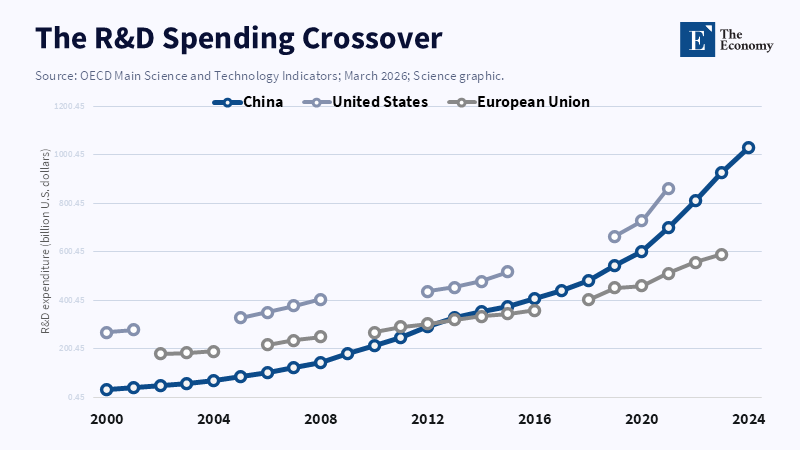
The fact that China's research intensity jumped close to the OECD average in 2024 and accounted for almost as much of the world's total as the United States tells us this is not your typical emerging economy trying to improve its exports; this is a production titan trying to leap to the next science tier before its export strategy fades. This means a new directive to educators, university departments and the firms themselves: focus not only on teaching more coding or opening more laboratories, but on laying down a hard-science foundation that can address real industrial vulnerabilities like safety, reliability, materials expertise, metrology, standards and product longevity.
Frontier science can close the trust gap but it isn’t automatic
The trust gap is the hardest of all to close. It can take years to build a strong reputation and seconds to destroy it. Consumers do not evaluate cars, phones, or medical devices by the speed at which they launch, but by their performance over many years of operation. Do the batteries hold their charge? Do software updates work or create new issues? Do companies fix faults before they are forced? Do the machines survive dust, heat, water, crashes and human carelessness? There is no solution to these problems that involves merely scaling up production, which can often worsen them if there’s a systemic defect that touches millions of people and makes a minor failure a global headline.
China’s burgeoning electric vehicle industry is the most vivid example of this shift. We are past the stage where Chinese EVs are considered just poor copies; many models are now the industry leaders in battery cost, in-cabin tech, charging speeds and rich software-driven design. Still, lingering quality doubts remain, with J.D. Powers' 2026 China new energy vehicle study noting 231 issues per 100 cars, with almost 70 percent related to design rather than conventional mechanical defects. This shows us that consumers want more than a functioning car: they want the car to feel solid and safe. Infotainment systems, driver assistance systems, in-car user interfaces and charging protocols are all increasingly part of perceived quality. Cars that perform flawlessly mechanically can still fail the trust test because the overall experience is rickety.
In fact, we should be careful about sensationalism regarding EV fires-these are still much rarer than gasoline-car fires, but regulations in China are getting tougher about preventing battery thermal runaway from 2026 onwards. This shows the right approach to quality: the real question is not whether the cars can make the leap to premium pricing with a flawless user experience and bulletproof safety record. Brands with this aim must embrace testing, recall mechanisms, independent performance reviews, robust warranty plans and the kind of customer service that turns product safety into a source of pride, not a source of shame.
Beyond cars, China has topped the charts in patent filings and cracked the top 10 on the Global Innovation Index. It is not only the leading producer of scientific publications but also awards more PhDs in engineering and science than any other nation on earth. This is all undeniably strong output, but the true measure is earned trust and not raw volume. Patents may vary in quality. Academic publications may or may not drive real scientific progress. Graduates may possess skills to varying degrees. A mature scientific system produces a consistent track record for success, which will manifest in fewer superficial patents, rigorous peer review, greater product liability, more demanding supplier qualification and much greater freedom for researchers to challenge prevailing corporate or official assumptions about failure.
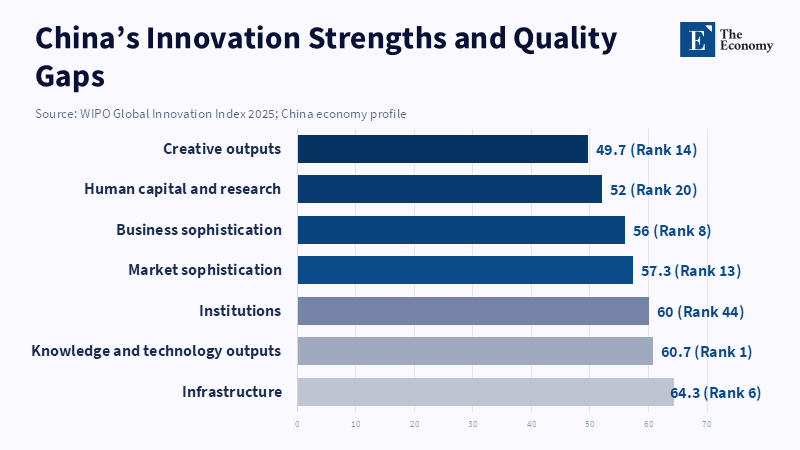
This argument will undoubtedly face the criticism that China's research community is not nearly as open to failure and doubt as its Western counterpart. That is a fair point: originality does need space for slow progress, iteration and the courage to explore dead ends. Above all, it needs incentives to work for quality rather than for output. But such criticisms become unhelpfully simplistic if we assume that China is incapable of learning from the world or building its own approach. The data over the past few years suggest a more dynamic reality: China is both pushing ahead in applied areas while raising its spending in fundamental science, investing in human capital and compelling firms to confront the defects that undermine global trust. The real question isn't whether China has found the perfect system. It's whether it's improving its systems more rapidly than its rivals are repairing their foundations.
The policy answer is discipline, not mimicry
Other developed countries should not respond by adopting the Chinese state model wholesale, for that misses the point. The risks in the Chinese advantages-overcapacity, waste-local competition, political intrusion on research and the risk that funding will flow with political fashion, not intellectual rigor, are enormous. Frontier science cannot prosper when every lab is pushed to demonstrate short-term utility. Nor can it when companies are pushed to hurry products out before the testing catches up. China itself proves both at the same time. Its ability to mobilize on a tremendous scale must still demonstrate that its quality assurance is as strong as its manufacturing.
The real lesson is discipline. Governments need to fund hard science even when the payoff will not be evident within a year. Administrators need to support the research labs studying failure, safety, materials, metrology and standards, not only those that produce shiny demonstrations. Firms need to value validation as a core element of innovation, not an unfortunate overhead. Educators and research leaders need to train engineers who ask the inconvenient questions about defects, not only those who optimize for speed. Policy-makers should actively promote open benchmarks and independent testing. National pride does not buy trust; verifiable claims do.
For China, the direct challenge is now immense. It cannot win at a higher price point unless its quality is truly legible. The cheaper car might win the price war; the trustworthy car will win the household. A less-expensive battery might penetrate an export market; a trustworthy battery will move into medical device and grid infrastructure. The same is true for robotics, AI, medical equipment, silicon and green-energy tech. Frontier science is a bridge; unless joined to standards, transparency and post-sale accountability, it may only leave China a powerful but second-best option.
This is why education systems and universities become relevant without making it a simple curriculum debate. The goal isn't producing more engineers per capita. It's producing people capable of testing claims. Engineers need more statistics, physics, chemistry, software assurance and ethics; managers need to know why cutting cycle times can destroy brands if validation is poor; public agencies need enough technical chops to regulate products they don't fully understand. Frontier science, at its root, is also a capacity to govern: to ask informed questions prior to the marketplace, or the accident report, making them brutally clear.
The coming few years will likely determine whether "Made in China" is a stamp of reliability at the frontier or just another caution on the purchase label. The old joke rested on a vivid memory of cheaply made goods that compromised safety or imitated form and hid flaws with volume. Today's China cannot be dismissed lightly; it invests at the frontier, trains at the frontier, publishes at the frontier and has pushed its industries into confronting the harder challenges. But its success ultimately rests not on its spending, but on its ability to command trust under duress. If China succeeds in forging frontier science into safer batteries, better software, stronger components and honest quality control, its customers will revise their opinions. Competitors can learn that the laughter must stop; it’s time to examine and strengthen their own foundations.
The views expressed in this article are those of the author(s) and do not necessarily reflect the official position of The Economy or its affiliates.
References
Dutta, S., Lanvin, B., Rivera León, L. and Wunsch-Vincent, S. (eds.) (2025) Global Innovation Index 2025: Innovation at a Crossroads. Geneva: World Intellectual Property Organization.
Hai, S.J. (2026) ‘China’s bet on frontier science’, East Asia Forum, 9 May.
J.D. Power (2026) ‘2026 China New Energy Vehicle Initial Quality Study’, J.D. Power, 2 April.
Li, Q., Yan, Z. and Goh, B. (2025) ‘China to tighten EV battery rules to reduce fire and explosion risks’, Reuters, 15 April.
Ma, Y. (2026) ‘Why China is winning in tech — and what the US is overlooking’, Brookings Institution, 30 April.
National Bureau of Statistics of China (2025) ‘China’s expenditure on research and experimental development exceeded 3.6 trillion yuan in 2024’, National Bureau of Statistics of China, 7 February.
National Bureau of Statistics of China (2026) ‘Statistical Communiqué of the People’s Republic of China on the 2025 National Economic and Social Development’, National Bureau of Statistics of China, 28 February.
National Science Board (2026) The State of U.S. Science and Engineering 2026. Alexandria, VA: National Center for Science and Engineering Statistics.
Normile, D. (2026) ‘China now tops the U.S. in R&D spending by one key measure’, Science, 2 April.
Organisation for Economic Co-operation and Development (2026) ‘OECD overall R&D growth stable; government R&D budgets decline and reorient towards defence’, OECD Statistical Release, 31 March.
Wagner, C.S. (2026) ‘China surpasses US in research spending — the consequences extend far beyond scientific ranking and clout’, The Conversation, 24 April.
World Intellectual Property Organization (2025) IP Facts and Figures 2025. Geneva: World Intellectual Property Organization.
Working across research, policy, and data-driven analysis, the Editorial Board ensures that published pieces reflect a consistent institutional perspective grounded in quantitative reasoning and long-term structural assessment.