“Gold Prices Fuel Scale Race”: Gold Mining M&A Fever Shows No Sign of Easing, With Mid- to Long-Term Bullish Outlook Intact

As one of the youngest members of the team, Tyler Hansbrough is a rising star in financial journalism. His fresh perspective and analytical approach bring a modern edge to business reporting. Whether he’s covering stock market trends or dissecting corporate earnings, his sharp insights resonate with the new generation of investors.
Authored On
Modified
Regis Resources and Vault Minerals Agree to All-Share Merger
Wave of Gold Mining M&A Points to Sector Restructuring Amid Bullion Rally
Clear Mid- to Long-Term Drivers for Gold Upside; Iran War and U.S. Rates Remain Near-Term Variables

Australian gold miners Regis Resources and Vault Minerals have moved to merge. As international gold prices remain locked in a multi-year upcycle, merger and acquisition (M&A) momentum across the sector shows little sign of cooling. Market analysts increasingly expect the M&A relay to continue. While Middle East conflict and U.S. monetary policy may act as near-term variables for gold prices, the mid- to long-term drivers behind bullion’s rise—stemming from the erosion of dollar hegemony—remain firmly in place.
Merger Relay Among Gold Miners
According to Reuters on the 7th local time, Regis Resources and Vault Minerals agreed on the 5th to an all-share merger. Regis shareholders are expected to own about 51% of the merged entity, while Vault shareholders will hold 49%. Under the terms, Vault shareholders will receive 0.6947 new Regis shares for each Vault share held. The merged company is expected to have a debt-free balance sheet with $1.9 billion in cash and annual gold production exceeding 700,000 ounces.
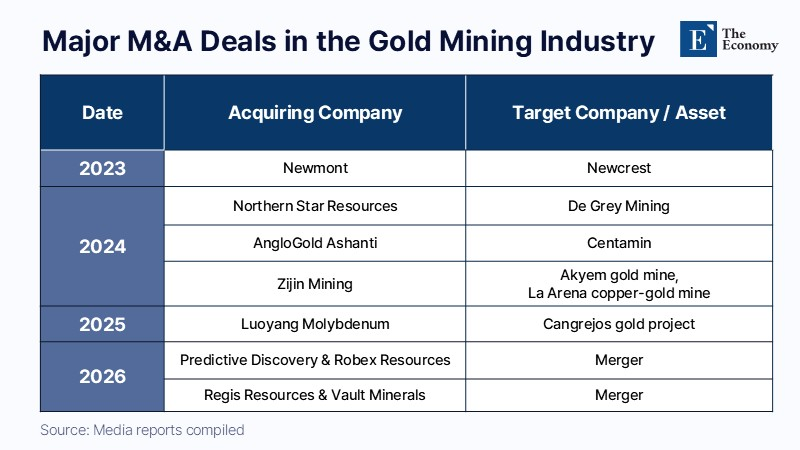
Similar M&A deals have been emerging across the gold mining sector. Last month, for instance, shareholders of Australian gold explorer Predictive Discovery and Canadian miner Robex Resources approved a merger valued at about $1.57 billion. Under the terms, Robex shareholders will receive 7.862 ordinary Predictive Discovery shares for each share held and will own about 46% of the combined company after the transaction closes.
Through the deal, the two companies plan to reorganize their business around large-scale gold production and development in West Africa, targeting annual production of more than 400,000 ounces by 2029. Their strategy is to diversify production capacity and asset portfolios by combining Predictive Discovery’s Bankan project with Robex Resources’ Kiniero gold mine. Bankan is expected to produce 272,000 ounces annually in 2029, while Kiniero is forecast at 155,000 ounces. Bankan, in particular, is expected to be developed without major additional equity financing or project financing (PF).
Gold Rally Fuels M&A Activity
The M&A boom across the sector has been under way for several years. As international gold prices have continued to surge, more companies have sought to build scale to expand their influence in global markets. A representative example is Newmont’s acquisition of Newcrest. Newcrest, an Australian gold miner, operated copper mines in Australia and five gold mines across Oceania, Africa and South America. In 2023, Newmont acquired 100% of Newcrest for $19.2 billion, taking over those mining assets.
In 2024, Australia’s Northern Star Resources acquired Australian resources explorer De Grey Mining for $3.26 billion, while AngloGold Ashanti, Africa’s largest gold miner, spent $2.48 billion to acquire Egyptian smaller-scale gold miner Centamin. In October of the same year, China’s Zijin Mining secured the Akyem gold mine in Ghana, West Africa, from Newmont for $1 billion, and in November bought Pan American Silver’s La Arena copper and gold mine in Peru for $245 million. Last April, Chinese nonferrous metals company Luoyang Molybdenum also announced it would acquire the Cangrejos gold project under development in Ecuador, South America, for about $423 million.
As major M&A transactions have followed in succession, restructuring across the gold mining industry has accelerated rapidly. Once large companies begin preempting assets through M&A, the difficulty of survival for small and midsize miners rises sharply. Gold mining profitability is determined by how efficiently companies operate equipment, labor, logistics and refining facilities. Larger companies can more easily lower production costs, while smaller players face disadvantages in cost competitiveness and financing. The recent decline in new gold discoveries and the rising difficulty of mine development are also seen as factors driving the M&A boom. Companies are increasingly favoring the acquisition of proven assets over new exploration.
How Long Can the Gold Rally Continue?
This trend is expected to persist. Gold prices are unlikely to lose momentum for some time. Experts assess that the fundamental drivers supporting mid- to long-term gold demand remain intact. As the influence of the petrodollar system that has underpinned dollar hegemony weakens, gold is re-emerging as an alternative safe-haven asset against currency volatility and geopolitical uncertainty. Central banks are in fact expanding gold holdings to reduce reliance on the dollar in foreign reserves. This represents long-term demand driven by strategic shifts, rather than short-term speculation.
Some analysts argue that once the Iran war ends, restructuring in the gold mining sector could accelerate further. The preference for safe-haven assets that intensified during wartime is likely to persist even after the conflict ends. In addition, if easing Middle East risks push international oil prices lower, miners’ fuel and transportation cost burdens would ease visibly. That would create conditions for a substantial improvement in gold miners’ profitability. In that scenario, major players would move to secure additional assets to maximize profits, while more small and midsize firms could opt for mergers or asset sales to reduce development costs and financing burdens.
Another near-term variable is U.S. monetary policy. Recent U.S. economic indicators have sent mixed signals to markets. The services purchasing managers’ index compiled by the Institute for Supply Management (ISM) came in at 53.6 last month, below the market forecast of 53.7, while the price index reached 70.7, the highest level since October 2022. Labor indicators also showed ambiguous direction. According to the U.S. Labor Department’s Job Openings and Labor Turnover Survey (JOLTs), job openings in March stood at 6.87 million, little changed from the previous month. Actual hiring, however, rose markedly to 5.55 million over the same period. These figures point to a mixed phase in which signs of economic slowdown and labor-market strength are emerging simultaneously.
With price pressures elevated and the labor market remaining resilient, expectations for rate cuts are gradually fading. This weighs on gold prices, which tend to strengthen when real interest rates fall, while also heightening policy uncertainty and stimulating safe-haven demand. Against this backdrop, markets increasingly expect gold prices to search for direction amid volatility rather than easily shift into a downturn.
As one of the youngest members of the team, Tyler Hansbrough is a rising star in financial journalism. His fresh perspective and analytical approach bring a modern edge to business reporting. Whether he’s covering stock market trends or dissecting corporate earnings, his sharp insights resonate with the new generation of investors.
- Previous “Defeated-Nation Shackles Lifted” Germany Reduces Reliance on U.S. Troops, Accelerates Rearmament Through Defense Spending Surge and Independent Military Strategy
- Next Meta Bets on Humanoids Through ARI Talent Acquisition as Aggressive AI Spending Fuels Both Synergy Expectations and Monetization Concerns
Similar Post