"Facebook Drives the Decline": Meta Loses a Large Number of Users in Q1, With Further Earnings Deterioration Possible

As one of the youngest members of the team, Tyler Hansbrough is a rising star in financial journalism. His fresh perspective and analytical approach bring a modern edge to business reporting. Whether he’s covering stock market trends or dissecting corporate earnings, his sharp insights resonate with the new generation of investors.
Authored On
Modified
Meta’s DAP Falls 5% in Q1, With Russian Restrictions Cited as the Cause
Young Users Continue to Leave Facebook, With Demand Shifting to TikTok and Other Platforms
Illegal Advertising Risks and Aggressive Investment Raise Likelihood of Further Profitability Erosion

Meta’s integrated daily active people (DAP) across its entire family of services has turned downward. Meta pointed to Russian restrictions as the reason behind the deterioration in the metric, but the market views the real cause as weakness at Facebook, the social media platform under Meta. Some observers are even raising pessimistic forecasts that Meta’s overall earnings may enter a phase of deterioration as adverse factors accumulate, including a decline in user numbers, reduced illegal advertising revenue, and excessive artificial intelligence (AI) investment.
Meta’s Negative DAP Growth: Is Russia the Problem?
On the 8th, U.S. technology outlet Futurism assessed that Meta is leaving its past glory behind and heading down a Yahoo-like path of “decline,” citing Meta’s first-quarter earnings released on the 29th of last month as evidence. Meta’s DAP in the first quarter came in at 3.56 billion, down more than 5% from the previous quarter, or about 20 million users. DAP is a combined figure for the number of daily users who used at least one Meta service, including Facebook, Instagram, and WhatsApp. This was effectively the first time Meta recorded a quarterly decline in the metric.
Meta cited restrictions on WhatsApp access in Russia and related factors as the cause of the DAP decline, but the market has pointed out that Meta’s claim lacks credibility. Meta’s social media services had already failed to gain a strong foothold in Russia. Since the 2010s, Meta has continuously removed Russian propaganda and public opinion manipulation accounts, and after controversy over Russian interference in the 2016 U.S. presidential election, it strengthened crackdowns on Russia-linked accounts, advertisements, and misinformation networks. After the outbreak of the war in Ukraine in 2022, it also fully restricted advertising and monetization by Russian state media outlets such as RT and Sputnik.
In response, the Russian government designated Meta as an “extremist organization” and blocked access to Facebook and Instagram, while Russian users moved en masse to domestic social media platforms that had already been strong, including VKontakte and Odnoklassniki. This trend is likely to accelerate further. The Russian government is pursuing a so-called “sovereign internet” strategy aimed at reducing dependence on Western platforms. WhatsApp restrictions, YouTube speed throttling, Telegram function limits, and the expansion of domestic messengers—the factors Meta cited as grounds for the DAP decline—are representative examples of this sovereign internet strategy.
Facebook Loses Its Foothold
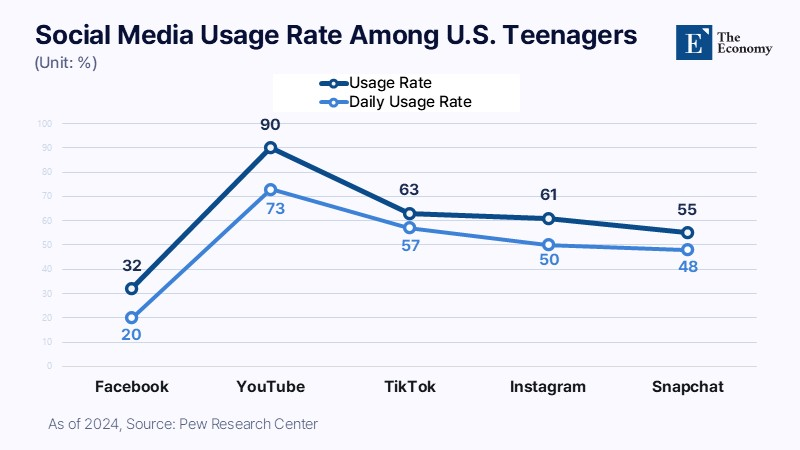
The substantive reason behind Meta’s DAP decline is widely seen as the departure of younger users. Among Meta’s services, Facebook is the platform showing particular weakness. According to the Pew Research Center, the share of U.S. teenagers using Facebook plunged from 71% in 2014–2015 to 32% in 2024. In the same survey, YouTube’s usage rate stood at 90%, TikTok at 63%, Instagram at 61%, and Snapchat at 55%. Daily usage also remained at just 20% for Facebook, while YouTube reached 73%, TikTok about 60%, and Instagram and Snapchat around 50%.
Behind this shift in indicators lies a decline in the quality of content inside the platform. Facebook’s timeline, once used as a space for communication with acquaintances, is now filled with crude AI-generated content, low-quality advertisements, and unverified information. Futurism described this as “AI slop”—low-quality digital content mass-produced by generative AI—and criticized Meta for effectively losing its will to clean up the platform. These problems are creating a vicious cycle that reduces user dwell time, weakens advertising efficiency, and worsens earnings.
Another adverse factor is that demand among young social media users has shifted sharply toward video platforms, especially short-form platforms such as TikTok. Advertising research firm eMarketer analyzed that TikTok’s average daily usage time among U.S. users aged 18 to 24 reached about 76 minutes last year. This overwhelmingly exceeds Facebook usage time among the same age group. One market expert said, “TikTok’s short-form video recommendation algorithm has significantly increased user dwell time,” adding, “By contrast, Facebook appears to have seen its influence weaken sharply as it has increasingly come to be perceived among younger users as a ‘parent-generation platform.’”
Meta has so far defended public perception by avoiding putting Facebook’s standalone metrics at the forefront. It is interpreted as having concealed Facebook’s weakness by emphasizing Instagram and other services that show clear user growth. Based on external estimates, Meta’s monthly active users (MAU) in the first quarter of this year are estimated at 2.14 billion. That represents a 6.3% increase from a year earlier. The decline in Meta’s DAP therefore means that even Instagram’s growth was no longer enough to offset the decline in Facebook users.
Profitability Warning Lights
The industry believes the deterioration in Meta’s overall earnings will accelerate beyond user numbers. Warning lights have turned on for advertising revenue as the possibility of sanctions over “illegal advertising” has emerged. In November last year, Reuters, citing internal Meta documents, reported that Meta generated $16 billion in revenue from illegal advertisements on its social media platforms. The illegal advertisements that circulated covered a wide range of categories, including fraudulent e-commerce, investment scams, illegal online gambling, and sales of prohibited medical products. High-risk scam advertisements exposed to all users were estimated at about 15 billion per day on average. Meta has managed illegal advertisements through an automated system, but it blocks advertisers only when the probability that they are committing fraud reaches 95%. In effect, it has responded to the issue with extreme passivity. This is read as a move driven by concern over a decline in advertising revenue.
Meta’s illegal advertising practices became the subject of investigations by the U.S. Securities and Exchange Commission (SEC) and British regulators, and this year actual legal risks related to the issue have surfaced. The Consumer Federation of America (CFA) filed a lawsuit last month, alleging that Meta obtained unjust gains by neglecting scam advertisements. According to U.S. technology magazine Wired, the complaint included the claim that “about 10.1% of Meta’s advertising revenue in 2024 came from fraudulent advertisements.” This figure matches the internal Meta data cited by Reuters. State prosecutors in the U.S., including New York, are also reported to have criticized Meta’s response to investment scam advertisements as inadequate.
In addition, aggressive AI investment is also cited as an obstacle to earnings growth. In its first-quarter earnings announcement, Meta projected that its capital expenditures this year would reach $125 billion to $145 billion. This is far above market expectations and represents an increase of about 7.4% from the previous forecast presented in January. The problem is that many investors are questioning Meta’s move, citing a lack of concrete explanation about its monetization strategy. In the stock market recently, Meta’s expanded investment spending has even been treated as a negative factor. Meta’s shares have fallen by about 9% from the time the capital expenditure outlook was disclosed to the present.
As one of the youngest members of the team, Tyler Hansbrough is a rising star in financial journalism. His fresh perspective and analytical approach bring a modern edge to business reporting. Whether he’s covering stock market trends or dissecting corporate earnings, his sharp insights resonate with the new generation of investors.
Similar Post