“Space Industry on the Brink of a New Era” SpaceX Nears ‘Mega-IPO,’ With Starship V3 Emerging as Critical Inflection Point

Anne-Marie Nicholson is a fearless reporter covering international markets and global economic shifts. With a background in international relations, she provides a nuanced perspective on trade policies, foreign investments, and macroeconomic developments. Quick-witted and always on the move, she delivers hard-hitting stories that connect the dots in an ever-changing global economy.
Authored On
Modified
Targets $75 Billion Raise and $2 Trillion Valuation
Musk’s Blueprint Extends From Mars Colonization to Space Data Centers
SpaceX Listing Seen as a ‘Headwind’ for Tesla Shares
SpaceX, the aerospace company pursuing what could become the largest initial public offering in history, has disclosed its prospectus to the U.S. Securities and Exchange Commission. The market appears to have largely dismissed the possibility of a failed listing despite the company’s astronomical losses and aggressive investment plans, focusing instead on how much liquidity could be drawn into SpaceX. Still, the mood has become more complicated as the Starship V3 test flight, now the biggest pre-listing variable, was postponed due to technical issues. Market participants see the test outcome as a decisive barometer for SpaceX’s future valuation.
SpaceX IPO Filing Disclosed, Nasdaq Listing Slated for Late June
According to Bloomberg on the 21st, SpaceX said in its listing documents submitted to the SEC the previous day that it is targeting a raise of up to $75 billion and a valuation of more than $2 trillion. The figure would far exceed the previous record for the largest IPO, the $29.4 billion listing by Saudi Arabian state energy company Aramco in 2019.
SEC filings showed that SpaceX posted first-quarter revenue of $4.69 billion and a net loss of $4.28 billion this year. In the same period a year earlier, the company recorded revenue of $4 billion and a net loss of $528 million. On a full-year basis, SpaceX generated $18.7 billion in revenue last year but reported a net loss of $4.94 billion. Losses tied to its artificial intelligence business alone reached $6.36 billion.
SpaceX said it invested $12.7 billion into its AI segment last year alone. The company has positioned Starlink satellite internet services and AI operations as its primary growth engines. Starlink subscribers surged from 2.3 million in 2023 to 8.9 million last year, while related revenue more than doubled to $4.42 billion from $2 billion a year earlier.
The company, currently valued at roughly $1.25 trillion, is expected to exceed a $1.5 trillion valuation after listing. Shares will trade on the Nasdaq under the ticker symbol “SPCX.” Goldman Sachs, Morgan Stanley, Bank of America, Citigroup and JPMorgan are serving as lead underwriters. Following a roadshow expected around June 4, roughly 15 days after the prospectus disclosure, the listing is projected to take place around June 12.
SpaceX IPO Could Become a Liquidity Black Hole
Market skepticism surrounding the success of the SpaceX listing has effectively disappeared. Instead, concerns are growing that capital currently allocated to legacy space and AI-related sectors could rapidly migrate into SpaceX. Existing space-industry stocks that had served as alternative investment vehicles to SpaceX could face intensified selling pressure. In addition, SpaceX’s decision to lease its powerful computing infrastructure to outside AI companies could create a formidable challenger for incumbent cloud providers such as Oracle, which have long dominated the infrastructure rental market, potentially weighing on both earnings and share prices.
Analysts also argue that the SpaceX listing poses a greater threat to so-called “high-multiple growth stocks.” These are equities trading at valuations far above their current earnings because investors have already priced in expectations of substantial future expansion. AI-linked stocks such as Nvidia, Arm and Palantir, which have experienced explosive rallies in recent years, fall into this category.
Some on Wall Street believe the IPO could also weigh on Tesla in the near term. Tesla’s competitive positioning has gradually weakened, while many investors are expected to rebalance portfolios and liquidate Tesla holdings in order to buy into SpaceX. Both retail and institutional investors heavily focused on Elon Musk could aggressively rotate capital into SpaceX shares, leaving Tesla somewhat sidelined.
Tesla’s first-quarter electric vehicle and energy storage system results both fell short of market expectations, while concerns over the competitiveness of new businesses such as autonomous driving continue to intensify. Investment bank Oppenheimer noted that “Tesla is aiming to expand commercialization of autonomous robotaxis, but its technology continues to struggle to satisfy regulatory requirements,” adding that “its AI humanoid robot initiatives are also facing difficulties in improving performance.”
Conversely, some analysts argue that a strong market valuation for SpaceX could trigger a broader reappraisal of the entire Musk-led technology ecosystem. Reuters noted that the SpaceX listing is tied not only to the space industry but also to broader AI investment flows. Wedbush analyst Dan Ives even mentioned the possibility of future integration between SpaceX and Tesla, arguing that Musk could further consolidate his dominance over the AI ecosystem. From Tesla’s perspective, a successful SpaceX listing could deliver two major benefits: stronger investor confidence in Musk’s leadership and potential spillover gains as Tesla’s autonomous driving, robotics and AI training infrastructure become increasingly interconnected with SpaceX, Starlink and xAI.
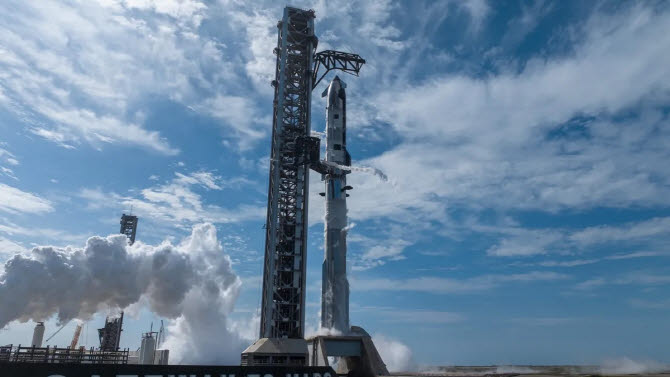
Countdown Halted for Starship V3 as “Engine Defect Detected Moments Before Launch”
One reason the SpaceX listing has captured extraordinary market attention is the company’s transformation into a massive platform spanning satellite communications, data infrastructure and space transportation. In particular, its reusable rocket technology has dramatically lowered launch costs, fundamentally reshaping the economics of the global space industry. More recently, the company has rapidly expanded into aviation, maritime and military communications markets, while in certain regions Starlink has reportedly become critical infrastructure during natural disasters and communications outages.
Another core pillar is development of the next-generation Starship spacecraft. Starship consists of a two-stage launch system comprising the spacecraft upper stage and the Super Heavy booster. SpaceX designed the platform as a fully reusable transportation system capable of carrying both cargo and crew to low Earth orbit, the Moon and Mars. According to official specifications, Starship is being developed to deliver more than 100 tons into orbit in its fully reusable configuration, while the Super Heavy booster is equipped with 33 Raptor engines. The latest V3 architecture is an upgraded iteration with enhanced propulsion performance and fuel capacity, incorporating designs intended for orbital refueling and large-scale Starlink satellite deployments required for long-range missions.
However, the postponement of Starship V3’s unmanned test flight due to technical problems has raised concerns in some corners of the market that a failed launch could dampen investor sentiment. Starship V3 had originally been scheduled to lift off at 7:30 p.m. on the 22nd, but the launch countdown stopped with 40 seconds remaining after a mechanical issue was discovered. SpaceX attempted to resolve the problem but ultimately announced a delay. Musk later said on X that “the hydraulic pin securing the tower arm failed to retract,” referring to a malfunction involving the arm-like apparatus used to hold Starship in place. Given that Starship V3 represents the first major redesign from previous models, SpaceX appears to have prioritized a safer retry over a rushed launch attempt.
In this regard, CNBC noted that “the success or failure of this test flight will be the single most decisive momentum factor institutional investors use to determine SpaceX’s future valuation.” Analysts say whether Musk’s vast ambitions for space evolve into a capital markets big bang or encounter a severe setback may ultimately depend on the flames reignited beneath Starship V3 in its next launch attempt.
Anne-Marie Nicholson is a fearless reporter covering international markets and global economic shifts. With a background in international relations, she provides a nuanced perspective on trade policies, foreign investments, and macroeconomic developments. Quick-witted and always on the move, she delivers hard-hitting stories that connect the dots in an ever-changing global economy.
Similar Post