Uber Emerges as Delivery Hero’s Largest Shareholder, Accelerating Global Expansion Amid Delivery Platform Consolidation

Siobhán Delaney is a Dublin-based writer for The Economy, focusing on culture, education, and international affairs. With a background in media and communication from University College Dublin, she contributes to cross-regional coverage and translation-based commentary. Her work emphasizes clarity and balance, especially in contexts shaped by cultural difference and policy translation.
Authored On
Modified
Uber expands Delivery Hero stake from 7% to 19.5%
Uber reinforces strategy after setbacks in Korea and Southeast Asia
Global race for dominance in AI- and robotics-driven delivery intensifies
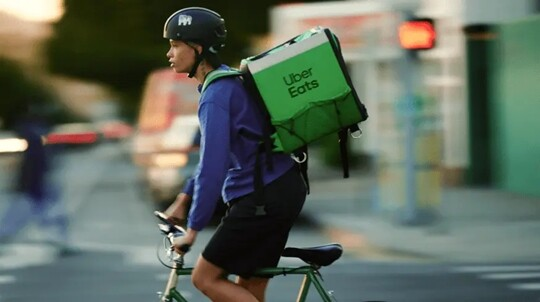
Global mobility platform Uber has aggressively accumulated shares in German food delivery company Delivery Hero, becoming its largest shareholder. The expanded stake is widely viewed as more than a financial investment, reflecting Uber’s broader strategy to counter rival global alliances and secure influence across Asian and European markets. While Uber has struggled to establish a dominant foothold in Asian food delivery markets such as South Korea and Southeast Asia, Delivery Hero has built an extensive network spanning Europe, the Middle East, and Asia. At the same time, competition surrounding artificial intelligence (AI)-driven dispatch systems and autonomous delivery robots is rapidly intensifying, pushing the global delivery platform sector toward a survival race centered on logistics and automation infrastructure.
Securing a 19.5% Stake in Delivery Hero
According to The Wall Street Journal (WSJ) on the 19th local time, Uber disclosed that it had increased its stake in Delivery Hero from roughly 7% to 19.5%. Separately, Uber also secured an option to purchase an additional 5.6% stake in the company. In April, Uber acquired approximately $318 million worth of Delivery Hero shares from South African investment firm Prosus, the company’s largest shareholder at the time, lifting its ownership to 7%. With the latest purchase, Uber has rapidly become Delivery Hero’s largest shareholder.
In a separate statement, Uber left open the possibility of further share acquisitions, provided its stake remains below 30%. According to Delivery Hero’s filing on the 18th, Uber stated that it “may acquire additional voting rights or dispose of shares within the next 12 months,” while clarifying that it currently has “no intention of obtaining 30% or more of the issuer’s voting rights.” Under German regulations, ownership exceeding 30% of voting rights could trigger mandatory tender offer obligations toward other shareholders, a threshold Uber appears intent on avoiding.
The transaction was finalized amid mounting antitrust pressure from European regulators. Prosus had been ordered to dispose of a substantial portion of its Delivery Hero holdings as a condition for regulatory approval of its acquisition of another delivery platform, Just Eat Takeaway. As the deadline for the forced divestment approached, Uber viewed the situation as a pivotal opportunity for territorial expansion. After acquiring Delivery Hero shares through a block trade last month, Uber swiftly raised its stake to 19.5% within just one month. European regulatory pressure has effectively become a catalyst reshaping ownership structures across the global food delivery industry.
Uber’s Attempted Turnaround Through Delivery Hero After Defeats to Baemin and Grab
Market participants do not view Uber’s move as a simple financial investment. Delivery Hero operates a massive network spanning Europe, the Middle East, and Asia through platforms including South Korea’s leading delivery app Baedal Minjok, Foodpanda, Glovo, and Talabat. For Uber, the company represents a strategic gateway capable of instantly absorbing regions where independent expansion efforts have stalled. Particularly in Europe, where DoorDash subsidiary Wolt is rapidly expanding its influence, Uber faces growing pressure as maintaining dominance through its U.S. market position alone becomes increasingly difficult.
Uber Eats continues to maintain strong market share in select regions such as the United States and Japan, but its expansion efforts in South Korea and Southeast Asia have repeatedly encountered setbacks. In Japan, Uber Eats successfully localized its operations after entering the market nine years ago, securing a dominant market share of roughly 70% and becoming a widely cited success story in the global platform industry. During the same period, several Korean delivery platforms, including Baedal Minjok and Coupang-affiliated services, attempted to enter the Japanese market but ultimately withdrew after failing to gain traction.
In South Korea, however, Uber Eats exited the market in 2019, just two years after launch. Despite aggressive discount campaigns and strong global brand recognition, Uber failed to penetrate the entrenched domestic ecosystem dominated by Baedal Minjok. At the time, international media outlets including Reuters and The Straits Times described South Korea’s food delivery app market as “one of the most competitive in the world.” Industry analysts argued that ultra-fast delivery culture, dense local restaurant networks, and high consumer loyalty effectively neutralized Uber’s standardized expansion strategy.
Southeast Asia has likewise remained a painful market for Uber. The company failed to overcome the super app ecosystem built by Grab. According to Singapore-based research firm Momentum Works, Grab continues to command approximately 55% market share in Southeast Asia’s food delivery market based on gross merchandise value (GMV), maintaining overwhelming dominance. In core markets such as Singapore, Malaysia, and the Philippines, Grab has reinforced network effects by integrating food delivery, mobility, and fintech services within its super app ecosystem. Since Uber ceded its Southeast Asian operations to Grab in 2018, regional competitive intensity has fallen sharply. Grab has since moved to expand beyond Southeast Asia, including efforts to acquire Foodpanda’s Taiwan business.
Escalating Autonomous Delivery Competition as Technology Emerges as the Ultimate Battleground
The global food delivery platform market has already entered a new phase of consolidation through mergers, acquisitions, and strategic alliances. DoorDash completed its acquisition of European delivery heavyweight Deliveroo last year, broadening its footprint across Europe, Asia, and the Middle East beyond the United States. Prosus is also pursuing the acquisition of Just Eat Takeaway, reshaping the European delivery market landscape. Uber’s increased investment in Delivery Hero represents a continuation of this broader consolidation trend. By becoming the largest shareholder in a company operating dense last-mile delivery networks across more than 70 countries, Uber aims to elevate itself into a dominant global logistics and delivery powerhouse.
Industry observers believe the ultimate outcome of this platform restructuring battle will likely hinge on technological investment. Whereas rider acquisition and discount wars once determined market share, the critical differentiator is increasingly becoming AI-powered dispatch systems and robotic delivery capabilities. In Europe, Just Eat Takeaway has partnered with Swiss robotics company RIVR to begin testing autonomous delivery robots in Zurich, with plans to expand deployment across major European cities. The robots utilize a hybrid structure capable of climbing stairs and curbs, focusing on improving delivery efficiency in densely populated urban areas.
In the United States, automation competition is intensifying around DoorDash. The company recently unveiled large-scale investment plans aimed at autonomous delivery and the construction of an AI-driven integrated logistics platform, while also beginning efforts to integrate global technology infrastructure including Wolt. Similar trends are emerging across Asia. Grab recently acquired Chinese AI delivery robotics company Infermove to strengthen automation capabilities, while Chinese platform giants such as Alibaba and Meituan are accelerating commercialization efforts for autonomous delivery services.
Uber Eats is likewise expanding unmanned delivery operations through partnerships with Serve Robotics and Alphabet subsidiary Waymo. In March, Uber Eats also launched robotic delivery services in downtown Philadelphia through a partnership with autonomous robotics company Avride. The delivery robots deployed in Philadelphia’s Center City utilize a hybrid perception system combining multiple LiDAR sensors, cameras, and ultrasonic sensors, enabling them to detect and avoid pedestrians and pets with millimeter-level precision. Using high-definition mapping technology, the robots pre-learn curb structures and traffic signal locations to maintain optimal routes without deviation. Uber Eats stated that robot delivery services do not require customer tipping, which it believes could significantly lower barriers to adoption.
Siobhán Delaney is a Dublin-based writer for The Economy, focusing on culture, education, and international affairs. With a background in media and communication from University College Dublin, she contributes to cross-regional coverage and translation-based commentary. Her work emphasizes clarity and balance, especially in contexts shaped by cultural difference and policy translation.
- Previous [U.S.-Iran Peace Talks] “Military Strike on Iran Put on Hold” U.S. Maintains Military Pressure Amid Nuclear Deadlock as Focus Shifts Toward ‘Economic Negotiations’ Before the Storm
- Next Korea and Japan Forge Energy Alliance Amid Iran War Shock, Expanding Toward Southeast Asia to Build Major Economic Bloc
Similar Post