Fractures Emerging in 86-Year U.S.-Canada Military Coordination as Trump’s Alliance Pressure Fuels Anti-American Drift

Siobhán Delaney is a Dublin-based writer for The Economy, focusing on culture, education, and international affairs. With a background in media and communication from University College Dublin, she contributes to cross-regional coverage and translation-based commentary. Her work emphasizes clarity and balance, especially in contexts shaped by cultural difference and policy translation.
Authored On
Modified
Disputes between Trump and Carney spill into military-security sphere
Western allies accelerate push for strategic defense autonomy
Capability gaps with the United States leave alternative security architecture facing steep hurdles
The United States has suspended participation in its joint defense advisory body with Canada, ending an 86-year framework maintained since 1940. The move is widely viewed as retaliation for Canadian Prime Minister Mark Carney’s sharp criticism of U.S. President Donald Trump’s “America First” doctrine during a speech at the World Economic Forum (WEF) in Davos, Switzerland, in January. Canada’s backlash also aligns with a broader wave of “strategic defense autonomy” spreading across Western allies. Germany and France have already begun restructuring defense supply chains centered on Europe, while Australia is expanding domestic submarine and advanced weapons production capabilities with the explicit aim of reducing reliance on the United States. As Washington intensifies pressure on allies to shoulder greater costs, fractures within the U.S.-led security order are becoming increasingly visible.
U.S. Defense Official Shares Carney’s ‘Anti-American Speech’
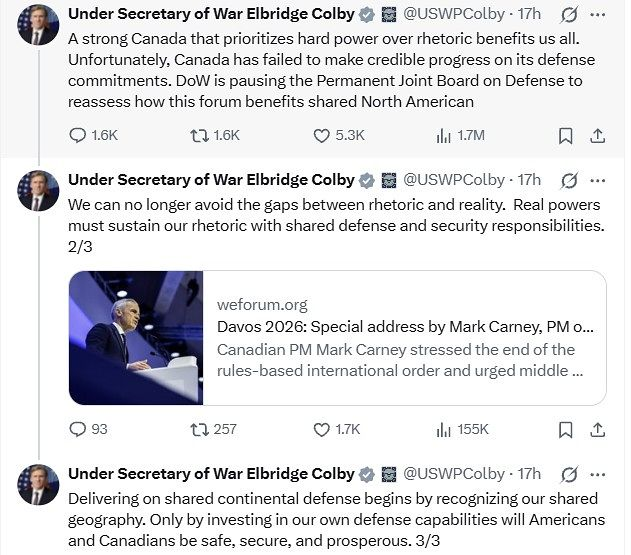
According to U.S. political outlet The Hill on the 20th (local time), Elbridge Colby, undersecretary of defense for policy at the U.S. Department of Defense, wrote on X on the 18th that “unfortunately, Canada has failed to demonstrate credible progress toward fulfilling its defense commitments,” adding that “the Department of Defense is temporarily suspending activities in order to reassess what benefits the Permanent Joint Board on Defense (PJBD) brings to North American collective defense.”
The PJBD was established under the Ogdensburg Agreement signed in August 1940 by former U.S. President Franklin Roosevelt and former Canadian Prime Minister William Mackenzie King during the height of World War II. The body is regarded as one of the most symbolic institutions representing bilateral defense cooperation, including its advisory role to the jointly operated North American Aerospace Defense Command (NORAD). Although the board is required to meet at least once annually, no session has been held since Trump’s second term began in January of last year.
The decision marks the first case in which the Trump administration’s escalating demands for greater security contributions from allies have translated into concrete action. Colby specifically shared a link to Carney’s Jan. 20 speech at the Davos forum, stating that “we can no longer ignore the gap between rhetoric and reality,” while adding that “true great powers must back up their words with shared defense and security responsibilities.” The remarks effectively signaled that the speech lay behind Washington’s suspension from the defense board.
In that address, Carney described the current geopolitical landscape as a “rupture,” arguing that “middle powers must unite.” The remarks were interpreted as a call to abandon lingering dependence on the U.S.-led order in the Trump era and instead strengthen an anti-Trump alignment. On Jan. 27, Carney again emphasized during questioning at Canada’s Parliament in Ottawa regarding prospects for trade negotiations with Washington that “the world has changed. Washington has changed. Almost nothing in America is normal right now.”
Trump subsequently expressed irritation, declaring that “Canada exists because of the United States.” In late January, he warned that Canada would face 100% tariffs if it signed a free trade agreement with China and referred to Carney as “Governor Carney,” signaling that he had not abandoned ambitions of folding Canada into the United States. Trump also pressured Ottawa by threatening to block the opening of a new bridge linking Canada and Michigan, while Canada responded by reviewing reductions in purchases of U.S.-made military equipment, deepening tensions between the two leaders.

Canada Reviews U.S. Arms Purchases, Pursues Defense Cooperation with Europe
Carney is currently reviewing Canada’s contract to purchase Lockheed Martin F-35 fighter jets while simultaneously engaging European defense firms, leaving open the possibility of procurement diversification. Canada originally decided in 2023 to acquire 88 F-35 aircraft, though reports indicate Ottawa began examining alternative options after Trump returned to office. Canada has not yet fully abandoned the existing U.S. fighter purchase program, but analysts view the review process itself as a sufficiently strong political signal against the U.S.-centered defense procurement structure.
The Canadian government has also formally accelerated defense investment plans while simultaneously pursuing reconstruction of its military and restructuring procurement systems. On Feb. 17, Carney unveiled a new defense industrial strategy in Montreal, making clear Ottawa’s intention to move beyond a U.S.-centric security framework. “There are many advantages to partnership with the United States, but it has become a form of dependency,” Carney said, stressing that “we must expand an independent defense industrial base so we are not held hostage to another country’s decisions on security matters.”
Canada’s new strategy is summarized by three words: “Build, Partner, Buy.” The framework prioritizes domestic production for military procurement, limits allied cooperation to cases involving technology transfer when local production is impossible, and relegates direct overseas purchases to a last resort.
The strategy also includes a concrete target of allocating 70% of federal defense contracts to Canadian firms within the next decade. Domestic companies currently account for roughly 43% of such contracts. To raise that share by nearly 30 percentage points over the next 10 years, Ottawa plans to inject a record-breaking $367 billion into military equipment procurement and defense infrastructure expansion, including $132 billion for weapons acquisition and $213 billion for defense infrastructure. Carney explained that “for decades, Canada relied excessively on geographic advantages and protection from other countries while neglecting defense spending and industrial investment,” adding that “this has created vulnerabilities that are no longer sustainable.”
Earlier, on Feb. 6, Trump signed an executive order directing that weapons required by the U.S. military be produced domestically first while pressuring allies to purchase American-made equipment. The order explicitly stated that allies must assume greater responsibility for regional security and rapidly procure advanced U.S. weapons systems to do so. The measure is widely interpreted as de facto coercion to purchase U.S. arms and a warning shot aimed at allied defense industries.
Against that backdrop, some analysts view Canada’s new defense industrial strategy as a direct rebuttal to Trump’s “Buy American” push through a “Canada First” procurement response. Bloomberg likewise described the initiative as “a direct response to Trump’s aggressive security and trade policies and tariff threats.”
The Trump administration’s approach to alliances increasingly frames defense commitments less as long-term investments in collective security and more as mechanisms for cost recovery and burden shifting. Countries such as South Korea, Japan, and the Philippines face difficulties openly resisting Washington’s demands because of their strategic proximity to China. Canada, however, occupies a different position. As a core component of the North American defense network, Ottawa is not exposed to the same level of front-line security pressure facing Indo-Pacific states. That distinction forms a central driver behind Canada’s growing anti-American posture.
Last year, Canada increased defense spending by $6.8 billion, barely meeting NATO’s benchmark of 2% of gross domestic product (GDP). The Trump administration, however, recently reinforced an informal expanded target during the NATO summit in The Hague, pushing the benchmark toward 5% of GDP, including 3.5% in direct military expenditures and 1.5% in defense infrastructure. As Washington increasingly treats defense commitments as tools for financial extraction, strategic distrust among allies is deepening in parallel.
Germany, France, Britain, and Australia Accelerate Defense Autonomy Pushes, Though Success Remains Uncertain
Canada is far from the only ally pursuing independent defense capabilities. In February, the Australian government approved an initial $1.8 billion in funding to build a new submarine construction facility in Osborne, South Australia, as part of the AUKUS security pact involving the United States, Britain, and Australia. Australian Prime Minister Anthony Albanese described the funding as a “down payment” on a long-term project expected to cost $19 billion, calling it “essential infrastructure for Australia to directly construct conventionally armed, nuclear-powered submarines.”
Australia has also begun cultivating defense-related software capabilities alongside hardware production. A representative initiative is the planned $640 million Advanced Capability Investment Fund. The fund will co-invest with venture capital firms to support startups developing advanced defense technologies including hypersonic missiles, artificial intelligence (AI), autonomous systems, and quantum technologies. The initiative mirrors Silicon Valley’s venture-backed defense technology model and is widely interpreted as an attempt to fundamentally reshape Australia’s defense industrial ecosystem.
Europe has likewise concluded that it can no longer rely indefinitely on the United States for security amid escalating friction with the Trump administration and is moving to strengthen its own defense capabilities. Last March, Germany amended its constitution to effectively exempt defense spending from debt ceiling restrictions. The change allows Berlin to finance defense expenditures exceeding 1% of GDP through new borrowing. Germany’s core defense budget is consequently projected to rise from 2.4% of GDP in 2025 to roughly 3.5% by 2029. The Financial Times estimated that Germany’s defense spending will climb 70% from 2025 levels to approximately $175 billion by 2029. France is also planning to raise defense spending from around 2% of GDP to between 3% and 3.5% by 2030, while Britain aims to expand military expenditures from roughly 2.3% of GDP to 2.6% in 2027 and 3% by 2029.
Experts caution, however, that the success of these efforts toward defense autonomy remains highly uncertain. Rebuilding defense industrial ecosystems that have depended on the United States for decades will not be easy within a short timeframe. Analysts overwhelmingly agree that the gap with Washington remains especially severe in naval power and long-range operational capabilities. The United States effectively stands alone in its ability to integrate carrier strike groups, strategic transport, aerial refueling, satellite surveillance, and ammunition supply networks into a unified operational framework.
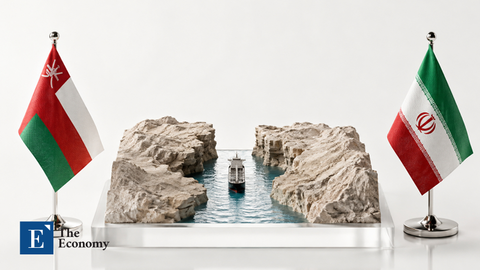
Britain and France have recently led coalition responses around the Strait of Hormuz, though many observers argue that their actual deterrence capacity remains limited. European naval forces, by themselves, lack the operational depth required to sustain long-term missions in the Middle East or Indo-Pacific.
Defense production capacity also faces structural constraints that cannot be resolved quickly. Following the end of the Cold War, major European powers maintained extended military downsizing policies that weakened shipbuilding, steelmaking, and heavy industrial capacity overall. Defense companies also shifted business models toward more profitable civilian aviation and commercial manufacturing sectors. Shortages of skilled welders, military engineers, and nuclear reactor specialists have intensified simultaneously.
Britain’s Type 31 frigate program, for example, has suffered surging costs due to rework and supply chain disruptions, while the AUKUS submarine initiative remains constrained by production bottlenecks at British shipyards and procurement difficulties involving critical components. Germany and France are also moving to expand ammunition production and air defense systems, though analysts note that expanding production lines, securing raw materials, and rebuilding subcontractor supply chains will require substantial time. The reality underscores the considerable gap between political declarations of defense autonomy and actual industrial capability.
Siobhán Delaney is a Dublin-based writer for The Economy, focusing on culture, education, and international affairs. With a background in media and communication from University College Dublin, she contributes to cross-regional coverage and translation-based commentary. Her work emphasizes clarity and balance, especially in contexts shaped by cultural difference and policy translation.
Similar Post