The AI Retraining Illusion: Education Policy in an Age of Superhuman Labor

Keith Lee is Professor of AI and Finance at the Gordon School of Business, Swiss Institute of Artificial Intelligence (SIAI). His primary research lies in financial mathematics and AI-driven computational science, with a focus on quantitative modeling of complex economic and financial systems. His work integrates machine learning, stochastic modeling, and data-centric methods to study structural transformations in markets and institutions.
His work examines the broader socioeconomic consequences of artificial intelligence, including labor markets, public finance, demographic change, and institutional adaptation.
He holds a PhD in Mathematical Finance from Boston University, and previously earned an MSc in Finance and Economics from the London School of Economics. He completed his undergraduate studies in Economics at Seoul National University under the Korea Foundation for Advanced Studies scholarship program.
Authored On
Modified
AI is raising output while reducing the need for average human labor
Mass retraining alone will not solve a labor market that needs fewer workers
Education policy must shift from teaching adaptation to protecting human economic relevanc

Labor markets may appear stable even as they lessen reliance on typical human input. Recent findings warrant rapid attention from education policymakers and university leaders. Since the deployment of generative AI in workplaces, employment among workers aged 22 to 25 in the United States who occupy AI-exposed roles has declined by approximately 13% relative to other workers, controlling for firm-level shocks. This phenomenon is not reminiscent of traditional manufacturing displacement yet signals disruption in clerical, support, coding, and other white-collar occupations historically serving as entry points into professional careers. The prevalent policy response has emphasized expanded retraining, encompassing additional education, certification, and accelerated skill acquisition. Although theoretically simple, this approach may fail to address the core challenges that have shifted from merely a skills mismatch to a more extensive deficit in labor demand. As firms reorganize work around AI-augmented high productivity, the requirement fority for entry-level and average-skilled workers diminishes, rendering mass retraining an incomplete solution to structural employment changes.
The Limits of Retraining
The rationale underlying AI retraining policies misinterprets the main challenge. Conventional wisdom suggests that major market transformations require accelerated educational adaptation. This perspective held some validity during earlier digital revolutions, when technologies such as personal computers and smartphones created substantial new routine tasks that required human involvement. In contrast, current AI advancements encroach upon functions integral to cognitive processing, including drafting, sorting, analysis, coding, and client interaction—tasks once considered secure bastions of white-collar employability. The risk is that governments will continue investing in retraining programs as if the future labor market will resemble prior states with abundant clerical and junior professional roles. This assumption increasingly appears untenable, calling into question the continued viability of traditional retraining paradigms.
Evidence suggests that AI adoption enables firms to increase productivity with fewer employees rather than replacing workers outright. For example, a large study involving over 5,000 customer support employees showed a 14% average productivity increase attributable to AI assistance, with novice and low-skilled workers experiencing improvements of up to 34%. Similarly, a cross-industry experiment with more than 7,000 knowledge workers found that frequent users of AI-enhanced tools reduced time spent on email by 31% and accelerated document completion. These productivity gains explain managerial enthusiasm but also illustrate a critical policy gap. Enhanced output per worker means firms can maintain or increase productivity without proportionally increasing headcount. Consequently, productivity improvements may simultaneously elevate individual skills and reduce aggregate labor demand.
This dynamic is reflected in employer attitudes and actions. According to the World Economic Forum, 86% of employers anticipate significant effects of AI and related technologies by 2030. However, the same data reveal significant constraints on training capacity: among employees projected to require substantial retraining, a substantial share has limited access to such opportunities. Research by Morgan Stanley reports an 11.5% increase in productivity alongside a net 4% reduction in workforce size in AI-affected industries, with losses concentrated in large firms and among early-career employees. Corporations such as Accenture are reportedly making workforce decisions based on anticipated AI capabilities, encountering challenges in timely retraining that keeps pace with technological evolution. These trends suggest that retraining alone may struggle to keep pace with the speed and nature of labor market transitions driven by AI.
The Real Educational Challenge
The fundamental educational challenge centers not on skill acquisition per se but on the labor market's capacity to absorb workers at adequate wages in a post-AI environment. The International Labour Organization estimates that approximately 25% of jobs globally face exposure to generative AI, with higher exposure rates in developed economies and particularly among clerical occupations. While the ILO emphasizes transformation rather than immediate displacement, such transformation can lead to reduced employment opportunities, fewer entry-level positions, and amplified competition within existing job categories. Notably, occupational redefinition may increase barriers to entry without eliminating roles entirely.
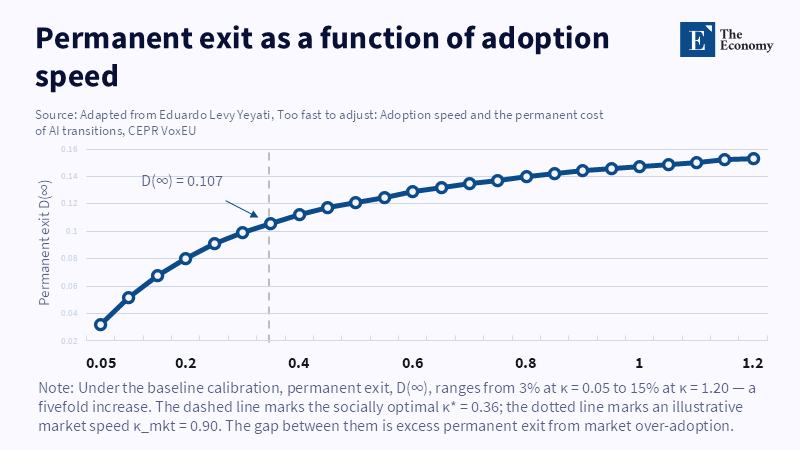
Comparisons to earlier office software adoption may obscure key distinctions. According to a recent report from Anthropic, while traditional word processors primarily increased typists' productivity without combining many tasks, modern AI models now integrate diverse functions such as drafting, summarizing, translating, preparing presentations, communicating with clients, and coding. Although current professional use of AI only taps into a small portion of these capabilities, Anthropic has launched a system to monitor the resulting job shifts, highlighting that significant changes in white-collar employment are already underway. As AI deployment advances, educational systems encounter a moving target, with firms concurrently contracting the volume of traditional roles.
Moreover, the assertion that AI benefits lower-performing workers does not fully resolve policy concerns. While AI may narrow performance disparities on specific tasks, this can reduce employers’ incentives to maintain expansive training programs, broad junior-level cohorts, or gradual career advancement tracks. Empirical findings from Stanford indicate that employment declines within AI-exposed occupations disproportionately affect early-career individuals, whereas more experienced workers remain comparatively stable. This pattern undermines the traditional model whereby education secures access to entry-level positions that serve as stepping stones for skill development and career progression. Consequently, generalized retraining ceases to be a universally effective remedy.
Rethinking Education Policy for an AI Economy
Given these developments, education policy must adopt a more nuanced and targeted approach. Firstly, framing AI literacy as a universal safeguard for employability risks overstates. Basic proficiency with AI tools will rapidly become widespread, yet this alone may not sustain wage levels. Instead, the emphasis should shift toward cultivating judgment skills that encompass problem framing, fact verification, accountability, and performance under conditions in which errors entail significant consequences. Curricula ought to reduce reliance on routine production tasks susceptible to AI completion and increase focus on critical reasoning, oral defense, supervised practice, and domain-specific responsibility. Educators should thus prioritize training students to critically evaluate and refine machine-generated outputs.
Secondly, policymakers should disentangle multiple objectives commonly conflated in retraining discourse. Foundational capability guarantees that all individuals possess sufficient AI fluency to participate meaningfully in civic and economic realms. Elite leverage refers to a smaller subset trained extensively to use AI to maximize productivity, encompassing advanced workflows, data interpretation, and oversight. Social protection acknowledges a segment of the population unlikely to access high-leverage AI roles, necessitating investment in income support, career counseling, localized job creation, and in sectors reliant on relational, physical, or trust-based human services. Public funds should reflect these distinct goals rather than funnel predominantly into generalized reskilling programs.
Thirdly, education systems must prepare for fluctuating credential value amid increasing automation of analytical, communicative, and administrative tasks. The wage premium associated with broad-based degrees is likely to diminish unless such qualifications confer access to occupations that are protected by licensing, require tacit knowledge, or involve intensive human interaction. Institutional responses should include open reporting of labor-market outcomes, discontinuation of programs with weak employment prospects, expansion of experiential learning in less automatable fields, and streamlined pathways into care, health support, skilled trades, and community services. This realignment does not oppose education but aims to prevent it from perpetuating unrealistic expectations about labor market security.
Beyond Reskilling: A Broader Policy Response
A comprehensive AI retraining strategy must incorporate the principle that workers have the right not only to learn but also to remain needed. While early AI adoption remains limited—EU data show 20% of enterprises employing AI in 2025, up from 13.5% in 2024—anticipations of job transformation coexist with projections of net job creation by 2030. Nonetheless, these aggregate figures do not mitigate challenges related to entry-level job availability, career transitions, and wage maintenance. The critical issue is whether displaced workers can access developing opportunities with comparable remuneration in a timely and cost-effective manner—an outcome yet to be demonstrated.
Effective public policy should integrate industrial, educational, and labor strategies, with government oversight of metrics such as entry-level hiring, apprenticeships, wage trajectories, and job turnover in AI-impacted sectors. Expansion of academic AI programs ought to be accompanied by accountability for graduate employment outcomes. Employers reducing junior positions while anticipating productivity gains must be required to contribute to workforce transition mechanisms, including retraining initiatives, income supports, and the creation of human-centric roles. The societal cost of AI will arise not merely from technological transformations but also from policy inertia rooted in the erroneous belief that all displaced workers can readily upskill and remain employed.
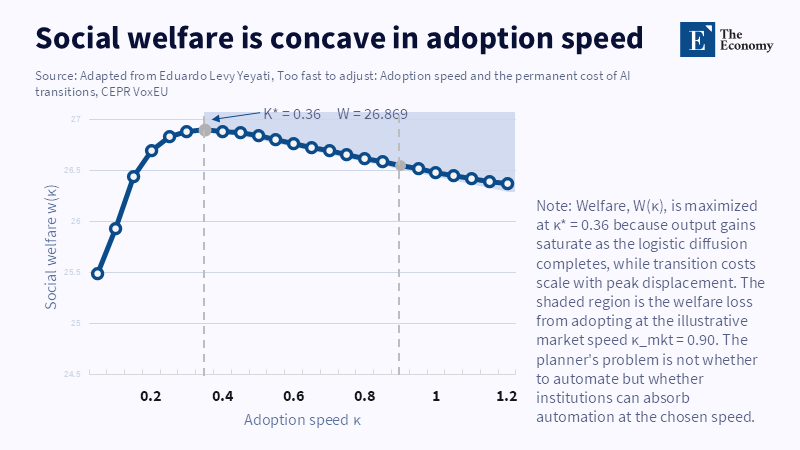
In sum, emerging labor market data suggest that the challenge goes beyond AI outperforming human workers to encompass the fragility of institutions predicated on traditional levels of human labor demand. As firms realize that smaller cohorts of AI-augmented employees can replicate the output of larger teams, the implicit promise that education ensures labor market security loses credibility. Retraining will remain a necessary component, but it is insufficient in isolation. Educational systems remain crucially relevant yet must adapt their mission to help societies identify essential human capabilities, design supported labor transitions, and uphold dignity at a time when AI-enabled labor increasingly supplants routine human work. Failure to accept this shift will impose costs not only on displaced individuals but on wider economic and social structures.
The views expressed in this article are those of the author(s) and do not necessarily reflect the official position of The Economy or its affiliates.
References
Business Today Desk (2025) ‘39% of skills outdated by 2030: WEF warns of AI’s impact on jobs’. Business Today, 10 January.
Brynjolfsson, E., Chandar, B. and Chen, R. (2025) Canaries in the Coal Mine? Six Facts about the Recent Employment Effects of Artificial Intelligence. Working paper. Stanford, CA: Stanford Institute for Economic Policy Research.
Brynjolfsson, E., Li, D. and Raymond, L.R. (2023) Generative AI at Work. NBER Working Paper No. 31161. Cambridge, MA: National Bureau of Economic Research.
Chen, L., Guo, J., Li, W. and Wang, G. (2025) ‘The dynamic impact of higher education on youth employment opportunities and quality: an empirical analysis based on age-period-cohort models’. Frontiers in Sociology, 10, 1680077.
Congruence Foundation Research Team (2025) Artificial Intelligence Impact on the Global Job Market (2025–2030). Congruence Foundation.
Davenport, T.H. and Srinivasan, L. (2026) ‘Companies Are Laying Off Workers Because of AI’s Potential—Not Its Performance’. Harvard Business Review, 29 January.
Dinelli, E.J., Crown, D., Kudla, A., Capraro, P., Sheth, M., Trierweiler, R., Munsell, E. and Heinemann, A.W. (2024) ‘Facilitators and barriers to employment for people with adult-onset physical disabilities: results from a U.S.A. survey’. Work, 79(3), pp. 1433–1450.
Dillon, E.W., Jaffe, S., Immorlica, N. and Stanton, C.T. (2025) Shifting Work Patterns with Generative AI. NBER Working Paper No. 33795. Cambridge, MA: National Bureau of Economic Research.
Eurostat (2025) ‘20% of EU enterprises use AI technologies’. Eurostat News Articles, 11 December.
Ghosal, S. and Butts, D. (2025) ‘Generative AI reshapes U.S. job market, Stanford study shows’. CNBC, 28 August.
Gmyrek, P. (2025) ‘Generative AI at work: What it means for jobs in Europe and beyond’. International Labour Organization, 29 September.
Gmyrek, P., Berg, J., Kamiński, K., Konopczyński, F., Ładna, A., Nafradi, B., Rosłaniec, K. and Troszyński, M. (2025) Generative AI and Jobs: A Refined Global Index of Occupational Exposure. ILO Working Paper No. 140. Geneva: International Labour Organization.
Jacobs, J. (2025) ‘AI labor displacement and the limits of worker retraining’. Brookings, 16 May.
Kumar, A. (2025) ‘Why AI is replacing some jobs faster than others’. World Economic Forum, 12 August.
Landymore, F. (2026) ‘AI Is Forcing Employees to Work Harder Than Ever’. Futurism, 12 March.
Levy Yeyati, E. (2026) ‘Too fast to adjust: Adoption speed and the permanent cost of AI transitions’. VoxEU, 19 March.
Massenkoff, M. and McCrory, P. (2026) ‘Labor market impacts of AI: A new measure and early evidence’. Anthropic, 5 March.
Modestino, A.S., Burke, M.A., Sadighi, S., Sederberg, R., Stern, T. and Taska, B. (2023) No Longer Qualified? Changes in the Supply and Demand for Skills within Occupations. IZA Discussion Paper No. 16542. Bonn: IZA Institute of Labor Economics.
Morgan Stanley Research (2026) ‘AI’s Impact Accelerates’. Morgan Stanley, 5 February.
Mühlemann, S. (2025) ‘Artificial intelligence adoption and workplace training’. Journal of Economic Behavior & Organization, 238, 107206.
Shapiro, A. (2025) ‘Accenture to Cut Staff Who Can’t Reskill on AI in Major Restructuring’. AiNews.com, 1 October.
Stevens, R. (2026) Payrolls to Prompts: Firm-Level Evidence on the Substitution of Labor for AI. arXiv preprint arXiv:2602.00139.
Subin, S. (2025) ‘AI is already taking white-collar jobs. Economists warn there’s “much more in the tank”’. CNBC, 22 October.
World Economic Forum (2025) The Future of Jobs Report 2025. Geneva: World Economic Forum.
Keith Lee is Professor of AI and Finance at the Gordon School of Business, Swiss Institute of Artificial Intelligence (SIAI). His primary research lies in financial mathematics and AI-driven computational science, with a focus on quantitative modeling of complex economic and financial systems. His work integrates machine learning, stochastic modeling, and data-centric methods to study structural transformations in markets and institutions.
His work examines the broader socioeconomic consequences of artificial intelligence, including labor markets, public finance, demographic change, and institutional adaptation.
He holds a PhD in Mathematical Finance from Boston University, and previously earned an MSc in Finance and Economics from the London School of Economics. He completed his undergraduate studies in Economics at Seoul National University under the Korea Foundation for Advanced Studies scholarship program.