U.S.–China Trade Tensions Flare Again, but a Diplomatic Truce Still in Sight

As one of the youngest members of the team, Tyler Hansbrough is a rising star in financial journalism. His fresh perspective and analytical approach bring a modern edge to business reporting. Whether he’s covering stock market trends or dissecting corporate earnings, his sharp insights resonate with the new generation of investors.
Authored On
Modified
The U.S.: “Extra tariffs depend on China’s response”
Trade tensions flare again, now hitting shipping
Will the Trump–Xi APEC meeting go smoothly?
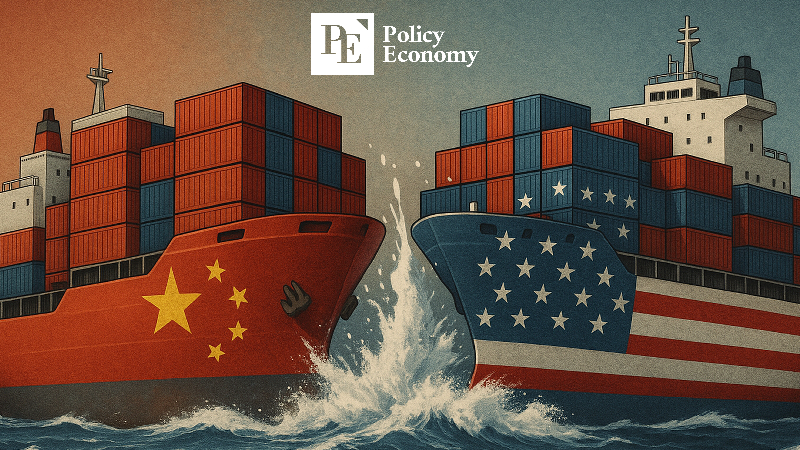
Trade tensions between the United States and China have flared up once again. As China announced plans to tighten export controls on rare earth elements, the U.S. responded with a fresh wave of tariff threats, heightening friction between the world’s two largest economies.
U.S.–China Tensions Deepen
According to Reuters on October 15 (local time), Jamieson Greer, the U.S. Trade Representative (USTR), said in an interview with CNBC that “depending on China’s response, the additional 100% U.S. tariffs could take effect on or before November 1,” adding that “Washington and Beijing held working-level talks yesterday, and there is still room to resolve the rare earth export issue.” His remarks came just days after President Donald Trump announced a plan to impose an additional 100% tariff on Chinese goods in retaliation for Beijing’s decision to tighten controls on rare earth exports.
Trade friction between the two countries has intensified rapidly since Washington unveiled its retaliatory tariff plan. On October 14, President Trump wrote on Truth Social that “China’s deliberate decision not to buy our soybeans and to hurt our farmers is an act of economic hostility,” adding that he was “considering cutting business ties with China involving cooking oil and other trade items.” U.S. soybean exports to China have been completely suspended since June, following a tit-for-tat escalation that began when Trump announced a 34% reciprocal tariff in early April, to which Beijing responded with equivalent duties on American agricultural products, including soybeans.
What also drew attention was Trump’s specific mention of cooking oil — an issue long seen as a potential flashpoint in U.S.–China trade relations. American farmers have repeatedly voiced frustration over the surge in imports of used cooking oil (UCO) from China, which is used as feedstock for renewable diesel. The rise in UCO imports has sparked fears that it could erode the market for biofuels made from U.S.-grown soybeans. In response, the Biden administration previously restricted foreign cooking oils from qualifying for renewable fuel tax credits, while the Trump administration has moved to tighten import controls on related products and expand mandates for biofuel usage.
China Moves to Restrain U.S. Shipping Industry
Tensions between the United States and China have now spilled into the maritime sector. On October 14, China’s Ministry of Commerce announced sanctions on five U.S. subsidiaries of Hanwha Ocean — Hanwha Shipping, Hanwha Philly Shipyard, Hanwha Ocean USA International, Hanwha Shipping Holdings, and HS USA Holdings — banning all transactions, investments, and cooperation with them. Beijing claimed the companies had “assisted U.S. shipbuilding and maritime regulations that undermine China’s security and development interests.”
At the same time, China introduced a special port fee system targeting vessels linked to the United States. Under the new rule, ships owned, operated, or built by the U.S., as well as those with more than 25% American ownership, will be subject to an additional charge of about $55 per net ton. The fee will increase gradually each year, reaching around $155 per net ton by 2028. Vessels built in China, however, will be exempt from the surcharge.
Analysts warn that the sanctions could deal a serious blow to Hanwha Ocean, which has been expanding its manufacturing footprint in the U.S. The measures may restrict the company’s fund transfers, equipment sourcing, and port access in the region. Hanwha Ocean, which acquired the Philly Shipyard last year, has been pursuing naval and commercial shipbuilding projects in the U.S. and plans to invest up to $5 billion starting this year.
Prolonged Conflict Seen as Unlikely
Experts increasingly believe that tensions between the United States and China may ease in the near future. Stephen Olson, a visiting senior fellow at the ISEAS–Yusof Ishak Institute in Singapore, told the South China Morning Post on October 13 that “too much is at stake, and if the summit is canceled, the market and business sentiment would be hit like a tsunami.” He added that the ongoing trade dispute could soon enter a lull. Olson also cautioned that “both sides are playing a potentially dangerous game — as threats, measures, and countermeasures pile up, it becomes increasingly difficult to step back. If a broader negotiation fails, another tariff truce will likely be necessary.”
Wang Dan, director for China at the Eurasia Group, shared a similar view, saying, “Trump’s goal is to secure a deal in which China pays a price for access to the U.S. market, not to trigger a complete decoupling through punitive tariffs.” She assessed that the likelihood of Washington actually implementing additional tariffs on China remains low. Wang also noted that both leaders are still likely to meet at the upcoming APEC summit and that a new trade agreement could be reached early next year.
Wu Xinbo, dean of the Institute of International Studies at Fudan University in Shanghai, also said the probability of a summit remains high. Similarly, Wang Yiwei, a professor at Renmin University’s School of International Studies, suggested that the recent escalation of tensions may actually pave the way for the two leaders to meet during the APEC summit. “In essence, confrontation is a route to compromise,” he said, adding that the U.S. move serves as “a warning not to provoke further disputes.”
As one of the youngest members of the team, Tyler Hansbrough is a rising star in financial journalism. His fresh perspective and analytical approach bring a modern edge to business reporting. Whether he’s covering stock market trends or dissecting corporate earnings, his sharp insights resonate with the new generation of investors.
Similar Post