Trump Warns of U.S. Default Risk if Tariffs Are Struck Down, Supreme Court Hearing Set for November

Authored On
Modified
Supreme Court to Begin Hearing on November 5
Trump Administration Lost in Lower Courts
Trump: “If Tariffs Are Voided, the U.S. Economy Will Suffer for Years”
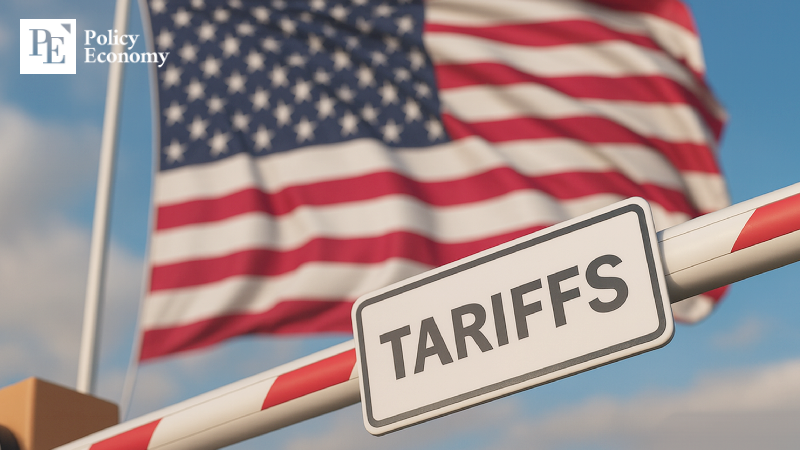
Next month, the U.S. Supreme Court will begin a landmark hearing to determine whether to invalidate the Trump administration’s global tariff policy, a decision that could reshape the scope of presidential trade authority. Prominent foreign policy and national security figures have filed an amicus curiae brief supporting the annulment of the tariffs, arguing that no president has ever possessed unilateral authority to alter tariffs under the pretext of foreign policy discretion. The Trump administration, however, continues to warn that striking down the tariffs would inflict years of economic pain on the United States.
Conservative justices, known for their support of strong executive power, now face the challenge of balancing that stance with the constitutional limits of presidential authority claimed by Trump. Though the case hinges on legal interpretation, its implications span all three branches of government—legislative, judicial, and executive—and could shape institutional power dynamics for decades.
Amicus Brief Filed Against Trump Tariffs
According to the U.S. Supreme Court docket, on October 17 a coalition of legal scholars and Republican foreign policy veterans—among them Philip Zelikow, former counselor of the State Department; Robert Zoellick, former World Bank president; and Chuck Hagel, former Secretary of Defense—submitted an amicus curiae brief urging the Court to invalidate Trump’s tariffs. The amicus curiae mechanism, rooted in Roman law’s “friend of the court” principle, allows neutral third parties to submit written opinions to inform judicial deliberations in matters of public interest.
Zelikow and Zoellick, key figures spanning the George H.W. Bush and George W. Bush administrations, currently hold posts at Stanford University’s Hoover Institution and Harvard’s Belfer Center for Science and International Affairs, respectively. Hagel, a Republican who served as Secretary of Defense under President Barack Obama, joined them in the submission.
In Section V of their brief, titled “Diplomacy Is No Escape,” the fifteen co-signatories asserted that “no president has ever held independent authority to adjust tariffs as an exercise of foreign policy discretion.” They dismissed the Trump administration’s invocation of drug trafficking and trade imbalances as national emergencies, arguing that “the so-called threats that triggered the tariffs consist of long-standing economic trends and grievances dating back to the 1970s.” The brief continued, “Such chronic issues, however serious, do not constitute a sudden crisis or extraordinary departure from the status quo. Rather, they are ordinary and persistent challenges to be resolved through legislation and policy debate.”
Trump Administration’s Consecutive Defeats in Lower Courts
The Supreme Court is scheduled to hold its first oral arguments on November 5 regarding the Trump administration’s tariff policy under the International Emergency Economic Powers Act (IEEPA). The central question is whether the president has the authority to impose tariffs under IEEPA. On August 29, the U.S. Court of Appeals ruled by a 7–4 vote that tariffs fall within Congress’s legislative authority, not the president’s, upholding the lower court’s decision.
The appeals court cited the U.S. Court of International Trade’s opinion that “IEEPA makes no mention of tariffs or similar instruments and includes no procedural safeguards for their imposition.” The ruling stated that “the power to levy tariffs and taxes resides with Congress, and IEEPA does not supplant that authority.” It further emphasized that “if Congress intends to delegate tariff authority to the president, it must use explicit terms such as ‘tariffs’ or ‘tariff rates,’ or otherwise make such delegation unmistakably clear within the statutory framework.”
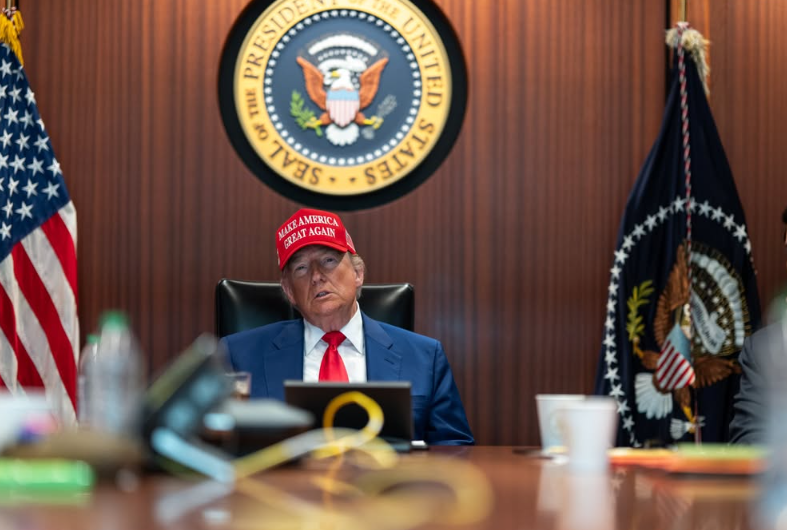
Condemning the ruling as “highly partisan,” President Trump appealed to the Supreme Court and has since continued to plead his case publicly. In a Fox News interview on October 19, Trump warned that overturning his tariff measures would leave the U.S. economy struggling for years. “I don’t even want to think about losing,” he said. “We’re doing incredibly well. If they take away the tariffs, they’re taking away our national security.” Treasury Secretary Scott Besant, in documents submitted to the Court, estimated that a loss would require refunding between $750 billion and $1 trillion in collected tariffs, calling it “a catastrophic outcome for the U.S. economy.”
Trump Warns of Fiscal Shock, Prepares for Oral Arguments
A Supreme Court defeat would likely deliver an immediate blow to the U.S. economy. The required $1 trillion in refunds could force tax hikes or cuts to welfare programs. According to a Congressional Budget Office (CBO) simulation, refund costs and reduced revenues would swell the U.S. fiscal deficit from $2 trillion to $2.3 trillion in 2026—roughly 10% of GDP, rivaling the early-1930s Great Depression deficit surge of 5%. The burden would fall heavily on middle-class households already strained by high interest rates and record household debt.
Invalidating the tariffs could also trigger a manufacturing shock, as corporations scramble to restructure supply chains. The Court’s ruling will have far-reaching consequences for U.S. trade policy, given that IEEPA underpins not only most foreign sanctions but also recent regulations on outbound investment, data security, and ICT controls. The case thus touches the core of the U.S. constitutional separation of powers and the legal foundation of its economic statecraft.
The Trump administration remains cautiously optimistic, buoyed by a 6–3 conservative majority on the Court, which has previously backed expansions of executive authority. Chief Justice John Roberts, in earlier rulings affirming the president’s power to dismiss independent agency heads, underscored “the president’s constitutional prerogatives.” Trump’s decision to personally attend the Supreme Court hearing is unprecedented for a sitting president—a move analysts see as more than political theater. “I need to witness it myself. This is America’s future,” Trump declared, suggesting confidence that the Court’s six conservative justices are aligned with him.
Similar Post