IMO Carbon Tax Fails to Pass: Trump Reshapes the Hard-Realist Global Order

Authored On
Modified
IMO Delays Mid-Term Measure Decision by One Year
U.S. Threatens Sanctions Against Pro-Regulation Nations
Member States Abstain Over Fear of Trump’s Retaliation
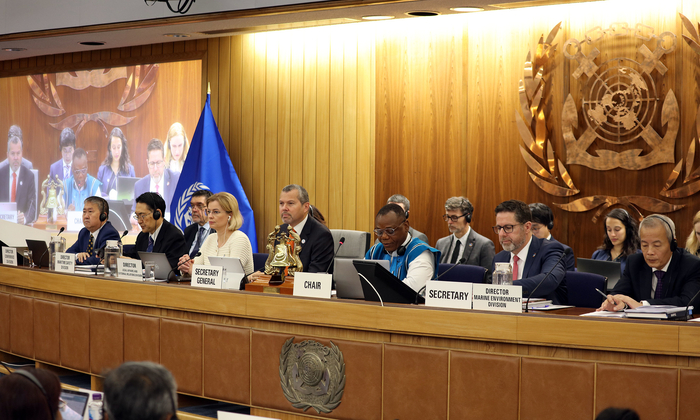
The International Maritime Organization’s (IMO) plan to adopt a comprehensive greenhouse gas (GHG) reduction framework for the shipping industry has been postponed by one year following strong opposition from U.S. President Donald Trump. While the official reason is to delay the vote by a year, observers say the measure is effectively shelved as long as Trump wields influence. Washington has warned that nations supporting the plan could face tariffs, visa restrictions, and additional port fees — a threat that, combined with the mobilization of global shipping giants against the measure, has made approval increasingly unlikely.
IMO Grants One-Year Deferral on Carbon Tax
According to shipping industry sources on October 23, the IMO decided at its Marine Environment Protection Committee (MEPC) meeting in London on the 17th to defer by one year its decision on adopting the “Mid-Term Measure” for maritime greenhouse gas reduction. The IMO had previously approved the measure at its 83rd MEPC session in April. The proposal would require all international vessels over 5,000 gross tons to meet enhanced fuel GHG intensity standards. Ships failing to comply would pay fees proportional to their emissions. Maritime transport currently accounts for about 3% of global GHG emissions.
The regulation was part of the IMO’s broader “Net-Zero Framework,” aimed at reducing the sector’s net carbon emissions to zero by 2050. Under the original timeline, the revised MARPOL Convention would have passed at this interim session and taken effect in March 2027, requiring large vessels to cut emissions by 17% by 2028.
However, the measure was delayed after objections from several member states. According to the IMO, Saudi Arabia proposed the one-year deferral, which passed with 57 votes in favor, 49 against, and 21 abstentions. Saudi Arabia opposed the measure out of concern over reduced oil demand. China, which initially supported a carbon pricing system, voted for the deferral after forecasting increased demand for eco-friendly vessels, while South Korea, Japan, and Greece abstained.
Greece’s Sudden Reversal
Greece’s shift drew particular attention. A European Union (EU) member that had supported the proposal in April, Greece abruptly pivoted to prioritize economic growth over environmental policy. Not only did it abstain in the IMO vote, but it also refused to sign the EU’s draft position paper for next month’s UN Climate Conference (COP30) in Brazil, citing language that endorsed the IMO’s April session results and carbon tax initiative.
The reversal reflected domestic industry concerns. Greece, home to one of the world’s largest shipping fleets, feared that stringent regulations would inflict serious harm on its maritime sector. That anxiety is spreading across the global shipping industry. According to Norway’s maritime journal TradeWinds, an anti-regulation coalition led by Greek shipowner Maria Angelicoussis has expanded within weeks to represent more than 1,200 vessels worldwide.
The coalition argued in a joint statement that “the IMO’s Net-Zero Framework fails to deliver meaningful decarbonization for the shipping industry and lacks fairness across sectors,” citing the absence of coordination mechanisms, inadequate incentives, and an unrealistically tight implementation schedule. It also criticized the lack of policy incentives for transition fuels such as liquefied natural gas (LNG) and biofuels.
“Carbon Tax Is a Scam”: Trump Warns of Retaliation
The Trump administration’s open opposition also influenced Greece’s stance. The United States, the world’s largest oil producer, has consistently argued that “taxes burdening the shipping industry are unnecessary.” More recently, Washington escalated from opposition to outright threats of retaliation. President Trump warned IMO member states that voting in favor of the decarbonization pact would trigger tariffs, visa restrictions, or additional port duties.
The U.S. State Department also notified member nations that it would “respond immediately” if the Net-Zero Framework were adopted, applying diplomatic pressure through bilateral channels. The Dutch Ministry of Infrastructure and Water Management reportedly received a verbal warning from a U.S. representative that the Netherlands would face trade or port sanctions if it supported the pact.
Even in the days leading up to the meeting, the pressure intensified. On October 16, Trump posted on his social media platform Truth Social that “the United States will never accept the global Green Scam Tax,” urging IMO members to vote against the proposal. He declared that “America will not comply with this measure in any form and will assert even greater influence over global shipping.”
Experts view Washington’s posture as an effort to reframe the issue as one of maritime sovereignty rather than climate policy, with the administration focusing on economic leverage rather than environmental responsibility. The Trump government has previously wielded tariffs as a bargaining tool in trade negotiations — a tactic it appears to be repeating here. Consequently, analysts believe the IMO’s mid-term measure is unlikely to advance while Trump remains in office.
Similar Post