“Work-life balance is an illusion”: Takaichi declares Japan’s return to a culture of diligence

Niamh O’Sullivan is an Irish editor at The Economy, covering global policy and institutional reform. She studied sociology and European studies at Trinity College Dublin, and brings experience in translating academic and policy content for wider audiences. Her editorial work supports multilingual accessibility and contextual reporting.
Authored On
Modified
Consensus among postwar generations drives Japan’s economic revival
Deep-rooted social perception of “labor as virtue”
Economic rebuilding and defense expansion as pillars of national unity
Japanese Prime Minister Sanae Takaichi has intensified her “strong Japan” agenda, coupling her claim that “work-life balance is an illusion” with plans to ease labor regulations and expand defense spending. By merging labor ethics and national security into a nationalist narrative, she has turned these themes into political slogans. While conservatives hail her approach as a symbol of economic recovery, opposition parties such as the Social Democratic Party warn that her policies will increase the public’s financial burden and erode democratic norms. Yet Takaichi continues to promote a leadership style centered on national mobilization—reviving the old ideal of “prosperity through diligence.”
Divided opinions within Japan
According to Japan’s Nikkei and other local media on the 23rd, a directive issued on the 21st included the phrase: “We will revise regulations to support diverse work styles while maintaining employees’ mental and physical health.” Since taking office, Takaichi has named deregulation of working hours her first corporate reform priority, prompting speculation that Japan’s 2019 overtime cap law is now under review. Earlier this month, shortly after being elected as leader of the Liberal Democratic Party (LDP), she stirred controversy by saying, “We must forget the term ‘work-life balance.’ Everyone should work as much as they talk.”
Her remarks carry extra weight because Japan has spent years trying to limit overwork since the 2015 death of a Dentsu advertising agency employee from karoshi, or death by overwork. In response, the 2018 “Work Style Reform Law” capped overtime at 45 hours per month and 360 hours per year, with criminal penalties for violations. Even under exceptional circumstances, overtime cannot exceed 100 hours per month or 720 hours annually. Takaichi’s criticism reflects a view that these restrictions have become too rigid, stifling corporate activity.
Public reaction is sharply divided. Labor groups accuse the government of undermining hard-won workplace reforms. Hiroshi Kawato, secretary general of the National Lawyers’ Network on Karoshi, denounced the move as “a revival of the era when people were expected to endure everything through willpower,” criticizing it as a return to “spiritualism.” In contrast, business leaders welcome the initiative, citing severe labor shortages and calling for expanded discretionary work systems and flexible overtime caps by industry. Their argument: there simply aren’t enough workers to go around.
Japan’s demographic reality gives Takaichi’s message some traction. According to the Ministry of Health, Labor and Welfare, as of mid-2024, 31.9 percent of companies with 21 or more employees allow staff to work until age 70. Employment rates for those aged 65–69 stand at 50.8 percent, for 70–74 at 33.5 percent, and even for those over 75 at 11 percent. Against this backdrop, her call for “working longer and harder” resonates with older generations who view labor as both a means of survival and a symbol of national recovery. Commentators describe her rhetoric as a collision between the work ethic of Japan’s postwar generation and the lifestyle values of Generation Z.
Why Japan is taking a different path
In Japan, work is more than a means of earning a living—it is a moral value that sustains the community. Postwar diligence and the corporate-centered social order have long intertwined, framing labor not just as self-reliance but as contribution to the nation. This sentiment gives Takaichi’s dismissal of work-life balance added weight. Japan’s government has promoted shorter working hours while expanding total employment, creating a social consensus that values shared stability over individual leisure. The result is a uniquely Japanese work culture that prioritizes collective survival over personal balance.
Employment statistics reflect this mindset. Between 2013 and 2023, Japan’s population fell by 900,000, yet regular employment increased by 3 million and non-regular employment by 2 million, while self-employment dropped by about 1 million. During the same period, unemployment remained around 2 percent, and the job-offer-to-applicant ratio hovered above 1.2. Companies have responded to labor shortages by hiring more workers rather than extending hours—transforming the old “isshokenmei” (work with all one’s might) spirit into a more collective “work-sharing” approach.
Workers, in turn, have accepted lower wages in exchange for stability. Since average wages peaked in 1997, starting salaries for young workers have declined, but youth unemployment has remained below 5 percent, and social anxiety has eased. Female labor participation has also surged, with employment rates among women in their early 40s reaching 80.5 percent in 2023. Within this social context, Takaichi’s “work and work again” mantra reflects not just a political slogan but the persistence of Japan’s distinctive labor ethos.
Nationalism linking labor and defense
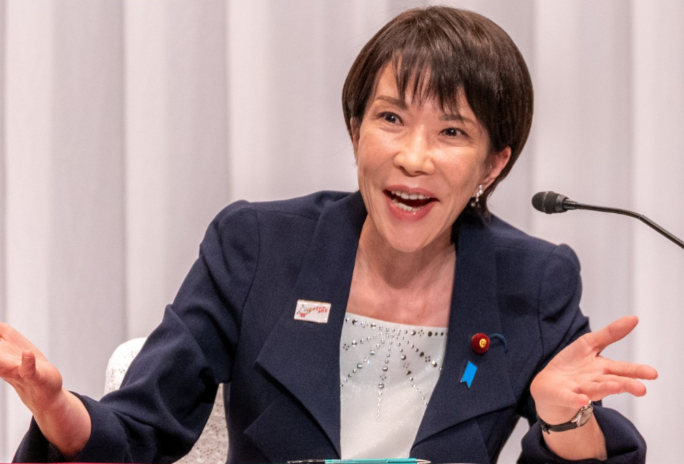
Takaichi has made no secret of her intent to build a “strong Japan” on this foundation. Her agenda, combining deregulation and longer working hours with a sweeping defense buildup, is becoming increasingly explicit. In her recent policy speech to an extraordinary session of the Diet, she pledged to accelerate Japan’s plan to raise defense spending to 2 percent of GDP by two years, framing economic revitalization and national security as two sides of the same coin. Her call to “abandon work-life balance” aims to reshape work culture, while the defense budget hike sends a message of unity and duty to the nation.
The “strong Japan” stance also aligns with a political realignment. Takaichi replaced the centrist Komeito with the more hardline Japan Innovation Party as the Liberal Democratic Party’s coalition partner, signaling a clear rightward shift. The two parties’ policy agreement includes early revision of Japan’s three key security documents, easing restrictions on arms exports, and tightening immigration controls—integrating economic independence with military expansion. Together, these measures fold defense strategy into national development policy, linking labor ethics and patriotism under a shared nationalist vision.
Critics warn that Takaichi’s hardline course will strain society. The Social Democratic Party argued that “loosening labor rules and raising defense spending simultaneously will only increase everyday burdens on citizens,” accusing the ruling coalition of using “strong Japan” rhetoric to distract from political funding scandals and falling approval ratings. Even so, Takaichi shows no sign of retreat, pushing her nationalist agenda forward through legislative and budgetary channels—anchored in a vision that binds labor and defense into a single national mission.
Niamh O’Sullivan is an Irish editor at The Economy, covering global policy and institutional reform. She studied sociology and European studies at Trinity College Dublin, and brings experience in translating academic and policy content for wider audiences. Her editorial work supports multilingual accessibility and contextual reporting.
Similar Post