Shaheen Project Emerges as a New Variable in Petrochemical Restructuring — NCC-Centered Industry Faces Inevitable Blow upon Completion Next Year

Anne-Marie Nicholson is a fearless reporter covering international markets and global economic shifts. With a background in international relations, she provides a nuanced perspective on trade policies, foreign investments, and macroeconomic developments. Quick-witted and always on the move, she delivers hard-hitting stories that connect the dots in an ever-changing global economy.
Authored On
Modified
S-Oil Set to Launch Korea’s First TC2C Plant Next Year
Direct Crude-to-Ethylene Conversion without Intermediate Processing
Major Variable amid Stalemate in Petrochemical Restructuring Efforts
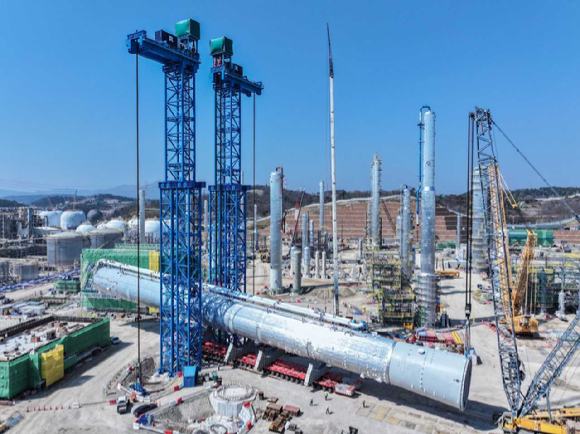
As S-Oil’s “Shaheen Project,” the largest petrochemical initiative in Korea with an investment of approximately $6.5 billion, approaches commercial operation next year, concerns are escalating across the domestic petrochemical industry. Despite the current market slump, driven by Chinese oversupply that has left major Korean petrochemical companies reporting consecutive losses, the Shaheen Project is deemed efficient enough to surpass the break-even point. Industry insiders warn that if new ethylene capacity comes online while restructuring efforts remain stalled, attempts to reduce output could be undermined — potentially pushing many petrochemical firms to the brink of insolvency.
Shaheen Project Maximizes Yield Advantage over Competitors
According to the petrochemical sector on the 27th, the Shaheen Project has reached about 85% completion and is on track to begin operations next year. Mechanical completion is expected by June, after which trial runs will commence before full-scale production. The project is an advanced petrochemical complex being built by S-Oil, involving a total investment of $6.6 billion and covering 880,000 square meters. It is the largest investment in Korea’s petrochemical history. Once operational, the facility will produce 1.8 million tons of ethylene annually, equivalent to nearly 15% of Korea’s total ethylene production of 12.95 million tons last year.
The Shaheen Project has been described within the industry as a “game changer,” given its revolutionary ethylene production process. Traditionally, ethylene was produced by processing naphtha, a byproduct of gasoline refining. However, Shaheen employs TC2C (Thermal Crude to Chemicals) technology, converting crude oil directly into naphtha and other petrochemical feedstocks. A senior petrochemical executive explained, “The yield of chemical feedstock from crude oil used to be around 20%, but with the TC2C process, it can reach up to 70%. This makes it possible to compete with low-cost ethylene producers in China.”
Korean petrochemical firms have long failed to initiate a meaningful industry overhaul, even as the market cycled through booms and busts. However, since the Shaheen Project began two years ago, urgency has intensified. With its imminent start-up, industry consensus has grown that countermeasures must be in place before cost competition becomes untenable. The government, too, is actively encouraging industrial restructuring. In August, it urged petrochemical firms to submit plans to cut up to 3.7 million tons of naphtha cracking capacity by year-end — equivalent to one-quarter of Korea’s total annual production capacity of 14.7 million tons.
A “Time Bomb” against Capacity Reduction Efforts
The scale of reduction presents a serious challenge. While facilities must be streamlined and output of oversupplied products curtailed, companies are increasingly alarmed that Shaheen’s exceptional efficiency could overwhelm competitors. According to government restructuring plans, the Yeosu industrial complex is expected to cut 1.2 to 1.5 million tons of capacity, Daesan 1.5 million tons, and Ulsan around 670,000 tons — representing a 20–30% reduction per site. Ulsan currently has a combined ethylene capacity of 1.76 million tons, distributed among Daelim Industrial (900,000 tons), SK Geocentric (660,000 tons), and S-Oil (200,000 tons).
When S-Oil brings its Shaheen facilities online, ethylene capacity will expand by another 1.8 million tons — surpassing Ulsan’s current total output. To meet the government’s reduction target, S-Oil would therefore have to share in production cuts. Industry sources note that S-Oil, having signed a memorandum of understanding (MOU) with SK Geocentric and Daelim Industrial in late September to jointly restructure Ulsan’s petrochemical cluster, was already expected to face reduction obligations.
However, S-Oil reportedly has no plans to scale back production. The company argues it cannot commit to capacity cuts before its new plant is even completed. Alternatives such as sourcing naphtha from Daelim Industrial or SK Innovation have been floated, but given that S-Oil imports low-cost crude from Aramco to maintain price competitiveness, such arrangements appear unlikely.
An S-Oil official stated, “The purpose of this industry-wide restructuring is not to simply shrink capacity, but to strengthen competitiveness. Reducing output alone doesn’t improve competitiveness.” The official added, “While the government is exploring structural reforms, S-Oil has already completed large-scale investments on its own. The Shaheen Project incorporates unmatched cost efficiency and operational excellence. It makes no sense to scale down such a competitive facility.”
Industry Raises Concerns over Lack of Support Measures and Fairness
Industry voices are growing louder against granting Shaheen an exemption. Many warn that S-Oil, with its cost advantage from direct crude procurement, could absorb market share from competitors forced to reduce production. In Ulsan alone, the ethylene capacities of Daelim Industrial and SK Geocentric stand at 900,000 tons and 660,000 tons, respectively. With Shaheen’s 1.8 million tons added — at 20–30% lower cost — the market balance could dramatically shift. Daelim Industrial, which has long sourced naphtha from S-Oil, must now seek alternative suppliers.
Given that other domestic petrochemical producers are bearing the burden of output cuts, fairness has become a central issue. One industry insider noted, “While companies are expected to voluntarily reduce capacity, S-Oil appears intent on completing the Shaheen Project and staying out of the reduction framework. If S-Oil is exempt, who else would agree to cut production?” Another executive added, “If S-Oil proceeds as planned while others make painful cuts, it will only benefit S-Oil. The entire reduction effort would be rendered meaningless.”
Some in the sector predict that shutdowns of naphtha cracking centers (NCCs) could accelerate. As TC2C technology becomes more common, it would allow direct petrochemical production without relying on NCC facilities. This could severely impact firms like Lotte Chemical, Hanwha TotalEnergies, and SK Geocentric — whose revenue depends heavily on basic feedstocks. Lotte Chemical, for example, earns $14 billion of its $20 billion in pre-adjustment revenue from basic materials, while Hanwha TotalEnergies derives $7 billion of $15 billion, and SK Geocentric $10 billion of $10 billion from the same segment. Although part of their cost pressure stems from increased imports of expensive Middle Eastern crude and naphtha following the Russia–Ukraine war, analysts agree that even post-war, these NCC firms will struggle to compete with TC2C technology. Under traditional methods, 10 tons of crude produce only 1 ton of feedstock, whereas TC2C yields 4–5 tons.
Given these circumstances, many in the market believe that voluntary restructuring agreements among firms by the government’s year-end deadline are unrealistic. A market observer commented, “The government has merely set the direction while leaving the burden of outcome entirely on private companies. With the industry already under severe financial strain, it’s impractical to expect firms to reach an agreement that sacrifices their own interests.” The government’s failure to specify detailed guidelines or support measures has also drawn criticism. Although it pledged incentives such as financial aid, tax relief, and deregulation for participating firms, the specifics of these policies remain undisclosed.
Anne-Marie Nicholson is a fearless reporter covering international markets and global economic shifts. With a background in international relations, she provides a nuanced perspective on trade policies, foreign investments, and macroeconomic developments. Quick-witted and always on the move, she delivers hard-hitting stories that connect the dots in an ever-changing global economy.
Similar Post