Europe Runs Out of Money and Consensus in Last-Ditch Struggle to Fund Ukraine

Authored On
Modified
Plan to Use Frozen Russian Assets Nears Collapse
Russia Faces Financial Crisis as Energy Exports Plunge
U.S. and Europe Renew Sanctions Coordination on Russian Oil
The European Union is approaching the limits of its financial capacity to sustain aid for Ukraine. Most member states have already exhausted their remaining budgets to assemble a new support program, but the plan’s cornerstone—using frozen Russian assets—has collapsed under Belgium’s opposition, leaving the bloc scrambling for alternatives. With discussions on issuing joint EU bonds stalled amid fiscal deficit concerns, Russia itself is also reeling from plunging energy revenues and mounting financial instability. Sensing an opening, the United States has stepped up sanctions targeting Russian oil exports in an effort to pressure Moscow toward negotiations.
Legal Risks Stall the Reparations Loan Plan
According to diplomatic sources on October 27, 26 of the EU’s 27 member states—excluding Hungary—met last week to discuss Ukraine’s financing needs. The joint statement released afterward urged the European Commission to “prepare possible financial support options as soon as possible.” This followed the collapse of the so-called “Reparations Loan” proposal, which aimed to provide Ukraine with interest-free loans backed by proceeds from frozen Russian central bank assets.
In July, the EU launched the Ukraine Investment Framework, channeling $2.7 billion into infrastructure reconstruction and small-business support. But projections showed that sustaining aid through 2026–2027 would be impossible without new funding sources. The Reparations Loan plan envisioned using part of the $163 billion in frozen Russian assets that had matured and become liquid, allowing the EU to lend these funds to Ukraine upfront. The loans would later be repaid through reparations from Russia after the war, easing Ukraine’s short-term fiscal strain while securing resources for postwar recovery.
Belgium, however, has firmly opposed the move. Most of the frozen Russian assets are held by Euroclear, the Brussels-based international securities depository. Belgian Prime Minister Alexander De Croo questioned who would bear the legal liability “if Russia demands the return of its assets after the war,” citing the legal risks and the potential for Belgium to share financial responsibility at a time when the government is in budget negotiations. France and Germany, wary of domestic political backlash, have also hesitated to support the measure, pushing the plan to the brink of collapse.
Some EU officials have floated issuing joint bonds as an alternative. Yet this approach would require far deeper political consensus than tapping Russian assets. Many member states are already struggling with ballooning deficits and debt, and collective borrowing would only heighten their political burdens. Analysts say the debate underscores the EU’s diminishing fiscal capacity, with officials acknowledging that the Reparations Loan remains the only realistic tool—though disagreements over legal liability continue to stall progress.
Russia’s Finances Crumbling Under Strain
Russia’s situation is scarcely better. Prolonged war and intensifying sanctions have left the country’s economy in a state of financial paralysis. In June, Bloomberg reported that even Russian regulators fear a “systemic banking crisis” could erupt within a year. Loan repayment rates by businesses and households have plunged, and nonperforming loans are soaring. The Russian credit rating agency ACRA warned that as much as $46.7 billion in loans—roughly 20% of total banking capital—could go bad.
The country’s energy sector, the backbone of its economy, is also faltering. According to the Russian finance ministry, oil and gas exports in July fell 27% year-on-year to $9.9 billion, while cumulative exports from January to July dropped 19% to $27.6 billion. Europe’s share of Russian gas imports has plunged from 45% in 2021 to just 13% this year. Price caps imposed by the U.S. and Europe have pushed Russian crude to trade more than $11.50 below international benchmarks, fueling forecasts that global oil prices could fall into the $40 range by 2026.
Production costs further erode Russia’s profitability. While Saudi Arabia produces oil at about $10 per barrel, Russia’s onshore and offshore costs reach $42 and $44, respectively. Many Siberian fields have already become unprofitable, and large sections of the region’s 65-year-old pipeline network have shut down under EU embargoes. The collapse of the once-mighty Soviet-era energy export system has effectively paralyzed Russia’s foreign currency income.
Moscow’s pledge to ease corporate taxes may offer temporary relief to businesses, but it also drains state revenue, further limiting wartime funding. The economy now faces the triple strain of high interest rates, shrinking income, and rising debt. Corporate lending by Russian banks fell by $26 billion in just the first two months of this year, and one in six large firms now spends over a third of its pre-tax profits on interest payments. With energy revenues collapsing and financial stability eroding, Russia is running out of money to sustain the war.
U.S.-China Dynamics Shape the Endgame
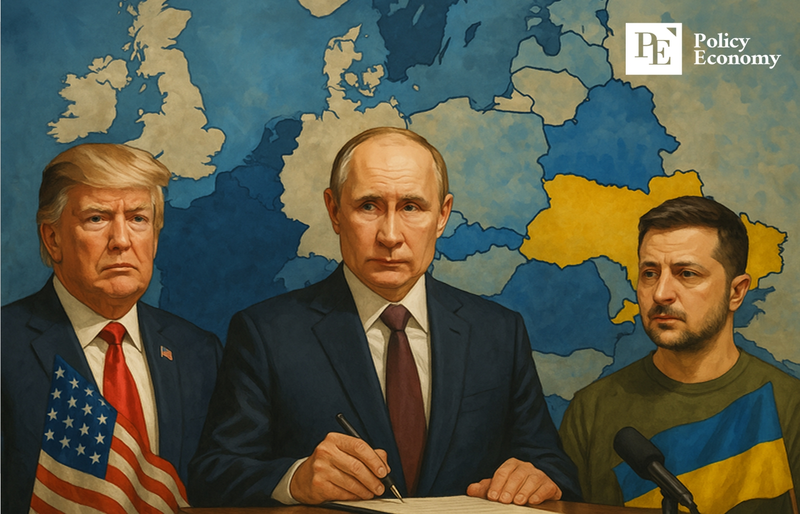
Against this backdrop, the United States has emerged as the decisive force shaping the next phase of the war. President Donald Trump recently expanded sanctions to include Russia’s major oil producers, Rosneft and Lukoil, directly targeting the country’s financial lifeline. The new measures also extend secondary sanctions to intermediary banks, effectively blocking Moscow’s global payment routes. President Vladimir Putin has insisted that the sanctions will not inflict “major damage” on the Russian economy, but with interest rates at 17%, inflation at 8%, labor shortages, and wartime austerity, most analysts believe Russia has reached its limit.
Europe and the United Kingdom have joined Washington in reviving a unified sanctions front. The EU has pledged to end all imports of Russian liquefied natural gas by 2027 and added more than 100 “shadow fleet” tankers to its blacklist. It has also sanctioned refineries, shipping companies, and financial institutions in third countries found to be re-exporting Russian oil. Britain, for its part, has targeted vessels tied to Russian energy giants. The alignment marks the first major restoration of U.S.-European coordination since the start of Trump’s second administration.
The key uncertainty lies in the “China factor.” To circumvent Western sanctions, Russia has been selling discounted crude to China and India, with China importing over 100 million tons last year to become its largest buyer, and India purchasing another 80 million tons. Washington’s latest sanctions include secondary penalties for Chinese and Indian refiners and banks, prompting Beijing to denounce the move as a “violation of international law.” Should China scale back energy transactions to gain leverage in tariff negotiations with the U.S., Russia’s export channels could shrink dramatically. But if Beijing maintains current trade flows, the West’s sanctions pressure would remain limited.
These shifting dynamics will heavily influence the war’s trajectory. Ukraine has warned that without new funding, its finances will be depleted by the first quarter of next year. Europe’s fiscal capacity is also nearing exhaustion, while Russia faces collapsing export revenues and a fragile banking system. As the U.S. and Europe tighten the screws on Moscow’s energy income to force peace talks, China continues to weigh its economic interests against geopolitical risks. The war between Russia and Ukraine is increasingly defined not by the exchange of bullets, but by the struggle over financial lifelines.
Similar Post