Argentina’s Midterm Election Also Shows ‘Trump Power’: Milei’s Ruling Party Stages Dramatic Comeback After a Month of Defeat

Matthew Reuter is a senior economic correspondent at The Economy, where he covers global financial markets, emerging technologies, and cross-border trade dynamics. With over a decade of experience reporting from major financial hubs—including London, New York, and Hong Kong—Matthew has developed a reputation for breaking complex economic stories into sharp, accessible narratives. Before joining The Economy, he worked at a leading European financial daily, where his investigative reporting on post-crisis banking reforms earned him recognition from the European Press Association. A graduate of the London School of Economics, Matthew holds dual degrees in economics and international relations. He is particularly interested in how data science and AI are reshaping market analysis and policymaking, often blending quantitative insights into his articles. Outside journalism, Matthew frequently moderates panels at global finance summits and guest lectures on financial journalism at top universities.
Authored On
Modified
Ruling Party Overtakes Opposition in Reversal of Polls
Trump Promises $40 Billion Currency Swap
“Support Will Be Withdrawn If Milei Loses,” He Warns

Argentine President Javier Milei, often dubbed the “Trump of Argentina,” has led his far-right ruling party, La Libertad Avanza (Freedom Advances), to victory in the country’s midterm elections. Pre-election polls had overwhelmingly predicted a win for the left-wing Peronist Union — the opposition bloc following former President Juan Perón’s populist line — but the outcome turned out to be the opposite. Analysts say the decisive factor was U.S. President Donald Trump’s overt and forceful backing of Milei, which critics called “foreign interference” but proved highly effective in swaying Argentine voters.
Ruling Party Wins Unexpectedly in Both Houses
According to Argentina’s election authority on the 26th (local time), of the 35.7 million eligible voters, 24.2 million (67% turnout) cast their ballots in the congressional elections. La Libertad Avanza secured 40.6% of the vote, defeating the Peronist Union, which managed only 24.3%. While the ruling party did not secure an absolute majority, it comfortably reached its target of controlling at least one-third of the 257-seat Lower House — enough to block the opposition’s attempts to reject government bills or override vetoes. In the 72-seat Senate, the ruling party is projected to hold around 20 seats, giving it greater leverage in legislative negotiations.
The ruling bloc also achieved a significant breakthrough in Buenos Aires Province, traditionally a leftist stronghold. It narrowly defeated the opposition bloc (41.5% to 40.8%), with a margin of less than one percentage point. Celebrating the win at his party headquarters in Buenos Aires, President Milei declared, “Today is a day of freedom to make Argentina great again,” thanking “the people who believe in liberty and responsibility.” He vowed, “Reform cannot and will not stop,” adding that his administration and party would actively engage centrist minor-party lawmakers in both chambers to advance the reform agenda.
Defeat in Local Elections and Scandal Cast a Shadow Before the Vote
Local media described the midterm result as “wholly unexpected.” Just weeks earlier, Milei had faced rising public discontent. Since taking office in 2023 on a pledge to eradicate Peronist populism through his so-called “chainsaw reform,” he has pursued aggressive austerity — slashing government spending, shrinking the number of ministries from 18 to 9, cutting subsidies, and driving the fiscal deficit to zero. His trademark slogan, “¡Viva la libertad, carajo!” (“Long live damn liberty!”), became a rallying cry. Inflation, once soaring above 25%, has recently fallen to 2–3% per month, and the government continues to post budget surpluses.
Yet backlash grew among lower-income groups hit hardest by cuts to welfare and a rising jobless rate, while the reduction in public spending slowed economic growth. Although annual inflation plunged from 289% in April 2024 to around 34% by August this year, real wages remain below pre-Milei levels.
Argentina’s foreign reserves have also been virtually depleted. Of its remaining funds, the bulk consists of the $20 billion loan received from the International Monetary Fund (IMF) in April. The government now has few tools left to defend the peso should the exchange rate spike. Compounding matters, a corruption scandal involving the president’s sister and chief of staff, Karina Milei, erupted after leaked audio recordings suggested she accepted large bribes — fueling anti-Milei sentiment nationwide.
The scandal contributed to the ruling party’s crushing defeat in last month’s Buenos Aires Province election, which serves as a bellwether for national trends. Following that loss, Argentina’s economy tumbled: the peso fell 4%, and sovereign bond prices plunged. Milei, acknowledging the setback, canceled overseas trips and convened an emergency cabinet meeting at the presidential palace.
Trump: “The Right Must Win for Support to Continue”
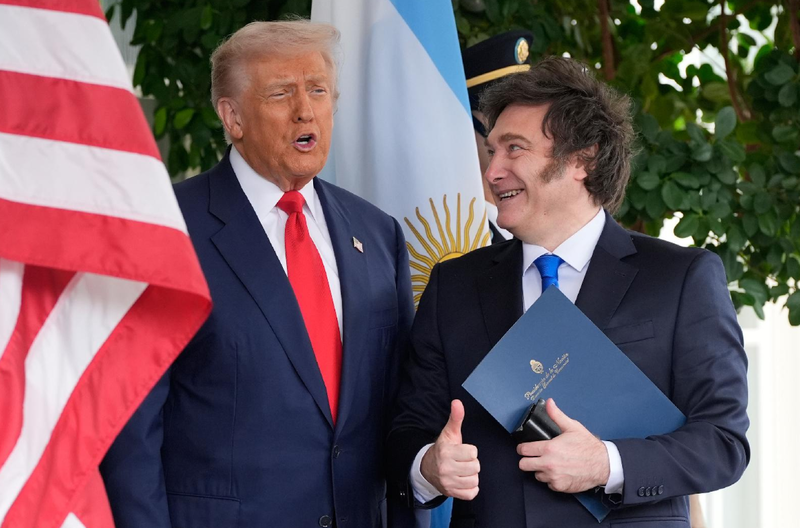
Amid this turmoil, President Trump extended a lifeline. He offered an extraordinary $40 billion (approximately $57.3 billion) support package — on the condition of Milei’s victory. During their White House meeting on October 14, Trump told aides, “We are here to support Milei in the upcoming election. If he loses, it will be difficult to help Argentina,” in what observers interpreted as an explicit endorsement.
Trump went on, “President Milei will be competing against the far-left forces that got Argentina into this mess in the first place. If he loses, there’s no reason for us to be generous with Argentina.” U.S. Treasury Secretary Scott Besant, who attended the meeting, added, “If Argentina returns to the failed policies of Peronism, the United States will reconsider its position.” The remarks fueled talk in Buenos Aires that “the U.S. has $20 billion riding on this election.”
When the results were announced, Trump posted on Truth Social, “Congratulations to Milei on his overwhelming victory. Our faith in him has been validated by the Argentine people.” The conservative Heritage Foundation commented that the outcome demonstrated how nations aligning closely with Washington could secure tangible benefits. Meanwhile, Trump has intensified pressure on anti-U.S. governments in Venezuela and Colombia.
Responding to Trump’s message, Milei wrote, “Thank you for believing in the people of Argentina,” calling him “a great friend of the Argentine Republic and an unbreakable ally.” He added, “We will fight for Western civilization, which has lifted over 90% of humanity out of poverty,” underscoring their shared ideological bond.
Currently, Trump continues to step up actions against leftist regimes in Latin America. Senator Lindsey Graham, one of his closest allies, said on the 26th that “the president will soon brief lawmakers on potential military operations against Venezuela and Colombia.” According to AFP and other outlets, the U.S. Navy destroyer USS Gravely docked that same day at Port of Spain, the capital of Trinidad and Tobago, near Venezuela.
Matthew Reuter is a senior economic correspondent at The Economy, where he covers global financial markets, emerging technologies, and cross-border trade dynamics. With over a decade of experience reporting from major financial hubs—including London, New York, and Hong Kong—Matthew has developed a reputation for breaking complex economic stories into sharp, accessible narratives. Before joining The Economy, he worked at a leading European financial daily, where his investigative reporting on post-crisis banking reforms earned him recognition from the European Press Association. A graduate of the London School of Economics, Matthew holds dual degrees in economics and international relations. He is particularly interested in how data science and AI are reshaping market analysis and policymaking, often blending quantitative insights into his articles. Outside journalism, Matthew frequently moderates panels at global finance summits and guest lectures on financial journalism at top universities.
Similar Post