“iPhone 17’s Eyes Are Made in Korea”: Samsung and LG to Supply Virtually All Apple Panels

Authored On
Modified
Korea Takes 98% of Next-Gen iPhone OLED
Post-LTPO Technology Extends Korea’s Lead
“From a volume race to a contest of technological leadership”
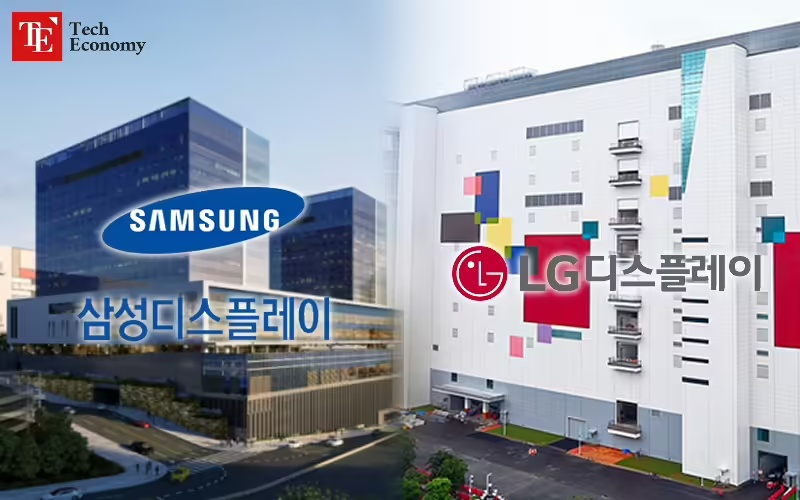
Apple has effectively handed the entire order book for the iPhone 17 series’ OLED displays to Korean suppliers, reshaping its supply chain. Samsung Display and LG Display account for 98% of total volumes, while China’s BOE, dogged by quality issues, is stuck at a little over 1% and is for all intents and purposes out. With unstable yields and luminance inconsistencies widening the gap, Apple’s confidence has swung back toward Korea. Industry voices say the “technological gap is rewriting market order,” adding that “the iPhone’s eyes have ultimately returned to Korea.”
BOE Falls Behind in LTPO Technology
According to global market researcher UBI Research, OLED panels deployed for the iPhone 17 series from early this year through this month are estimated at 88.9 million units. In that span, Samsung Display shipped about 57.3 million panels to Apple for a 64.5% share. LG Display followed with roughly 30.3 million units (34.1%), while BOE managed about 1.3 million (1.4%). These figures indicate that Apple’s long-standing three-way panel sourcing among Samsung Display, LG Display, and BOE has effectively consolidated into a Samsung Display + LG Display system.
The industry views the outcome as the first official case in which a “technology gap, not sheer volume, reset the market order.” For the first time across all four iPhone 17 models (Air, base, Pro, Pro Max), Apple adopted low-temperature polycrystalline oxide (LTPO) OLED. LTPO automatically adjusts refresh rates and can cut power consumption by up to 20%. BOE had targeted year-end certification and floated a 3-million-unit supply outlook, but repeated failures to secure uniform luminance and stable drive yields within the LTPO process left it short of Apple’s quality threshold. As a result, LG Display is taking over all volumes BOE was slated to supply.
In the meantime, the two Korean firms perfectly divided roles to boost supply-chain stability. Samsung Display supplies panels for all four models, anchoring a “volume-centric” procurement structure. LG Display focuses on the Air, base, and Pro Max models to establish a “high-ASP-centric” structure. Notably, the Pro Max panel is said to be priced as high as $70—about 1.5 times the base model’s roughly $40. In practical terms, Samsung Display serves as Apple’s main source on the strength of large capacity and delivery reliability, while LG Display lifts profitability through the premium lineup. The industry defines this as “a structure in which Korea fully neutralizes BOE risk.”
Will Tandem OLED Become Apple’s Next Card?
LG Display plans to push OLED technology one step further and has formally proposed adopting Tandem OLED to Apple. Tandem OLED stacks two or more emissive layers, delivering higher brightness at the same power while slowing burn-in and degradation. According to industry accounts, LG Display first pitched the approach late last year, and Apple subsequently sounded out Samsung Display on equivalent capabilities. Because a single-vendor setup would weaken its pricing leverage, Apple is seen as weighing the retention of at least two qualified suppliers.
Apple is already testing Tandem OLED across IT devices, including tablets. The OLED iPad introduced last year adopted a two-tandem structure that stacks all RGB subpixels in two layers, with a substantial portion sourced from LG Display. LG Display also has mass-production experience with two-tandem structures in automotive OLED. Given Apple’s characteristically conservative decision-making, however, new iPhone display architectures typically undergo a minimum of two years of development and validation, making mass-production adoption of iPhone-class Tandem OLED likely only after 2028. Until then, LG Display intends to cement its position in Apple’s supply chain by expanding dedicated lines, improving panel cost structures, and increasing share in premium tiers.
Samsung Display, for its part, is also moving to lock in leadership in Apple’s next-generation hardware. Tech outlet DigiTimes reported last month that “Apple is developing an inward-folding foldable iPhone for a 2026 launch target, with initial OLED panels set to be supplied exclusively by Samsung Display.” Because foldable panels must withstand repeated bending, they face the complex challenge of maximizing both durability and thinness. Samsung Display plans to pair LTPO-based TFT technology with Color on Encapsulation (CoE), which removes the polarizer, to deliver thinner, brighter panels with lower power draw.
To back this up, Samsung Display is proactively securing its “home turf” on the volume side. It is building an Apple-dedicated line at its A3 plant in Asan, South Chungcheong Province, aiming to expand capacity to 30,000 sheets per month by the second quarter of 2026. With annual output potential of 7–8 million panels, the plan aligns precisely with Apple’s initial order volumes. The line is expected to account for about 40% of Samsung Display’s total foldable panel shipments, lifting its share of the foldable OLED market from the 40% range to roughly 52% and widening the gap with rivals.
Acceleration of a Technology-Centered Quality Shift
Zooming out to the broader OLED market, the industry is in a transition from the 7th to the 8th generation. The competitive focus is narrowing to which players can produce high-quality panels more efficiently. Eighth-generation OLED uses glass substrates measuring 2,200×2,500 mm—about 2.2 times larger than the previous 1,500×1,850 mm—improving production efficiency and suiting mass production of large IT and TV panels. The Gen-8 shift thus marks a move from a volume race to a contest of technological leadership. Korean vendors’ full pivot from LCD to OLED likewise reads as an effort to upgrade the industry’s fundamentals.
LG Display is at the forefront of this structural shift. At the 16th Display Day ceremony held on the 26th of last month at Lotte Hotel World in Songpa-gu, Seoul, CEO Jeong Cheol-dong declared, “The future of displays is OLED,” formalizing a technology-centric strategy. The company has also proven the payoff from its OLED transition in mobile and TV with results. Based on FnGuide, LG Display’s third-quarter operating-profit consensus stands at about $311 million, nearly double the estimate from six months earlier (about $160 million). The market increasingly views the company as having climbed to a level where it can sustain an annual profit on OLED alone, rather than being buffeted by the LCD cycle.
Samsung Display is likewise shifting its technological axis toward large-format and IT panels. By expanding TV-class quantum-dot (QD) OLED and IT OLED lines for notebooks and tablets, it is pursuing a higher-margin model anchored in panel quality and power efficiency. Second-half operating profit is projected to reach up to about $1.0 billion, with an operating margin expected to stay above 15%. The industry anticipates that Samsung Electronics will accelerate OLED TV mainstreaming by broadening its QD-OLED TV lineup. Research firm Omdia forecasts that in the premium TV segment priced at $750 and above, OLED’s revenue share will rise from 29.9% this year to 32.7% next year, while premium LCD’s share will slip into the 60% range.
Experts characterize the shift from LCD price competition to OLED quality competition as a “Korean survival strategy.” While Chinese players such as BOE and CSOT continue low-price battles that sustain losses, Korean companies are moving the game to technology-driven profitability. “The display market is passing through a moment when transitions in generations, processes, and form factors are unfolding simultaneously,” said one industry official. “Korea now views the display market not as a volume-centric contest, but as an industry where technological leadership defines the competition.”
Similar Post