South Korea–China Summit: Progress in Economic and Livelihood Cooperation, but No Movement on Lifting the Hallyu Ban

Authored On
Modified
South Korea and China to Accelerate Second-Phase FTA Talks
Focus on Livelihood Sectors such as Silver Economy, Startups, and Export Quarantine
No Substantial Progress on Lifting the Hallyu Ban
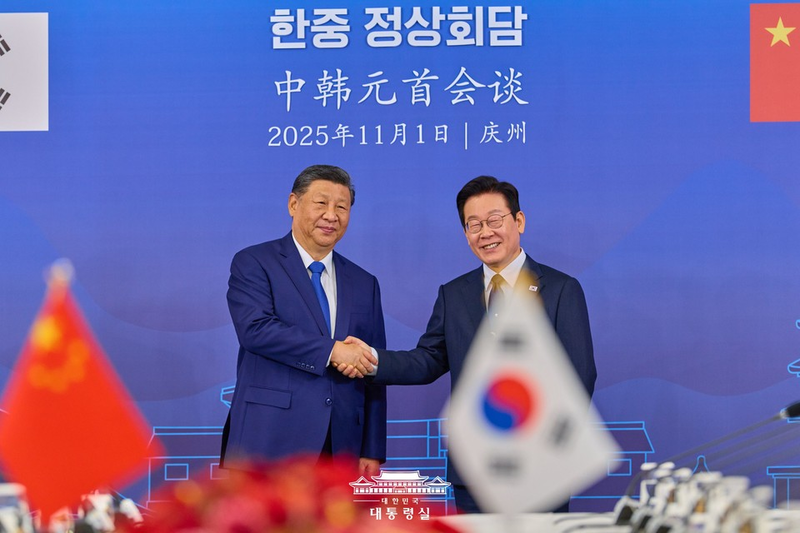
President Lee Jae-myung and President Xi Jinping held their first summit over the weekend on the sidelines of the Asia-Pacific Economic Cooperation (APEC) summit, seeking to restore relations between Seoul and Beijing. The key link in this effort is the expansion of economic cooperation. Both sides agreed to accelerate negotiations on the service and investment chapters of the Korea-China Free Trade Agreement (FTA) and to cooperate on stabilizing supply chains. However, discussions on lifting the “Hallyu ban” (restrictions on Korean cultural content) did not make it onto the table, remaining a lingering issue. Analysts attribute this to China’s “infant industry protection” policy, which prioritizes regime cohesion and domestic industrial growth over external liberalization, extending beyond the THAAD (Terminal High Altitude Area Defense) dispute.
Accelerating FTA Service and Investment Negotiations
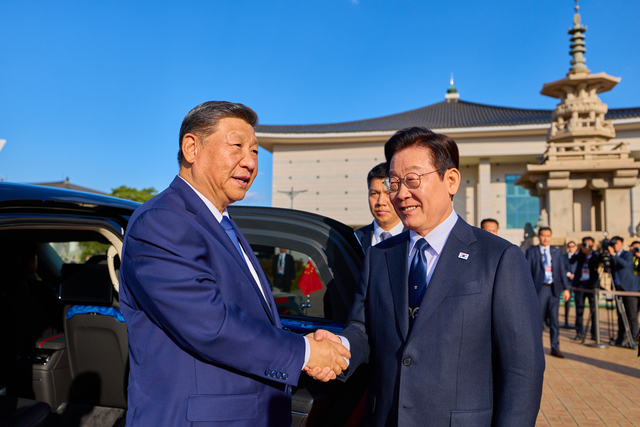
According to the Presidential Office on November 3, President Lee and President Xi exchanged six memoranda of understanding (MOUs) and one contract during their summit at the Gyeongju National Museum on November 1. The two countries first signed an “MOU on Cooperation in Combating Voice Phishing and Online Fraud Crimes,” laying the groundwork for joint responses by law enforcement authorities to transnational scam crimes. Recent reports have highlighted that Korean nationals have fallen victim to online scam operations in countries such as Cambodia, with alleged involvement of Chinese criminal networks. Beijing is said to view this issue with growing seriousness.
The two leaders also signed an “MOU on Strengthening Exchanges and Cooperation in Trade in Services,” intended to institutionalize economic cooperation by making tangible progress in FTA service and investment negotiations. Since concluding the FTA in 2015—which opened their goods trade sectors—both sides have been pursuing a “second phase” since 2017, aiming to expand it into services, investment, culture, and financial services.
Additional MOUs were exchanged covering the “Silver Economy,” a “Partnership Program for Innovative Startups,” and “Plant Quarantine Requirements for Fresh Persimmon Exports from Korea to China.” The Presidential Office explained that these agreements are “designed to advance forward-looking cooperation that tangibly benefits the livelihoods of both nations’ citizens.” The two governments also signed the “Korea-China Joint Economic Cooperation Plan (2026–2030) MOU,” setting a long-term direction for mutually beneficial collaboration.
Furthermore, the two central banks exchanged a renewed five-year “currency swap contract” worth $50 billion, equivalent to about $280 billion in total since its inception. The original swap, first established in 2009, was valued at $25 billion, then expanded to $50 billion in 2011 amid the European debt crisis. It was renewed again in 2020 and has now been extended under similar terms. The Presidential Office stated that the arrangement “is expected to contribute to financial and foreign exchange market stability and to promote bilateral trade.”
No Breakthrough on the Hallyu Ban
While the summit produced tangible outcomes in economic and livelihood cooperation, there was no progress on lifting China’s ban on Korean pop culture—the so-called Hallyu ban—which continues to hinder broader cultural and business exchanges. Ahead of Xi’s first visit to Korea in 11 years, ruling-party officials had suggested that Beijing might consider easing the restrictions. China imposed the ban in retaliation for the deployment of the U.S. THAAD missile defense system in South Korea in 2016, effectively prohibiting the broadcasting of Korean dramas and the staging of K-pop concerts.
In October 2017, during the Moon Jae-in administration, Seoul reaffirmed its “Three No’s” policy—no participation in the U.S. missile defense network, no additional THAAD deployments, and no trilateral military alliance with the U.S. and Japan—after which both governments agreed to “normalize exchanges and cooperation across all sectors.” Although sales of group travel packages to Korea have since resumed, restrictions on large-scale K-pop concerts and Korean films or dramas remain in effect. Even this year, a planned K-pop concert in China was abruptly canceled at the last minute.
During the summit, an unexpected moment drew attention when President Lee, President Xi, and J.Y. Park, chairman of the Korea-China Cultural Exchange Committee, discussed the idea of holding a large-scale concert in Beijing. Xi reportedly called in Foreign Minister Wang Yi to discuss the suggestion, sparking speculation that Beijing might finally open the door to K-culture. However, sources later confirmed that the Chinese side made no concrete commitment to lifting the ban during the official talks.
Strategic Blockade Based on “Infant Industry Protection”
Diplomatic analysts interpret Beijing’s continued enforcement of the Hallyu ban through the lens of its industrial strategy. Believing that China’s entertainment industry is not yet mature, the government seeks to shield it from foreign competition—particularly from Korea’s highly developed content sector. Moreover, industrial policies emphasizing “Chinese identity” and “socialist characteristics” have reinforced this protectionist stance. Since 2012, under the Xi-Li administration, China has promoted a cultural-industrial policy focused on cultivating domestic content rooted in traditional Chinese culture and ideology, viewing culture as a tool for internal cohesion rather than export growth.
In contrast, Korean cultural exports represent the opposite philosophy. K-pop celebrates personal freedom, aspiration, and happiness—values that often clash with Beijing’s ideological control. For Chinese authorities, the sight of young people gathering en masse at such performances is politically uncomfortable. This sensitivity extends to Western artists as well. Regulatory agencies such as the National Radio and Television Administration (NRTA) and provincial governments retain broad discretion to cancel or deny performance permits without recourse. Beijing’s recent statements about “allowing excellent content” fall within the same restrictive framework.
A foreign policy expert noted, “Even before the THAAD dispute, China had already begun to tighten controls on Korean content,” adding, “The removal of THAAD itself would not fundamentally change this dynamic.” He further emphasized, “China’s cultural-industrial policy remains firmly in place, making the situation inherently unpredictable. While private companies and fans may desire Korean content, the authorities’ stance will continue to determine the extent of access.”
Similar Post