“Changing Face of K-Tourism” — From Duty-Free Stores to ‘OlDaAmu,’ Goshiwons Gain Popularity Among Long-Stay Visitors

Matthew Reuter is a senior economic correspondent at The Economy, where he covers global financial markets, emerging technologies, and cross-border trade dynamics. With over a decade of experience reporting from major financial hubs—including London, New York, and Hong Kong—Matthew has developed a reputation for breaking complex economic stories into sharp, accessible narratives. Before joining The Economy, he worked at a leading European financial daily, where his investigative reporting on post-crisis banking reforms earned him recognition from the European Press Association. A graduate of the London School of Economics, Matthew holds dual degrees in economics and international relations. He is particularly interested in how data science and AI are reshaping market analysis and policymaking, often blending quantitative insights into his articles. Outside journalism, Matthew frequently moderates panels at global finance summits and guest lectures on financial journalism at top universities.
Authored On
Modified
Surging Chinese arrivals push annual visitor count toward 20 million
Shift from group tours to independent travelers redirects spending to road shops
Popularity of K-content fuels rise in long-term stays among foreign tourists
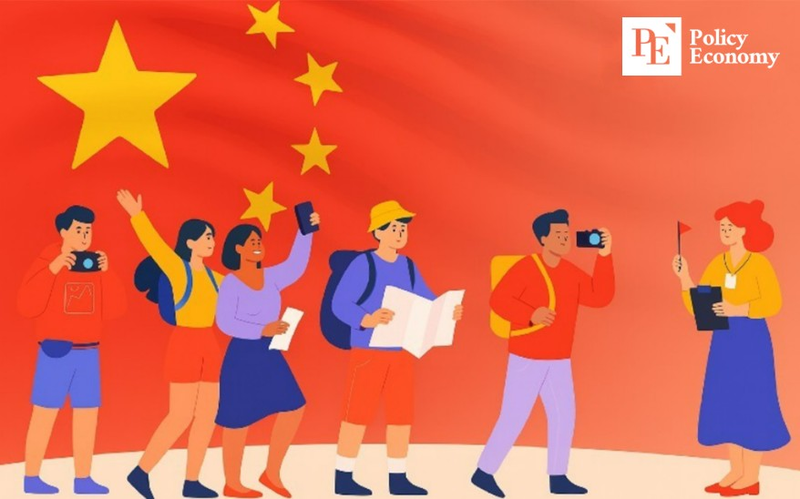
South Korea’s inbound tourism industry is on the brink of surpassing 20 million visitors this year, nearing pre-pandemic levels. The surge has been largely driven by the temporary visa-free policy for Chinese tourists implemented in late September, with the industry anticipating a record-breaking year. The travel landscape, however, has changed significantly. Group tours have declined while individual travel has become mainstream, shifting spending patterns from duty-free outlets to road shops such as Olive Young and Daiso, as well as local experiences. Coupled with the global spread of K-content, long-stay tourism—where visitors immerse themselves in local life—has emerged as a new trend.
Inbound Visitors Up 16.7% from Pre-Pandemic Levels
According to the Korea Tourism Organization, the number of inbound tourists between January and September reached 14.08 million, a 16.7% increase from the same period in 2019, before the pandemic. This figure also represents a 16% rise from last year’s 12.13 million. In September alone, more than 1.7 million foreigners visited Korea. By country, China accounted for the largest share with 503,000 visitors, followed by Japan (371,000), Taiwan (155,000), the United States (122,000), and the Philippines (48,000). With the temporary visa-free measure spurring a surge in Chinese tourists, the industry expects not only a new all-time high but also a possible breakthrough of 20 million visitors—surpassing the previous record of 17.5 million in 2019.
While the number of visitors has sharply increased, their travel behavior has changed considerably. The proportion of group tours fell from 15.1% in 2019 to 8.6% in the first quarter of this year, while individual travel rose from 77.1% to 82.9% during the same period. As group tours declined, shopping—once the core activity of inbound tourism—also weakened. In 2019, 92.5% of visitors cited shopping as a major activity, but that figure dropped to 79.4% in the first quarter of 2025. On a per-capita basis, foreign tourists spent an average of $1,012 during the first half of this year, down 17.4% from $1,255 in 2019. Total tourism revenue likewise declined 13.6% over the same period, to $8.94 billion. The industry’s quantitative growth has yet to translate into profitability.
The downturn in group travel and weakened shopping activity has dealt a heavy blow to the duty-free sector, once hailed as a “golden goose” of the tourism industry. On October 30, Shinsegae Duty Free announced that it would suspend operations for its DF2 concession (covering cosmetics, perfume, liquor, and tobacco) at Incheon International Airport. Earlier, on October 18, Shilla Duty Free had already relinquished its DF1 concession. Despite facing a combined $140 million in penalty fees, operators opted to withdraw, judging that potential losses would far exceed the penalties. Major duty-free stores at Incheon Airport are estimated to be losing between $4.3 million and $5.8 million per month.
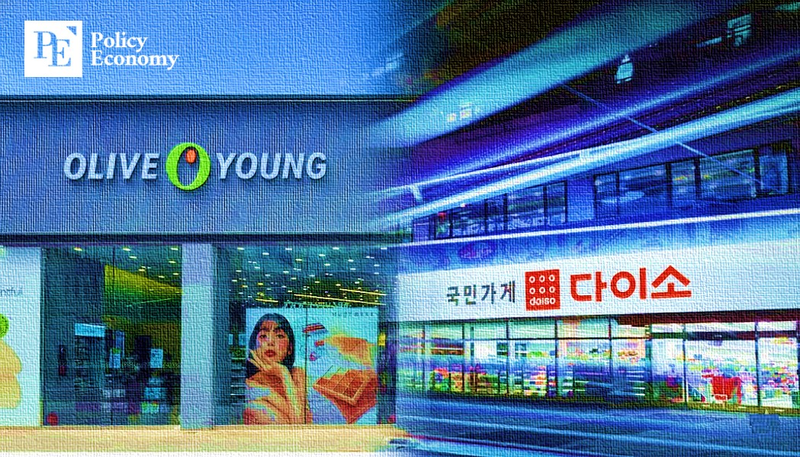
Road Shops Rise as Duty-Free Stores Fade
Replacing the once-booming duty-free stores are Korea’s street-level retail chains. Amid global economic uncertainty, tourists have shifted from luxury goods to high-value, affordable items. The nationalities of visitors have also diversified beyond China to include those from Southeast Asia (Thailand, Indonesia, Malaysia), North America (the United States and Canada), and Europe (France, Italy, Denmark). In response, road shops in key shopping districts such as Myeong-dong and Hongdae are enhancing experiential retail formats and expanding convenient payment options to attract international visitors.
Olive Young, Daiso, Artbox, and Musinsa—collectively dubbed “OlDaAmu”—have become must-visit spots for travelers seeking a taste of Korean trends and local shopping culture. Olive Young, known as the “mecca of K-beauty,” offers premium skincare and sunscreen products at reasonable prices, while Musinsa Standard represents the forefront of Korean fashion. Having evolved from an online fashion platform, Musinsa has expanded its offline presence since opening its first Musinsa Standard store in Hongdae in 2021, now operating locations in Myeong-dong and Seongsu to attract growing numbers of foreign shoppers.
Daiso has cemented its status as a “budget shopping hotspot,” selling more than 30,000 different products—ranging from cosmetics to household goods—priced mostly under $4. This affordability has made it a must-stop destination for Japanese and Southeast Asian tourists. Meanwhile, Artbox has emerged as a new favorite among K-fans as the “home of Korean stationery and lifestyle goods.” As a fully domestic brand that manages the entire process from product design to retail, Artbox operates with SPA-like agility, quickly adapting to shifting consumer trends.
Recently, foreign tourists’ shopping preferences have expanded from “OlDaAmu” to local pharmacies. Demand has surged for beauty products classified as over-the-counter items, such as scar-healing creams and acne treatments. A travel platform’s new “K-Pharmacy Tour” package saw bookings rise 44% within just two weeks of launch, with the largest increases from Singapore (121%) and Hong Kong (96%). The most sought-after products are cosmeceuticals—skincare products that blur the line between cosmetics and pharmaceuticals—led by the “salmon cream” brand Rejuol, which has become a viral bestseller.
‘Seoul Living’ Trend Drives Long-Stay Tourism
The growing global fascination with Korean culture has prompted more travelers to opt for extended stays rather than short-term visits. This trend has been fueled by the worldwide popularity of K-content—from BTS to hit series like Demon Hunters—and further accelerated by the rise of remote work. With its high-speed internet, strong public safety, and well-developed urban infrastructure, Korea has become one of the most attractive destinations for digital nomads and remote workers. The government has also introduced a “digital nomad visa,” allowing foreigners to live and work remotely in Korea for up to one year.
Long-stay visitors increasingly seek to “live like locals.” Their interests are shifting away from iconic landmarks toward neighborhood-based lifestyles. Seoul’s Seongsu-dong exemplifies this shift. In August alone, 435,000 foreign tourists visited the district—a 70% year-on-year increase. The area’s repurposed industrial alleys now teem with cafés, select shops, and artisan studios frequented by international visitors. Social media platforms such as Instagram, YouTube, and TikTok have amplified this movement, with hashtags like #SeoulLiving and #BusanLife spreading first-hand accounts that inspire even more long-term stays.
The rise of long-stay tourism is also reshaping Korea’s accommodation industry. Instead of hotels, visitors are choosing residential-style options that combine private spaces with communal living—such as goshiwons (small study residences), shared houses, micro-residences, and hanok stays. Among these, goshiwons have emerged as a new favorite among foreign tourists in their 20s and 30s. Viral social media clips promoting “One Month in Seoul for $300” have further boosted their appeal. Though small, goshiwons offer private rooms with basic amenities and secure door-lock systems, making them an affordable and practical alternative for visitors seeking to experience everyday life in Korea.
Matthew Reuter is a senior economic correspondent at The Economy, where he covers global financial markets, emerging technologies, and cross-border trade dynamics. With over a decade of experience reporting from major financial hubs—including London, New York, and Hong Kong—Matthew has developed a reputation for breaking complex economic stories into sharp, accessible narratives. Before joining The Economy, he worked at a leading European financial daily, where his investigative reporting on post-crisis banking reforms earned him recognition from the European Press Association. A graduate of the London School of Economics, Matthew holds dual degrees in economics and international relations. He is particularly interested in how data science and AI are reshaping market analysis and policymaking, often blending quantitative insights into his articles. Outside journalism, Matthew frequently moderates panels at global finance summits and guest lectures on financial journalism at top universities.
Similar Post