Backed by State Support, China’s Pharma and Biotech Industries Emerge as Global Innovation Leaders

Aoife Brennan is a contributing writer for The Economy, with a focus on education, youth, and societal change. Based in Limerick, she holds a degree in political communication from Queen’s University Belfast. Aoife’s work draws connections between cultural narratives and public discourse in Europe and Asia.
Authored On
Modified
China’s Pharma and Biotech Sector Builds Technological Edge Backed by State Support
Firms Move Aggressively to Raise Capital Through IPOs and Licensing Deals
From Generic Manufacturing to Innovation Leadership, Industry Set for Rapid Revenue Growth
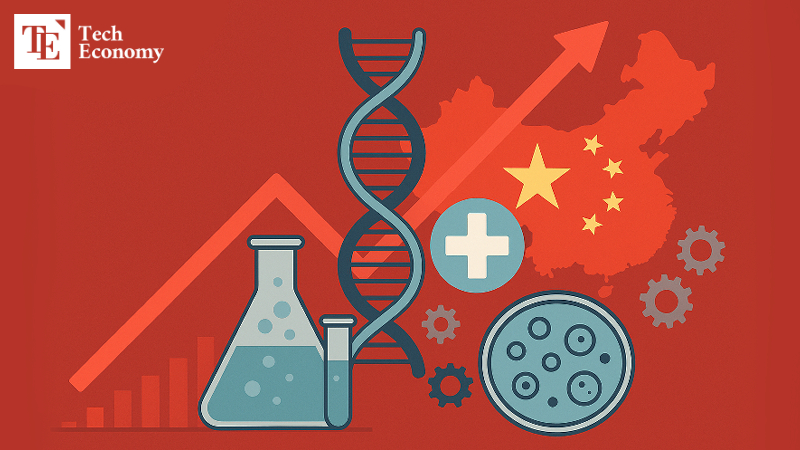
China’s pharmaceutical and biotechnology industries are experiencing explosive growth, fueled by aggressive government support and rapid capital raising through IPOs and other financing channels. Analysts say China is on track to sustain this momentum and emerge as a new center of gravity in the global pharma and biotech market.
China’s Pharma and Biotech Industries Accelerate Their Global Rise
According to industry sources on the 11th, China’s pharmaceutical and biotechnology sectors are rapidly expanding their influence in the global market. A study released last year by the Australian Strategic Policy Institute (ASPI) found that China now leads the United States in four of seven key biotech fields — synthetic biology, genome analysis, biomanufacturing, and antibiotic/virus research. In the Belfer Center’s “Critical and Emerging Technology Index” at Harvard Kennedy School, China ranked second only to the U.S. in biotechnology.
China’s growing dominance is also evident in patent activity for advanced biotech innovations. Since 2019, it has surpassed the U.S. as the world’s top patent filer in the sector and now ranks second in high-quality patent applications. The country has also seen a sharp increase in licensing-out deals — a key measure of technological competitiveness. In the first quarter of this year, 32% of the global biotech licensing value originated from China, while in the first half, the country’s total licensing-out value reached $66 billion.
This rapid ascent has been powered by strong, state-led policy support. The Chinese government has implemented major initiatives such as “Made in China 2025” (2015) and “Healthy China 2030” (2016) to foster biotech and pharmaceutical innovation. As a result, China’s R&D spending as a share of GDP has risen from 0.9% two decades ago to 2.7% in 2023, nearly matching that of the United States.
Chinese Pharma and Biotech Firms Accelerate Fundraising Efforts
China’s pharmaceutical and biotech companies are rapidly stepping up their capital-raising activities. According to healthcare sector data from market research firm Wind, 21 Chinese biotech firms have gone public on the Hong Kong Stock Exchange this year, with many seeing their stock prices more than double on debut. Specifically, Innogen surged 206%, while DualityBio, Ab&b Bio-Tech, and GenFleet all recorded gains exceeding 105% on their first trading day.
This IPO boom has been driven by a more favorable regulatory environment. The 18A listing rule, introduced by the Hong Kong Stock Exchange in 2018, allows biotech firms to list even while operating at a loss. In May this year, a new “Technology Enterprise Channel” (科企专线) was added, enabling non-public listing applications. As of July 2025, 70 biotech companies have successfully gone public under the 18A framework.
Meanwhile, international licensing and technology transfer deals have become another crucial source of funding for Chinese pharma and biotech firms. Global pharmaceutical companies, facing an estimated $366 billion in revenue losses from patent expirations between 2025 and 2030, are increasingly eyeing Chinese pipelines. A notable example is the partnership between Innovent Biologics and Japan’s Takeda Pharmaceutical. On December 2, the two companies agreed to co-develop the next-generation immunotherapy drug IBI363 and transfer overseas rights for two ADC (antibody-drug conjugate) drugs — IBI343 and IBI3001. The deal secured $1.2 billion in upfront payments for Innovent, with total potential value — including development and commercialization milestones — reaching $11.4 billion.
Outlook for China’s Pharma and Biotech Industry Remains Bright
Market sentiment toward China’s pharmaceutical and biotech sectors is overwhelmingly optimistic. In its “China Biotech Innovation Boom” report released in September, Morgan Stanley wrote that “China is transforming from a traditional manufacturer of generic drugs into a global leader in new drug discovery and development,” adding that this shift “will profoundly reshape the landscape of the global pharmaceutical industry — from treatment design to deal-making.”
According to the report, annual sales of Chinese pharmaceuticals are projected to reach $34 billion by 2030 and soar to $220 billion by 2040. The share of China-developed drugs approved by the U.S. FDA is expected to climb from 5% today to 35% by 2040. Morgan Stanley noted that China’s biotech boom has been fueled by “a combination of talent, patient access, and cost-efficient infrastructure,” allowing its innovators “to achieve more with fewer resources.” The bank concluded that “Chinese biotech is no longer a local story — it’s a global force.”
Still, some analysts warn that the industry could face growing pains similar to those seen in China’s electric vehicle (EV) sector, where rapid expansion led to intense competition and consolidation. One market expert observed, “It’s true that Chinese drugs are 30–50% cheaper than Western counterparts, but that doesn’t necessarily mean they’ll follow the EV industry’s path.” The analyst added, “It’s more accurate to see this as part of an Asian growth model — where governments pour support into strategic industries, shield them from foreign competition with trade barriers, and later open the market to pursue global expansion once domestic strength is secured.”
Aoife Brennan is a contributing writer for The Economy, with a focus on education, youth, and societal change. Based in Limerick, she holds a degree in political communication from Queen’s University Belfast. Aoife’s work draws connections between cultural narratives and public discourse in Europe and Asia.
Similar Post
















