Japan Accelerates Deep-Sea Rare Earth Mining Near Minamitori Island — Joining Hands with the U.S. to Cut Reliance on China

As one of the youngest members of the team, Tyler Hansbrough is a rising star in financial journalism. His fresh perspective and analytical approach bring a modern edge to business reporting. Whether he’s covering stock market trends or dissecting corporate earnings, his sharp insights resonate with the new generation of investors.
Authored On
Modified
Japan Accelerates Rare Earth Mining Preparations Near Minamitori Island
U.S. and Australia Deepen Cooperation with Resource- and Tech-Rich Partners
As China’s Grip on the Supply Chain Weakens, Is the Era of Rare Earth Monopoly Ending?
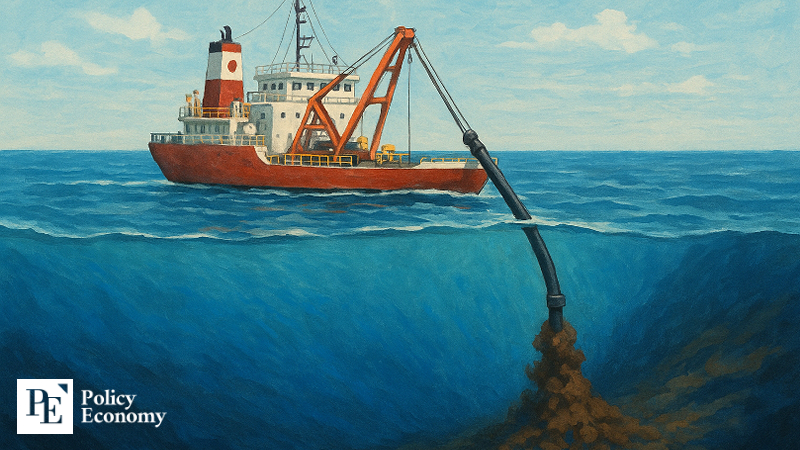
Rare earth development has emerged as a key pillar of Japanese Prime Minister Sanae Takaichi’s first comprehensive economic strategy. Japan plans to begin joint rare earth mining with the United States in waters near Minamitori Island, where significant deposits were first confirmed in 2011. The initiative is seen as part of Tokyo’s broader effort to counter China’s weaponization of its dominant position in the global rare earth supply chain.
Takaichi’s Cabinet Prioritizes Rare Earth Development
On the 10th, Japan’s government held its first National Growth Strategy Conference under Prime Minister Sanae Takaichi, discussing key initiatives to be included in a comprehensive economic plan due later this month. Among the main agenda items were support measures to revive Japan’s shipbuilding industry, following last month’s Japan–U.S. memorandum of understanding on expanding cooperation in the sector. Tokyo plans to outline a new “Shipbuilding Reconstruction Roadmap” and introduce investment incentives for domestic shipbuilders.
Resource policy also featured prominently. The government aims to accelerate development of rare earth deposits near Minamitori Island, located about 1,900 kilometers southeast of Tokyo within Japan’s Exclusive Economic Zone (EEZ). Rare earth-rich mud was first discovered there in 2011 at a depth of 5,500 meters, with estimated reserves of around 16 million tons.
Japan has since advanced its independent deep-sea mining technologies and exploration infrastructure. In August, the Japan Science and Technology Agency (JST) and the Japan Agency for Marine-Earth Science and Technology (JAMSTEC) announced that the research vessel Chikyu will collect about 35 tons of rare earth–containing seabed mud near Minamitori Island. The ship will lower drilling pipes 5,500 meters below sea level to extract samples, which are believed to contain around 2 kilograms of rare earth minerals per ton of mud.
U.S.–Japan–Australia Forge a Unified Front on Rare Earth Development
Japan is set to join hands with the United States to advance rare earth mining near Minamitori Island. On the 6th, Prime Minister Sanae Takaichi told Japan’s upper house that the government will begin a pilot project in January to recover rare earth–rich seabed mud from about 6,000 meters below the surface near the island. “Securing rare earths is strategically important not only for Japan but also for the United States,” she said, adding that the two countries are “discussing specific frameworks for joint development in the Minamitori region.”
This cooperation appears to build on the bilateral framework agreement signed during last month’s Japan–U.S. summit. According to a White House document titled “U.S.–Japan Framework on Securing Strategic Minerals and Rare Earth Supply through Mining and Processing,” the framework aims to strengthen bilateral collaboration to ensure a stable supply of key minerals and rare earths and to convene a ministerial-level meeting on mineral and metals investment within 180 days.
Japan is also extending its cooperation to the broader U.S.–Australia rare earth alliance. Last month, President Donald Trump and Australian Prime Minister Anthony Albanese signed the Framework for the Stable Supply of Critical Minerals and Rare Earths. Under this initiative, the U.S. Department of Defense plans to construct a gallium refinery in Western Australia with an annual capacity of 100 metric tons. The Center for Strategic and International Studies (CSIS) described the project as a trilateral effort among the U.S., Japan, and Australia, combining each country’s strengths: Australia will supply raw materials, Japan will provide refining and processing technology, and the United States will lead investment and end-use demand.
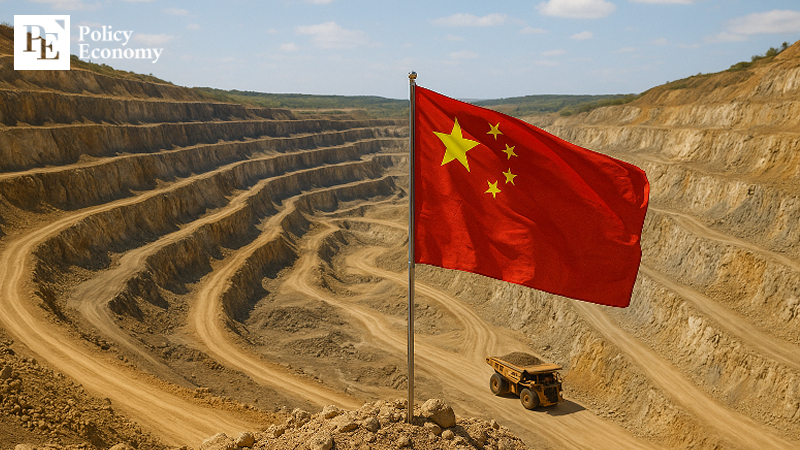
China Weaponizes Its Rare Earth Monopoly
The driving force behind the U.S.–Japan–Australia alliance is China’s near-total dominance of the global rare earth supply chain. Processing rare earth elements requires separating and refining mixed ores — a process that releases toxic chemicals, heavy metals, and radioactive waste. Western nations, including the United States, largely outsourced this environmentally hazardous work to China, allowing Beijing to gain overwhelming control of the market. According to the International Energy Agency (IEA), China accounts for around 70% of global rare earth mining, 90% of refining and oxide production, and 93% of finished permanent magnet manufacturing.
Beijing has leveraged this dominance as a strategic weapon. Rare earths are indispensable to high-tech industries — from smartphones and semiconductors to electric vehicles and fighter jets. Even a 10% disruption in supply can reduce global economic output by an estimated $150 billion. China has exploited this dependency to its advantage, most recently using rare earth export controls as diplomatic leverage ahead of last month’s summit with Washington — successfully pressuring the U.S. to ease some of its export restrictions on advanced technologies.
In response, the United States has accelerated investment in domestic rare earth producers and strengthened cooperation with resource- and technology-rich allies to reduce reliance on China. U.S. Treasury Secretary Scott Besant told the Financial Times last month that Washington could “find alternative rare earth suppliers within 12 to 24 months.” However, experts remain skeptical. Tim Foucault, Director of Raw Materials at the Eurasia Group, called the goal “naïve and overstated,” adding that “there is no realistic path for the U.S. to achieve full supply independence within that timeframe.” David Merriman, head of research at Project Blue, a rare earth and magnet market analytics firm, echoed that view: “Cutting off Chinese rare earths and magnets within 24 months is highly ambitious — it would require massive investment, permitting, and workforce development.”
As one of the youngest members of the team, Tyler Hansbrough is a rising star in financial journalism. His fresh perspective and analytical approach bring a modern edge to business reporting. Whether he’s covering stock market trends or dissecting corporate earnings, his sharp insights resonate with the new generation of investors.
Similar Post