U.S. Longest-Ever Government Shutdown Nears End, But Fears Over Shrinking Consumption, Widening Inequality, and Negative Growth Persist

Matthew Reuter is a senior economic correspondent at The Economy, where he covers global financial markets, emerging technologies, and cross-border trade dynamics. With over a decade of experience reporting from major financial hubs—including London, New York, and Hong Kong—Matthew has developed a reputation for breaking complex economic stories into sharp, accessible narratives. Before joining The Economy, he worked at a leading European financial daily, where his investigative reporting on post-crisis banking reforms earned him recognition from the European Press Association. A graduate of the London School of Economics, Matthew holds dual degrees in economics and international relations. He is particularly interested in how data science and AI are reshaping market analysis and policymaking, often blending quantitative insights into his articles. Outside journalism, Matthew frequently moderates panels at global finance summits and guest lectures on financial journalism at top universities.
Authored On
Modified
Senate Passes Stopgap Spending Bill, House Vote to Follow
Prolonged Shutdown Deepens Exodus of Unpaid Federal Workers
GDP Already Down 1.5%, Fourth-Quarter Contraction Likely
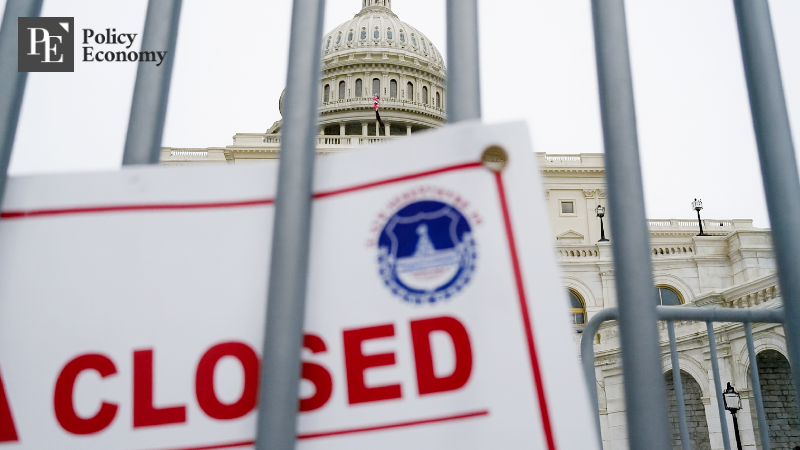
The record-breaking 41-day federal government shutdown is effectively nearing its end. The U.S. Senate has passed a stopgap funding bill to reopen the government through January next year, marking the first step toward resolving the crisis. The bill is now headed to the House of Representatives, followed by President Donald Trump’s signature, expected later this week. Yet, the broader economic fallout—from mass furloughs of unpaid federal workers and internal disputes over government restructuring to widening consumption inequality and slowing growth—is unlikely to be resolved anytime soon.
House Republicans Expected to Secure Majority Approval
On November 10 (local time), the U.S. Senate approved a temporary budget for fiscal year 2026 (October this year through September next year), ending the 41-day shutdown. The bipartisan stopgap bill will fund the federal government through January 30, 2026. However, full-year appropriations will be allocated to key departments directly tied to national security and public health—including the Department of Defense, Department of Agriculture, Department of Veterans Affairs, and the Food and Drug Administration (FDA). The measure also includes provisions for reinstating federal employees furloughed during the shutdown. The bill’s most contentious issue—extending subsidies for the public health insurance program known as “Obamacare”—will be voted on separately in the second week of December.
The Senate vote tallied 60 in favor and 40 against. Given that Republicans hold 53 of the chamber’s 100 seats, at least seven Democratic senators are believed to have crossed party lines to support the bill. Earlier, U.S. media including CNN had projected that between eight and twelve moderate Democrats would vote in favor. In the House, Republicans currently control 219 of 435 seats, giving them a comfortable majority to pass the measure. Speaker Mike Johnson (R) said, “The long nightmare is finally coming to an end,” adding that the bill would be brought to the floor for a vote “around the 12th.” Once it clears the House and receives President Trump’s signature, the longest government shutdown in U.S. history will officially end.
Federal Workers’ Unions Warn of Ongoing Pressure and Layoffs
Although the shutdown appears close to resolution, distrust toward the government is spreading among federal workers who have gone unpaid throughout the standoff. Given that President Trump has pursued government downsizing and efficiency reforms since taking office, tensions between public employees and the administration are unlikely to ease quickly. According to the White House, roughly 1.4 million federal workers have missed paychecks during the shutdown—about 700,000 of them furloughed without pay, and the remaining 700,000 continuing to work unpaid. Recently, furloughed employees were notified that their unpaid leave would be extended, but no provision was made for back pay upon reopening.
Even “essential” federal employees are under strain. For instance, air traffic controllers have worked without pay for more than a month. While unpaid wages are typically reimbursed once the shutdown ends, financial hardship has forced some controllers to skip shifts or take side jobs, triggering staffing shortages at multiple airports. The Federal Aviation Administration (FAA) announced on November 7 that it would reduce flight operations by 10% across 40 airports nationwide due to personnel shortages. President Trump warned, “All air traffic controllers must return to work immediately, or there will be significant pay cuts.”
Labor unions view the crisis as an extension of the Trump administration’s sustained push to restructure the civil service—through mass layoffs, budget cuts, early retirement incentives, and separation bonuses. Mica Niemeyer-Walsh, deputy vice president of the American Federation of Government Employees (AFGE) Local 3840, said, “Many agencies have been at a standstill for months due to staff reductions, and we’ve witnessed relentless attacks on the federal workforce. The situation has now spun out of control. We hope the administration finally realizes how severe the damage has become.”

Fears of Vanishing Consumer Demand Ahead of Thanksgiving
The economic toll of the shutdown is already significant. Goldman Sachs estimates that the crisis will shave 1.15 percentage points off fourth-quarter U.S. GDP growth this year, citing the prolonged disruption as a major drag. “During the 35-day shutdown between late 2018 and early 2019 under Trump’s first term, only select agencies were affected,” the bank noted. “This time, the scale is much broader, causing widespread impact across the economy. A prolonged shutdown suppresses federal spending and investment, with inevitable ripple effects across the private sector.”
The White House has also expressed concern about a potential recession. Kevin Hassett, chair of the National Economic Council (NEC), told CBS on November 9 that “the shutdown has already cost 1.5% of GDP.” He warned, “Thanksgiving and Black Friday represent the peak of the annual shopping season. If the shutdown isn’t resolved by then, consumption could collapse, pushing the economy into negative growth.” Hassett added that the decline in air travel and tourism demand would not merely delay spending but could “erase consumption altogether.”
A deeper concern is the polarization of consumer sentiment across income brackets. The University of Michigan’s preliminary consumer sentiment index for November came in at 50.3—the lowest in three and a half years—down from 53.6 in October, when early signs of domestic slowdown had already surfaced. Middle- and lower-income households, squeezed by persistent inflation and volatile financial markets, are slashing discretionary spending on dining, travel, and home goods while prioritizing essential purchases. Sales have weakened notably in sectors catering to these groups—processed foods, fast food, and low-cost furniture and apparel among them.
By contrast, high-income households, buoyed by gains in equities and asset prices, remain resilient spenders. Analysts at Morgan Stanley and Deutsche Bank found that improved third-quarter corporate earnings have lifted consumer confidence by about 10% among equity-heavy upper-income groups. Lisa Shalett, chief investment officer at Morgan Stanley, noted, “The top 40% of U.S. households hold 85% of national wealth, about two-thirds of which is in equities. As long as markets stay strong, affluent consumers will keep spending.” She added, “Year-end economic and consumption trends are likely to show a ‘polarized recovery’—a rebound driven by the wealthy, diverging sharply from the broader household experience.”
Matthew Reuter is a senior economic correspondent at The Economy, where he covers global financial markets, emerging technologies, and cross-border trade dynamics. With over a decade of experience reporting from major financial hubs—including London, New York, and Hong Kong—Matthew has developed a reputation for breaking complex economic stories into sharp, accessible narratives. Before joining The Economy, he worked at a leading European financial daily, where his investigative reporting on post-crisis banking reforms earned him recognition from the European Press Association. A graduate of the London School of Economics, Matthew holds dual degrees in economics and international relations. He is particularly interested in how data science and AI are reshaping market analysis and policymaking, often blending quantitative insights into his articles. Outside journalism, Matthew frequently moderates panels at global finance summits and guest lectures on financial journalism at top universities.
Similar Post