“The Era of Slack and Office Is Over”: OpenAI and Google Redefine the Future of Work

Stefan Schneider brings a dynamic energy to The Economy’s tech desk. With a background in data science, he covers AI, blockchain, and emerging technologies with a skeptical yet open mind. His investigative pieces expose the reality behind tech hype, making him a must-read for business leaders navigating the digital landscape.
Authored On
Modified
Tensions Rise in the Productivity Software Ecosystem
Big Tech Accelerates Shift Toward AI Automation
Agent-Based Workflows Signal a New Phase of Competition
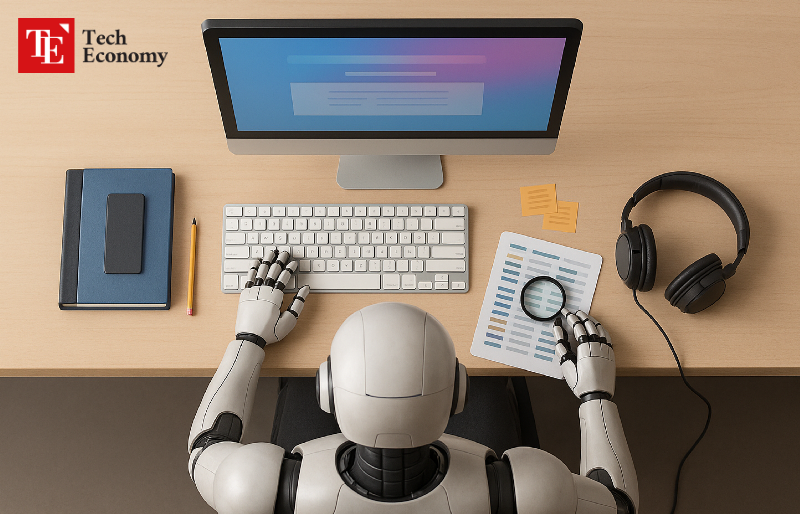
Sam Altman, CEO of OpenAI, declared that “AI will soon replace Slack and Office,” foreshadowing a major upheaval in the global productivity market. While figures such as Elon Musk have voiced opposition, automation through AI is widely seen as an unstoppable trend across the Big Tech industry. As Meta and Amazon slash tens of thousands of white-collar jobs and redirect savings into servers and AI agent development, Google has ignited a new corporate automation race with its enterprise-wide platform, Gemini Enterprise.
Co-opetition Shapes the Next Phase
In an interview with India’s Mint published on November 11, Altman criticized the inefficiency of traditional productivity suites, predicting that “AI will soon handle most office work—emails, documents, presentations—alerting humans only when necessary.” He added that widely used tools such as Slack and Microsoft Office are likely to be replaced by AI-driven platforms.
Altman’s remarks went beyond technical speculation, hinting at a deeper transformation in how offices function. He argued that “tools like Slack, which flood workers with notifications and messages, consume attention and cap productivity,” and that the next generation of platforms “will be goal-oriented rather than message-driven.” In this model, repetitive office tasks—emails, document writing, presentation formatting—are managed autonomously by AI, while humans intervene only for review and exceptions. Real-time collaboration remains intact, but the “digital busywork” of constant context-switching and input is minimized.
Elon Musk, CEO of xAI, responded almost immediately, calling Microsoft’s partnership with OpenAI “corporate suicide.” The comment pointed to the blurred line between cooperation and competition in Big Tech’s evolving alliances. Microsoft has poured billions into OpenAI and integrated its models across Office, Bing, and Azure. Yet if OpenAI’s AI agents begin to directly orchestrate workplace operations, conflicts over platform control, revenue sharing, and data governance may become unavoidable.
AI Systems Replace Management Layers
The shift is already materializing in workforce reductions. In just six months, Meta, Amazon, Microsoft, and Oracle have cut over 50,000 white-collar jobs in their push toward AI automation. Meta, for example, has automated compliance operations—including the division created after its 5 billion USD settlement with the U.S. Federal Trade Commission—using AI. Roughly 100 staff in global risk management roles have been affected, with automation now driving updates, safety protocols, and data protection decisions.
Amazon has taken the most aggressive stance, planning to eliminate 30,000 administrative roles—nearly 10 percent of its 350,000 white-collar workforce—primarily across HR, operations, and service divisions. “AI has allowed us to automate repetitive, structured work,” the company stated, while CEO Andy Jassy said the company would continue cutting “bureaucratic bottlenecks” through AI tools.
For Big Tech, the rationale is clear: operational efficiency and capital reallocation. Labor savings are being funneled into server expansion and agent-based AI systems. Microsoft paired its layoffs with Azure datacenter investments, while Amazon increased GPU server spending for its AI models Rufus and Titan. Salesforce and Meta similarly reinvested in AI platform development. As payroll budgets shift into capital expenditures, corporate growth models are evolving from labor intensity to asset efficiency.
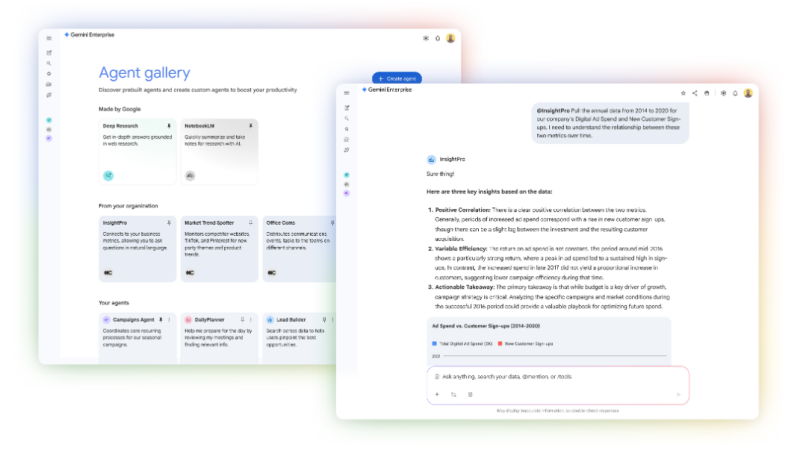
Google Declares Fully Automated Workflows
Google, moving fastest among Big Tech, has launched Gemini Enterprise, a unified platform designed to automate workflows across the entire organization. Its core design integrates models, agents, data, and processes within a single conversational interface. Using no-code workbenches, companies can build departmental workflows, automate approvals, reviews, and reporting, and deploy pre-trained “Google Agent Taskforces” to handle analytics, research, and operations optimization.
Google touts connectivity and governance as its main strengths. Gemini links seamlessly with Google Workspace, Microsoft 365, and Salesforce, enabling real-time data integration. It also merges native functions such as Biz for automated narration, Meet for live translation, and Builder for multilingual support in over 40 languages. Where previous attempts at such integration failed due to fragmented governance, Google’s unified approach aims to standardize policy management, workflow logs, and execution tracking across departments.
At the same time, Google is expanding infrastructure capacity, partnering with India’s largest telecom, Reliance, to establish an AI-dedicated data center in Jamnagar powered by renewable energy. The facility will host generative AI models, developer platforms, and enterprise applications for startups and public institutions alike. Google is also collaborating with Meta on enterprise AI systems based on the Llama model and negotiating local API deployment with OpenAI.
This strategy represents more than a functional upgrade—it redefines the concept of work itself. Productivity platforms are no longer support tools but structural frameworks for organizational decision-making. Competition has shifted from feature sets and usability to how swiftly and accurately companies can link decision-making with execution. AI is not merely replacing human roles; it is reshaping the operational architecture of organizations. Google’s enterprise-wide AI ecosystem marks the first step in that transformation.
Stefan Schneider brings a dynamic energy to The Economy’s tech desk. With a background in data science, he covers AI, blockchain, and emerging technologies with a skeptical yet open mind. His investigative pieces expose the reality behind tech hype, making him a must-read for business leaders navigating the digital landscape.
Similar Post