“Lead Tesla Through the EV Chasm” — Shareholders Bet $1 Trillion on Musk, Underscoring Renewed Reliance on His Leadership

Aoife Brennan is a contributing writer for The Economy, with a focus on education, youth, and societal change. Based in Limerick, she holds a degree in political communication from Queen’s University Belfast. Aoife’s work draws connections between cultural narratives and public discourse in Europe and Asia.
Authored On
Modified
Tesla Shareholders Approve Musk’s $1 Trillion Pay Package
As EV Market Slows, Investor Confidence in Musk’s Leadership Grows
Top Talent Exodus Further Highlights Musk’s Expanding Influence
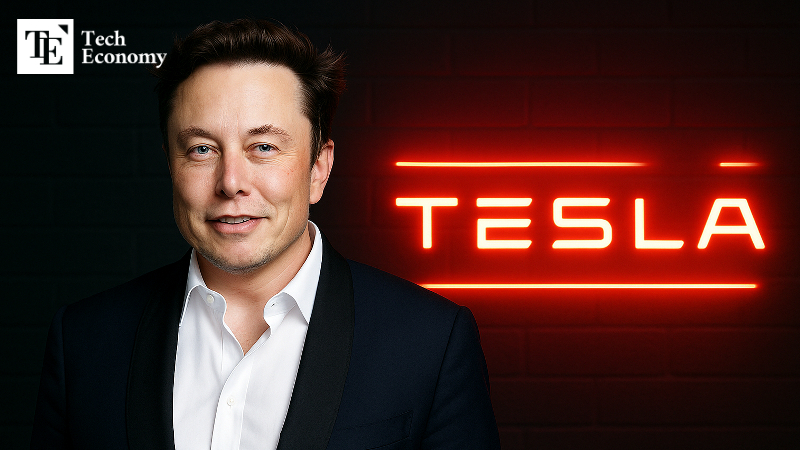
Tesla shareholders have approved CEO Elon Musk’s new compensation package, effectively betting on his leadership amid uncertain times for the electric vehicle maker. The performance-based plan ties Musk’s massive payout to future milestones, reflecting investor faith in his long-term vision. Analysts note that the growing influence of Musk within Tesla comes against the backdrop of a prolonged EV market slowdown—often described as the “EV chasm”—and a steady outflow of key talent from the company.
Tesla Shareholders Reaffirm Support for Musk’s Leadership
According to auto industry sources on the 12th, Tesla shareholders voted to approve CEO Elon Musk’s stock compensation plan at the company’s annual general meeting on June 6 in Austin, Texas. Tesla reported that over 75% of shareholders supported the package. Designed by the board, the plan ties Musk’s compensation to 12 performance milestones through 2035, granting stock awards as each target is achieved. If all are met, Musk could receive about 423 million shares, equivalent to roughly 12% of Tesla’s common stock, worth around $1 trillion.
The board’s final target envisions a market capitalization of $8.5 trillion, compared to Tesla’s current valuation of about $1.5 trillion. Other goals include 20 million vehicle deliveries, 10 million FSD (Full Self-Driving) software subscriptions, 1 million humanoid robots deployed, 1 million robotaxis in operation, and $400 billion in EBITDA.
Analysts say the approval underscores Musk’s indispensable role in Tesla’s future. The board described the package as an “incentive to ensure Musk remains at Tesla to execute the company’s long-term strategy.” Shareholders backing the plan are effectively betting on his vision and ability to drive growth. Yahoo Finance commented, “Tesla’s stock is now nearly inseparable from Musk himself,” adding that while companies like Amazon, Apple, and Microsoft continue to operate without their founders, “Tesla without Musk remains almost unimaginable for now.”
Prolonged EV Slowdown Leaves Tesla Searching for a New Breakthrough
Some analysts believe Tesla shareholders view Elon Musk as the key figure capable of steering the company through the prolonged “EV chasm” — a period of stagnating demand in the global electric vehicle market. According to data from J.D. Power and S&P Global Mobility, U.S. EV sales in October fell 57.3% month-over-month to just 64,000 units, while EVs’ share of total car sales plunged from 12% to 5%. The decline followed the expiration of the federal $7,500 tax credit at the end of September — a policy cut short by more than seven years after the newly inaugurated Trump administration and its Republican-led Congress decided to repeal it early.
As U.S. demand falters, automakers are pivoting from pure EVs to hybrids and plug-in hybrids (PHEVs). Hyundai recently launched the Palisade Hybrid, while Kia plans to introduce a Telluride Hybrid. Japanese and European automakers are also expanding hybrid lineups. Production cuts and layoffs are spreading: General Motors will dismiss 1,200 workers at its Detroit EV plant and 550 at an Ohio battery facility; Ford has scrapped its target to produce 2 million EVs next year; and Nissan has postponed mass production of two new EV models originally slated for 2028 in the U.S.
Tesla, by contrast, has sought to retain market share by lowering prices. The company introduced Standard trims of its Model Y and Model 3, roughly $5,000 cheaper than previous versions — a move aimed at offsetting higher out-of-pocket costs after the loss of federal subsidies. With traditional automakers retreating, Tesla has an opening to strengthen its position, though analysts caution that weak overall demand will likely limit earnings growth.
Musk’s broader diversification strategy may offer Tesla a path forward. The company has steadily expanded into autonomous mobility, AI, humanoid robotics, and space technology. Most recently, Musk announced plans for “TeraFab,” a massive semiconductor fabrication complex designed to power future AI and robotics initiatives. Tesla’s new AI5 chip, co-manufactured by TSMC and Samsung, is expected to be deployed across Tesla’s data centers and robotic systems, underscoring Musk’s long-term vision beyond electric vehicles.
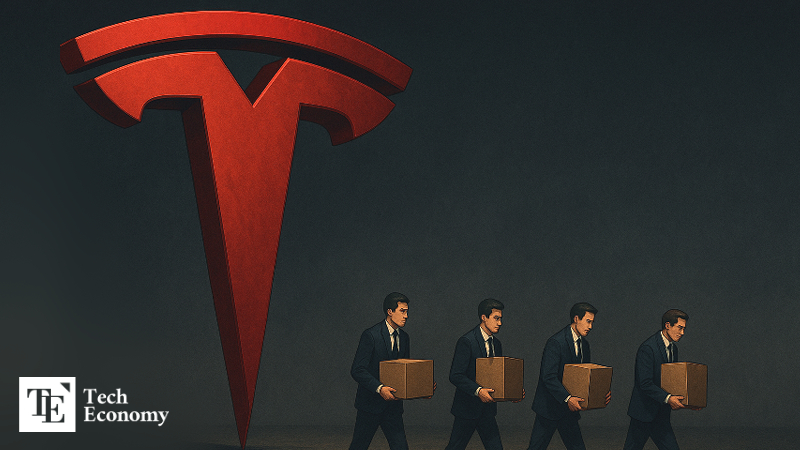
Top Talent Exodus Deepens Tesla’s Reliance on Musk
A growing wave of executive departures is further heightening Tesla’s dependence on CEO Elon Musk. Several key leaders responsible for the company’s core EV programs have recently left. On the 10th, Bloomberg reported that Siddhant Awasthi, who led the Cybertruck’s development and production for the past three years, announced his resignation on LinkedIn the previous day. Awasthi joined Tesla as an intern in 2017 and was most recently overseeing the Model 3 program as of July. “Leaving wasn’t an easy decision, especially given the exciting growth opportunities ahead,” he wrote.
Just hours later, Emanuele Lamacchia, who oversaw production and the global rollout of the Model Y, also announced his departure. Lamacchia spent eight years at Tesla and was considered a key figure behind the company’s mass-market success. Earlier exits include David Lau, former VP of Software Engineering, who joined OpenAI, and Milan Kovac, VP of Engineering for the Optimus humanoid robot program. In June, Omead Afshar, one of Musk’s longtime confidants, also left the company.
Analysts point to shifting market conditions as a driving force behind the exodus. Sales of Tesla’s mainstay Model Y and Model 3 have dropped sharply in North America following the expiration of federal EV tax credits, while the Cybertruck continues to struggle for traction in the pickup segment. Concerns are mounting that Tesla’s fourth-quarter sales could see a steep decline. To offset weakening demand, the company has introduced price cuts worth several thousand dollars across multiple models.
Aoife Brennan is a contributing writer for The Economy, with a focus on education, youth, and societal change. Based in Limerick, she holds a degree in political communication from Queen’s University Belfast. Aoife’s work draws connections between cultural narratives and public discourse in Europe and Asia.
Similar Post