Pacific Rare-Earth Battleground, U.S.-Led Resource Alliance Accelerates as China Expands Influence

Matthew Reuter is a senior economic correspondent at The Economy, where he covers global financial markets, emerging technologies, and cross-border trade dynamics. With over a decade of experience reporting from major financial hubs—including London, New York, and Hong Kong—Matthew has developed a reputation for breaking complex economic stories into sharp, accessible narratives. Before joining The Economy, he worked at a leading European financial daily, where his investigative reporting on post-crisis banking reforms earned him recognition from the European Press Association. A graduate of the London School of Economics, Matthew holds dual degrees in economics and international relations. He is particularly interested in how data science and AI are reshaping market analysis and policymaking, often blending quantitative insights into his articles. Outside journalism, Matthew frequently moderates panels at global finance summits and guest lectures on financial journalism at top universities.
Authored On
Modified
Pacific as a Strategic Hub of Vast Critical Mineral Deposits
China and Cook Islands Complete Joint Seabed Survey
U.S.–Japan Sign Rare-Earth Mining and Processing Pact
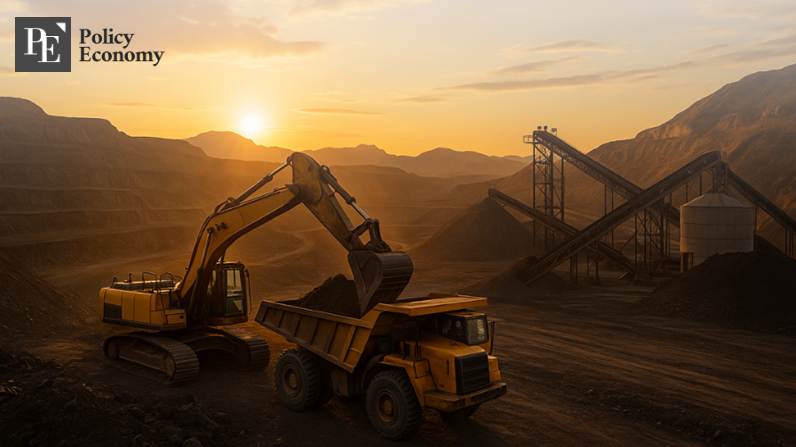
The Pacific is emerging as a new front in the U.S.–China contest over rare earths and other strategic resources, following the completion of the first joint deep-sea scientific survey by China and the Cook Islands in the South Pacific. The United States and Japan have also launched cooperative efforts on joint rare-earth extraction and processing to counter China’s growing reach, while Australia and New Zealand are discussing an intelligence and resource alliance involving Pacific Island nations—turning the region into a geopolitical flashpoint spanning both economic and security interests.
U.S.–China Surveys Conducted One Month Apart in the Same South Pacific Waters
The South China Morning Post (SCMP) reported on the 13th that China and the Cook Islands had completed their first joint scientific expedition in the South Pacific. According to the report, Dayang, a 4,000-ton Chinese ocean research vessel and one of the nation’s most advanced ships, entered Avarua Port on the 8th to conduct a seabed survey. The survey site overlaps with an area examined just one month earlier by the Nautilus, a research vessel supported by the U.S. National Oceanic and Atmospheric Administration (NOAA), underscoring how back-to-back expeditions by the two rivals are transforming Pacific waters into a deep-sea resource front.
Sun Shuxian, vice minister of China’s Ministry of Natural Resources, said the mission is part of the five-year implementation plan agreed during Cook Islands Prime Minister Mark Brown’s state visit to China in February. Brown noted that the Cook Islands “remain in the exploration and research stage” of marine resources, emphasizing that the goal is “understanding, not mining.” He added that the collaboration reflects a commitment to transparent data disclosure, education, and information-sharing that will help local communities build the capacity and confidence to manage their marine environment responsibly.
The Cook Islands—an autonomous territory of New Zealand composed of 15 islands in Polynesia—possess a vast exclusive economic zone (EEZ) rich in marine biodiversity and deep-sea mineral deposits including manganese, cobalt, nickel, and rare earths. Under the 2001 “Centennial Declaration,” the Cook Islands maintain authority over domestic affairs, legislation, and administration, while New Zealand oversees defense and foreign policy. Balancing strategic interests, the Cook Islands signed deep-sea resource agreements with China in February and with the United States in August.
2023 Competition Over Solomon Islands and Papua New Guinea
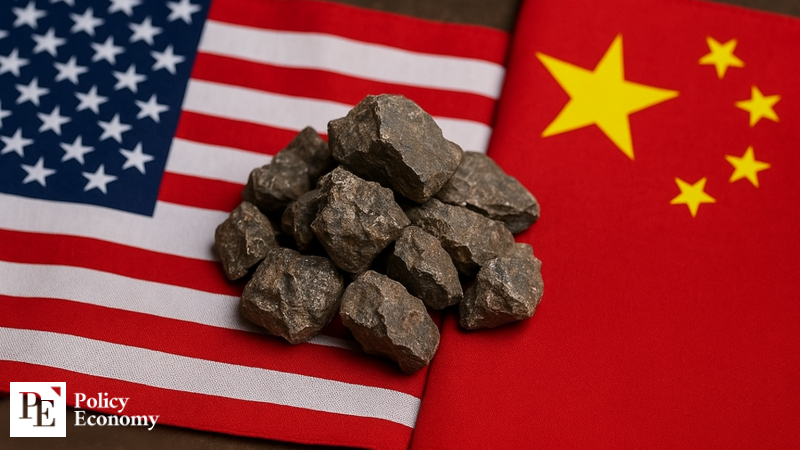
The Pacific hosts abundant rare earths—currently dominated by China’s global supply—as well as key natural resources and military assets, making it a strategic security nexus. Major-power rivalry in the region is not new. In April 2023, China signed a security pact with the Solomon Islands allowing Beijing to dispatch naval vessels and station military and police personnel on the islands when needed. In July that year, Solomon Islands Prime Minister Manasseh Sogavare and Chinese President Xi Jinping met in Beijing to announce the establishment of a comprehensive strategic partnership.
The agreement triggered alarm in Washington. Within a month of the China–Solomon Islands pact, U.S. Secretary of State Antony Blinken visited Papua New Guinea to meet Prime Minister James Marape and signed defense cooperation and maritime surveillance agreements. In July, U.S. Defense Secretary Lloyd Austin also visited Papua New Guinea to reinforce bilateral ties. Under these deals, the United States can deploy personnel and vessels at key PNG ports and airfields in exchange for supporting the country’s efforts to prevent maritime resource depletion and combat illegal fishing and smuggling.
Japan—bordering the Pacific—has intensified exploration of strategic resources in the region. In 2011, researchers at the University of Tokyo confirmed rare-earth-rich mud deposits near Tahiti, with estimated reserves of 90–100 billion tons—1,000 times larger than land-based reserves. In 2018, a joint research team from the University of Tokyo and Waseda University discovered 16 million tons of rare earths near Minamitori Island in the Ogasawara chain. The findings included deposits of dysprosium—used in automotive components—sufficient to meet global demand for 730 years, and yttrium—used in lasers—equivalent to 780 years of global consumption.
Australia Proposes a Regional “Resource Alliance” with New Zealand and Others
Intensifying geopolitical competition over Pacific Island nations and China’s expanding presence have raised concerns among the United States and Western allies, which have long regarded the South Pacific island chain as an informal defensive buffer. In response, a U.S.-centered “de-China” resource alliance is rapidly taking shape. On the 28th of last month (local time), U.S. President Donald Trump and Japanese Prime Minister Sanae Takaichi held their first summit in Tokyo and adopted a framework for “cooperation on mining and processing of minerals and rare earths” to counter China’s weaponization of critical minerals.
As part of efforts to reduce dependence on China’s rare-earth dominance, the two nations plan to begin experimental seabed extraction early next year. Japan, after facing China’s rare-earth export ban following the 2010 Senkaku Islands collision, has pursued independent resource development. Tokyo plans to begin commercial extraction of roughly 350 tons per day in 2027, with full-scale production slated for 2028 onward. The associated mining cost—previously estimated at a minimum of 12 billion yen—is equivalent to roughly USD 80 million. Researchers at the University of Tokyo estimate that daily extraction of around 3,500 tons would be required to achieve economic viability.
Broader concepts of a regional resource alliance are also being floated. Australia’s Lowy Institute warned that China’s “unprecedented security intrusions” in the Pacific have rapidly eroded the influence of Australia and New Zealand in the region. It proposed forming a “Pacific Eyes” alliance—modeled after the Five Eyes intelligence-sharing network—comprising Australia, New Zealand, Papua New Guinea, and Fiji, noting that additional members could be included if necessary.
Matthew Reuter is a senior economic correspondent at The Economy, where he covers global financial markets, emerging technologies, and cross-border trade dynamics. With over a decade of experience reporting from major financial hubs—including London, New York, and Hong Kong—Matthew has developed a reputation for breaking complex economic stories into sharp, accessible narratives. Before joining The Economy, he worked at a leading European financial daily, where his investigative reporting on post-crisis banking reforms earned him recognition from the European Press Association. A graduate of the London School of Economics, Matthew holds dual degrees in economics and international relations. He is particularly interested in how data science and AI are reshaping market analysis and policymaking, often blending quantitative insights into his articles. Outside journalism, Matthew frequently moderates panels at global finance summits and guest lectures on financial journalism at top universities.
Similar Post