Oil Falls Below $60 and Edges Toward $50 — A New Price Band Shaped by Oversupply

Niamh O’Sullivan is an Irish editor at The Economy, covering global policy and institutional reform. She studied sociology and European studies at Trinity College Dublin, and brings experience in translating academic and policy content for wider audiences. Her editorial work supports multilingual accessibility and contextual reporting.
Authored On
Modified
Entering a Weak Phase Amid Overproduction Warnings
Oil Alone Left Out of the “Everything Rally”
Successive Output Increases Collapse the Price-Defense Mechanism
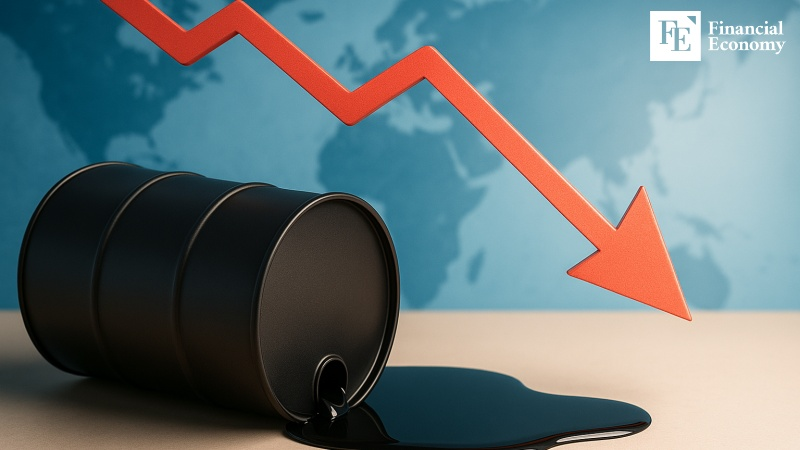
Crude prices have slipped below the $60 level, lending some weight to calls in parts of the market that a break below $50 could come into view. The downward pressure intensified as the production-increase stance of the coalition of oil-producing nations combined with rising inventory projections. Adding to this were growing concerns about a global economic slowdown. As a result, even during the current “everything rally”—where safe-havens like gold and risk assets such as cryptocurrencies are rising together—oil alone is firmly locked in a weak trajectory. Market participants broadly agree that without a strong demand-side catalyst, a sustained upward reversal will be difficult.
Psychological “Key Support Line” Broken
According to the New York Mercantile Exchange on the 13th (local time), December-delivery West Texas Intermediate (WTI) settled at $58.49 per barrel, down $2.55 (4.18%) from the prior session, marking the lowest level since October 21 ($57.82). Brent futures also plunged $2.45 (3.76%) to $62.71 per barrel, highlighting that the entire oil complex has been pushed into a bearish zone. With this, the market began emphasizing the need for position adjustments premised on further declines rather than expecting a short-term rebound, noting that “a key support line has collapsed.”
The immediate trigger for the plunge was the monthly report published by the Organization of the Petroleum Exporting Countries (OPEC). In its latest outlook, OPEC projected that next year’s global oil market will face an oversupply of roughly 20,000 barrels per day as production rises among OPEC+ members—including Russia—and other producers. Output forecasts for the U.S., Brazil, and Canada were revised higher, adding to supply-expansion pressure. This view stands in contrast to last month’s projection of a 50,000-barrel-per-day deficit. OPEC also cut next year’s demand forecast for OPEC+ crude by 100,000 barrels per day.
The market had already been bracing for such a correction since last month. Since October, WTI has repeatedly tested the high-$50 to low-$60 range—the lowest levels in five years since late 2020. Barring temporary bumps from geopolitical risks, the prevailing view was that in a cycle where economic slowdown and supply growth occur simultaneously, a recovery back to the $70–$80 range would be difficult. With OPEC’s oversupply signal layered on top, the more conservative view—that the price floor could move further down—grew stronger.
This trajectory also reflects the fiscal conditions of producing nations and global economic sentiment. Analysts estimate most producers require oil around $70 to balance their budgets, meaning recent prices sharply increase fiscal strain for OPEC+ members. The problem is that, with U.S. recession concerns and weakening demand prospects in China and Europe, producers see limited potential for a strong demand-side recovery. OPEC’s acknowledgment of potential oversupply effectively signals that producers may prioritize maintaining production and exports—as part of a market-share competition—over defending prices through cuts.
Economic Slowdown Fears Already Reflected in Demand Weakness
Against this backdrop, some in the market cautiously warn that a break below $50 is possible. Bank of America (BoA) wrote last month that if supply increases continue among OPEC and OPEC+ players such as Saudi Arabia, Iraq, and the UAE, global oil inventories could swell to levels last seen at the peak of the 2020 pandemic. In such a case, BoA warned, Brent could “temporarily fall below $50 per barrel.” Even so, the bank kept its average forecasts at $61 for Q4 this year and $64 for the first half of next year.
The prolonged U.S.–China conflict is also adding downward pressure. With the trade dispute showing no signs of resolution, global growth forecasts continue to be revised lower, and both WTI and Brent futures structures have slipped into contango. Contango refers to a state where spot prices are lower than futures prices, signaling that short-term supply is sufficient or excessive while demand is weakening. Private consultancy Lymata Energy Group, working with the International Energy Agency (IEA), projected that next year’s global oil supply will increase by more than 4 million barrels per day compared with this year’s average, with supply expanding roughly three times faster than demand.
In such an environment, even if producers opt for production cuts, the rebound in oil prices is expected to be limited. China Haitong Securities stated that “oversupply pressure is already materializing, so even if producers cut output, it will be difficult to significantly lift market expectations.” Goldman Sachs likewise predicted that Brent could fall toward $52 per barrel in Q4 next year. With oil alone weakening even as gold, global equities, and bitcoin rise together in an “everything rally,” most analysts believe that without a strong demand recovery or a major geopolitical supply shock, a sustained upward turn in oil prices is unlikely.

Demand-Side Shifts → Failed Price Defense
The production-increase stance of OPEC+ supports this outlook. Although the group had long relied on coordinated cuts to support prices, it has shifted toward boosting output this year. In June, Saudi Arabia, Russia, Iraq, the UAE, and five others agreed to increase production by 411,000 barrels per day. This pushed an additional 1.371 million barrels per day into the market in July alone—rapidly restoring much of the supply previously removed through cuts. With the group expanding supply rather than defending prices, hopes for a near-term rebound faded quickly.
In September, the eight OPEC+ nations agreed on an additional 137,000-barrel-per-day increase. This effectively restores almost all of the 2.2 million barrels cut in 2023, signaling that the group now prioritizes reclaiming market share over price defense. Since these increases began, crude prices have fallen roughly 12% on an annual basis. Although OPEC+ kept this month’s increase at the same level as last month to ease oversupply fears, the accumulated excess remains too large to reverse the downward pressure.
Experts say the repeated production-increase decisions show the weakening of the group’s traditional cartel structure. They point to Western sanctions on Russia after its 2022 invasion of Ukraine as the turning point. As Western buyers halted imports of Russian crude, unsold cargoes flooded the market. More recently, the U.S. has openly pressured producers to lower oil prices as part of its inflation-control efforts, forcing producing nations to prioritize securing buyers over maintaining prices. As a result, oversupply created by rising output is increasingly viewed as a structural, not temporary, feature of the market.
Niamh O’Sullivan is an Irish editor at The Economy, covering global policy and institutional reform. She studied sociology and European studies at Trinity College Dublin, and brings experience in translating academic and policy content for wider audiences. Her editorial work supports multilingual accessibility and contextual reporting.
Similar Post