China Secures NVIDIA AI Chips via Indonesia, Raising Concerns Over the Erosion of U.S. Semiconductor Controls

Matthew Reuter is a senior economic correspondent at The Economy, where he covers global financial markets, emerging technologies, and cross-border trade dynamics. With over a decade of experience reporting from major financial hubs—including London, New York, and Hong Kong—Matthew has developed a reputation for breaking complex economic stories into sharp, accessible narratives. Before joining The Economy, he worked at a leading European financial daily, where his investigative reporting on post-crisis banking reforms earned him recognition from the European Press Association. A graduate of the London School of Economics, Matthew holds dual degrees in economics and international relations. He is particularly interested in how data science and AI are reshaping market analysis and policymaking, often blending quantitative insights into his articles. Outside journalism, Matthew frequently moderates panels at global finance summits and guest lectures on financial journalism at top universities.
Authored On
Modified
A Chinese-invested Silicon Valley company used as the conduit
Chips not used for military purposes—thus not subject to sanctions
NVIDIA expands AI collaboration with Indonesia-based firms
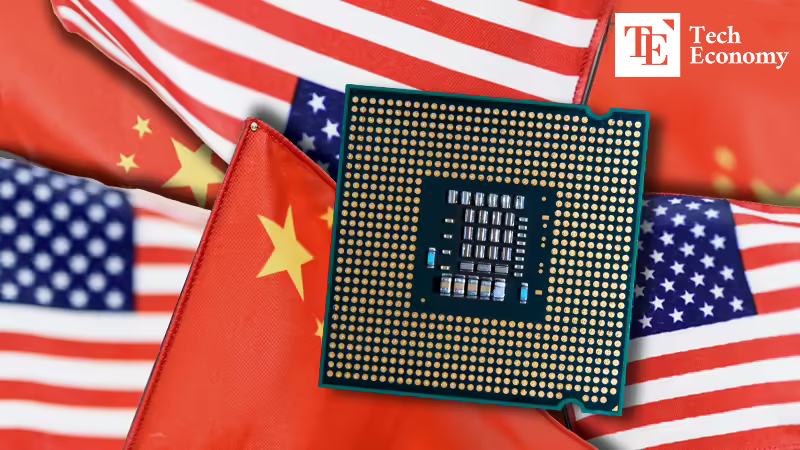
Despite stringent U.S. export controls on China, it has emerged that Beijing has consistently secured cutting-edge AI chips from NVIDIA by circumventing the restrictions through Indonesia—raising concerns about a de facto neutralisation of U.S. semiconductor policy. In particular, deals have surfaced in which advanced AI servers passed from Indonesia into China via non-sanctioned intermediaries with links to Chinese entities. Concurrently, NVIDIA is deepening its AI engagements in the Southeast Asian market, adding layers of complexity to bilateral strategic dynamics.
INF Tech of China Secures Computing Power Equivalent to 2,300 NVIDIA Chips
On the 13th (local time), The Wall Street Journal (WSJ) reported that China, which is barred from purchasing NVIDIA’s latest AI chips due to U.S. export restrictions, has been sourcing them through Southeast Asia. According to the WSJ, NVIDIA sells AI chips to the Silicon Valley firm Aibres, in which the Chinese company Inspur holds a one-third stake. Inspur was added to the U.S. government’s trade blacklist in 2023 for its involvement in developing military supercomputers, but Aibres itself is not designated, allowing it to transact freely with NVIDIA.
Indonesia served as the intermediary route. Last year, Aibres sold servers equipped with NVIDIA’s cutting-edge Blackwell AI chips to the Indonesian telecom operator Indosat. Indosat then supplied these servers to the Chinese client INF Tech through Aibres’ arrangement, enabling INF Tech to secure computing power equivalent to 2,300 NVIDIA chips. INF Tech intends to use the chips for AI training in fields such as drug discovery and scientific research. The company is an AI startup founded by MIT-educated Fudan University professor Chi Yuan and is also reportedly partnering with data centers in Singapore, Malaysia, and Thailand.
Trade experts generally believe that as long as the rerouted chips are not used for military purposes, such transactions do not violate the Trump administration’s export regulations. In effect, Chinese firms continue to gain access to NVIDIA’s state-of-the-art AI chips without formally breaching U.S. sanctions. The WSJ noted, “NVIDIA CEO Jensen Huang said the company’s market share in China fell from 95% to 0%, but Chinese firms are still using NVIDIA hardware.”
NVIDIA Chips Fuel an Expanding Black Market Behind China’s Semiconductor Push
Officially, Beijing has promoted a domestic “NVIDIA boycott” in response to Washington’s advanced semiconductor export controls. In August, Chinese authorities instructed local companies to cease using NVIDIA’s H20 chips, and last month mandated that only domestically produced AI chips be deployed in new data centers funded by state capital, accelerating the country’s “semiconductor self-reliance” agenda. Yet China still lacks the technological capability to meet its surging AI demand. Restricted access to extreme ultraviolet (EUV) lithography equipment has prevented the country’s largest foundry, SMIC, from achieving commercially viable yields in AI chip production.
As a result, rerouted procurement of NVIDIA chips has become an open secret. Even after President Trump fully banned exports of H20 chips in April, an estimated USD 1 billion worth of NVIDIA chips still entered China. This estimate is based on corporate disclosures, contract documents, and accounts from individuals directly involved in the transactions. While the United States has outlawed exports of NVIDIA’s B200 and H100 AI chips to China, their purchase and resale inside China remain legal as long as taxes are properly paid.
On Chinese social media platforms such as Douyin and Xiaohongshu, B200 servers and RTX 5090 units are openly sold, and some vendors are already taking pre-orders for the newly released B300 chips. These black-market trades generate substantial profits. The B200 chip is the most sought-after item: a server rack containing eight B200 chips sells in China for USD 0.49 million, more than 50% above U.S. domestic prices. Shenzhen-based distributor Gate of the Era is estimated to have generated USD 400 million in revenue by selling hundreds of such racks.
NVIDIA Chooses Indonesia as Its Southeast Asian Hub
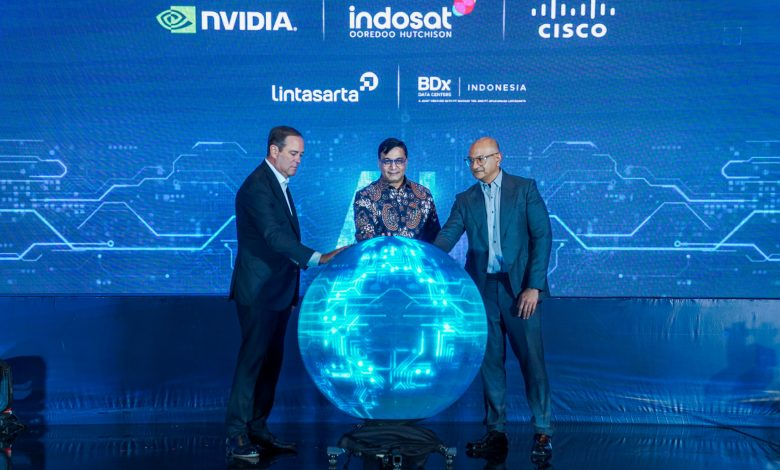
There is growing speculation that this controversy may also affect NVIDIA’s ongoing data-center project in Indonesia. Last year, NVIDIA partnered with Indosat to invest USD 200 million to build an AI center in Surakarta, Central Java. NVIDIA’s expansion into Indonesia reflects its strategy to strengthen its presence in Southeast Asia amid accelerating demand for generative AI. The planned facility is designed to support Indonesia-focused AI solutions, including the development of a large-language model (LLM) tailored to the Indonesian language.
In April, Indonesian data-center operator BDx obtained certification under NVIDIA’s “DGX-Ready Data Center Program,” confirming that its infrastructure meets power, cooling, and networking requirements necessary to operate NVIDIA’s high-performance DGX AI systems. With this certification, BDx can now deploy and manage NVIDIA-accelerated computing environments across Indonesia, enabling local companies to develop AI solutions more efficiently through data localization.
In September, NVIDIA, together with the Indonesian government, Indosat, and Cisco, launched the Sovereign AI infrastructure initiative. The project aims to build chatbots and AI solutions optimized for Indonesian-language natural-language processing (NLP). The Indonesian government emphasized at the time, “This project is a core pillar of the nation’s data-sovereignty strategy, reducing reliance on foreign technologies and enabling data to be generated, stored, and processed domestically.” The government added that the initiative would “serve as a pivotal moment in Indonesia’s transition from a mere consumer of technology to a producer and innovator of AI capabilities.”
Matthew Reuter is a senior economic correspondent at The Economy, where he covers global financial markets, emerging technologies, and cross-border trade dynamics. With over a decade of experience reporting from major financial hubs—including London, New York, and Hong Kong—Matthew has developed a reputation for breaking complex economic stories into sharp, accessible narratives. Before joining The Economy, he worked at a leading European financial daily, where his investigative reporting on post-crisis banking reforms earned him recognition from the European Press Association. A graduate of the London School of Economics, Matthew holds dual degrees in economics and international relations. He is particularly interested in how data science and AI are reshaping market analysis and policymaking, often blending quantitative insights into his articles. Outside journalism, Matthew frequently moderates panels at global finance summits and guest lectures on financial journalism at top universities.
Similar Post