[CHIPS Act] “U.S. Reshoring Hobbled by Harsh Reality” TSMC Arizona Plant Confronts a Triple Bind of Labor Shortages, Regulation, and Soaring Costs

Siobhán Delaney is a Dublin-based writer for The Economy, focusing on culture, education, and international affairs. With a background in media and communication from University College Dublin, she contributes to cross-regional coverage and translation-based commentary. Her work emphasizes clarity and balance, especially in contexts shaped by cultural difference and policy translation.
Authored On
Modified
TSMC’s plan to build a six-fab semiconductor cluster has hit the brakes
A cost structure 50% higher than Taiwan and a severe shortage of skilled labor
Heavy-handed regulations mean that even six fabs cannot meet U.S. demand

The construction of TSMC’s Arizona fabrication complex in Phoenix—widely regarded as the centerpiece of the U.S. government’s semiconductor revival—has run into formidable headwinds. Rebuilding a state-of-the-art manufacturing base in a country where industrial capacity has eroded for decades is proving extraordinarily difficult, encumbered by a combination of skilled-labor scarcity, rigid regulatory frameworks, and elevated cost structures that collectively constrain both speed and efficiency. It underscores the stark reality that massive capital injections alone cannot swiftly restore domestic semiconductor manufacturing capability.
A $100 billion investment meets local opposition, stalling ‘new city’ development
According to Phoenix broadcaster ABC15 on the 16th (local time), the North Gateway Village Planning Committee’s meeting on the 13th was packed with dozens of angry residents. Fierce opposition erupted over a proposal to build a large mixed-use new city called “NorthPark” near the TSMC plant. The development is a critical component of infrastructure required to accommodate the tens of thousands of TSMC engineers and partner-company employees, and is being spearheaded by TSMC and real-estate developer Pulte Group.
The Phoenix city government said it had received 243 comments expressing opposition or concern over the zoning change for NorthPark, compared with 68 in support—an overwhelming backlash. Residents’ anger centered on the anticipated deterioration in “quality of life.” Phoenix resident Ann Wilgie said, “We don’t want to deal with massive traffic. We like our quiet community.” She highlighted the severe congestion and safety risks that would arise from building a “city within a city” right next to residential neighborhoods.
A deeper source of frustration lies with water. Given Arizona’s desert climate, residents fear that TSMC’s massive project will strain regional water supplies. Semiconductor production relies heavily on water, particularly ultrapure water used in repeated cleaning processes, and usage increases with more advanced nodes. Resident Jim Umrlauf said, “Ten years from now we won’t regret not having built more houses. But we will absolutely regret not preserving more open space.” They argued that the state-trust land development would destroy the environment and reduce recreational space, urging the project to be relocated farther north of Loop 303.
The NorthPark development—now facing intense resistance—is indispensable for TSCM’s U.S. plant operations. Bringing tens of thousands of engineers and skilled workers into the middle of the desert requires housing, schools, hospitals, and commercial facilities. The traffic impact is also unavoidable. While TSMC pledged to reroute truck logistics to highways rather than residential roads, the 24-hour flow of raw materials and finished chips inherent to semiconductor manufacturing directly collides with residents’ desire to preserve their quiet suburban lifestyle.
Regulatory constraints limit supply to just 7% of U.S. demand
Regulatory hurdles are another factor stalling TSMC’s investment. The company is expanding its semiconductor capacity in Arizona through a phased $100 billion investment closely tied to incentives under the Biden administration’s CHIPS and Science Act. The legislation provides billions of dollars in subsidies and tax credits to secure domestic semiconductor infrastructure.
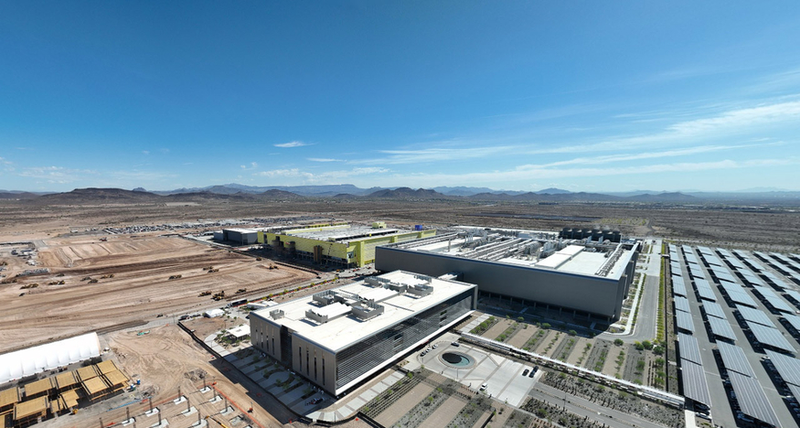
TSMC began construction of its first Arizona fab in May 2020 and started producing advanced chips this year. The second fab within the Fab 21 complex was recently completed using a 3nm process. A third fab (P3, F21)—now under construction as of the second quarter—will deploy a 2nm node to meet high-performance semiconductor demand from key customers. The fourth fab will incorporate 2nm and A16 processes, while the fifth and sixth fabs will adopt even more advanced technologies. TSMC ultimately aims to integrate the six fabs, two advanced packaging plants, and an R&D center into a full semiconductor cluster.
Despite this aggressive build-out, TSMC is still far from meeting U.S. domestic semiconductor demand. U.S. Treasury Secretary Scott Besant said on The All-In Podcast in July that the Arizona fabs currently supply only about 7% of U.S. demand, pointing to equipment-clearance delays and sluggish permitting processes that are undermining production efficiency.
Skilled-labor scarcity and more than double the production cost
A shortage of skilled talent is another major barrier to TSMC’s U.S. expansion. The first Arizona fab was originally slated to begin operations last year, but the company could not secure enough skilled workers to install advanced equipment, pushing the schedule back by a full year. TSMC attempted to bring in roughly 1,000 highly trained technicians from Taiwan—half of the required workforce—to stay within budget and meet construction timelines. But local unions opposed the move, arguing it would take away American jobs, forcing TSMC to scrap the plan. The company ultimately spent a year sending Taiwanese engineers to train U.S. workers or sending some American workers to Taiwan for instruction.
Skilled-labor shortages have plagued the U.S. semiconductor strategy from the outset. Samsung Electronics, TSMC, Micron, and Intel have all announced major U.S. fabs, but they lack the specialized technicians needed to run them at scale. The U.S. Department of Commerce has estimated that the country faces an annual shortage of 100,000 semiconductor workers.
On top of labor shortages, high U.S. production costs further compound TSMC’s challenges. Industry consensus holds that building and operating a semiconductor fab in the United States costs 30–50% more than in Asia. TSMC has estimated that its U.S. production costs could be as much as 100% higher than in Taiwan. Some analysts argue that operating an advanced fab in the U.S. can be more than twice as expensive as in East Asia.
A study by Exyte, a semiconductor cleanroom construction firm, found that building a fab in the United States takes twice as much time and money as in Taiwan. While Taiwan can complete an advanced fab in about 19–20 months, U.S. projects take roughly 38 months due to permitting, regulatory procedures, and restrictions on 24-hour construction. Construction costs excluding equipment—labor, materials, and related expenses—are also twice as high. During operations, utilities such as electricity and labor costs push per-chip production costs more than 50% higher than in Taiwan. Cost disadvantages span labor, construction, and ongoing operations.
Experts warn that unless TSMC overcomes these cost barriers, it risks eroding the commercial viability of its U.S. operations despite massive capital investments. The CHIPS Act is designed to narrow this cost gap, but such government support can only be temporary. While the Trump administration is pursuing higher semiconductor tariffs to revive domestic manufacturing, long-term survival will ultimately depend on U.S. fabs reducing costs, improving yields, and achieving their own form of competitiveness.
Siobhán Delaney is a Dublin-based writer for The Economy, focusing on culture, education, and international affairs. With a background in media and communication from University College Dublin, she contributes to cross-regional coverage and translation-based commentary. Her work emphasizes clarity and balance, especially in contexts shaped by cultural difference and policy translation.
Similar Post