The Curtain Falls on China’s Real Estate Utopia, Economy Plunges into Darkness

Anne-Marie Nicholson is a fearless reporter covering international markets and global economic shifts. With a background in international relations, she provides a nuanced perspective on trade policies, foreign investments, and macroeconomic developments. Quick-witted and always on the move, she delivers hard-hitting stories that connect the dots in an ever-changing global economy.
Authored On
Modified
Deepening property slump intensifies downward pressure on China’s economy
Sector once responsible for a quarter of GDP now trapped in protracted downturn
Market collapse driven by oversupply, mounting debt, and regulatory shocks
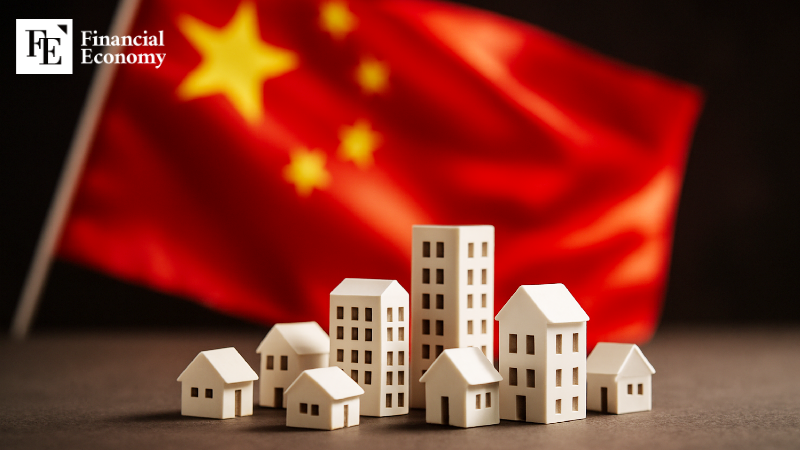
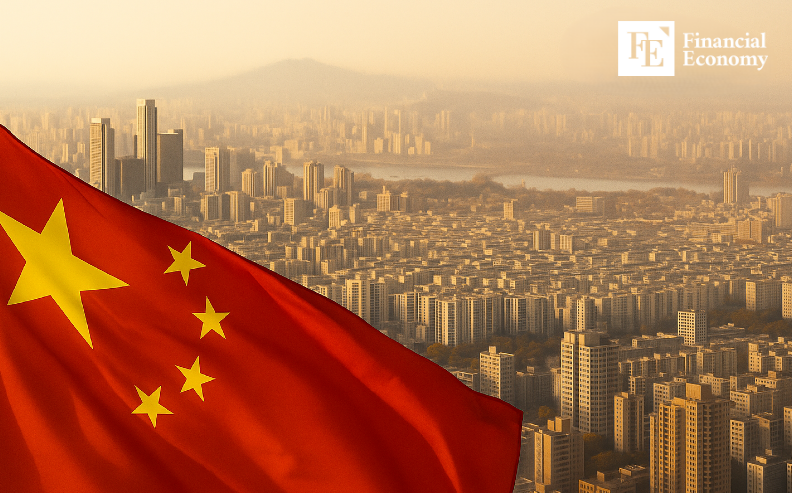
China’s real estate sector—long portrayed as the goose that laid golden eggs—is now dragging the broader economy into a systemic crisis. Analysts warn that a five-year downturn in the property market could push China into an irreversible recession. To meet its growth target of around 5% for both last year and this year, property-sector stabilization is essential, yet conditions continue to deteriorate. A convergence of oversupply and regulatory shocks has locked the market into a persistent slump, while mounting debt, collapsing domestic demand, and tightening financial conditions have accelerated the erosion of China’s economic resilience, stoking fears of a deflationary spiral.
Real Estate, China’s Domestic Demand Engine, Has No Viable Path Forward
According to Taiwan’s Economic Daily News on the 17th, Lou Jiwei, former Chinese finance minister and current chairman of the National Council for Social Security Fund, warned at a recent forum that China’s property sector has “virtually no chance of a dramatic turnaround in its current contraction phase” and that the downturn “will persist for five years.” He argued that the real estate industry will contribute nothing to China’s growth for at least the next half-decade.
Lou’s assessment carries weight in light of the fact that the combined liabilities of China’s top 10 property developers reached approximately USD 1.4 trillion as of late October. The founders of Evergrande, Country Garden, and Wanda—Xu Jiayin (67), Yang Guoqiang (70), and Wang Jianlin (71)—once hailed as the richest magnates in China’s property boom, are now mockingly referred to as the country’s most indebted tycoons.
Despite Beijing’s aggressive stimulus measures, China’s housing market shows no signs of revival. According to the National Bureau of Statistics, average new-home prices in September fell 0.41% from the previous month, marking the steepest drop this year. The weakness extends well beyond new-home prices: after more than five years of persistent market contraction, real estate investment in the third quarter plunged 13.9% year-on-year. New-home sales by floor area and transaction value also declined 5.5% and 7.9%, respectively. Since Beijing introduced a sweeping financial-easing package on September 24 last year, equities—another major household asset class—have rebounded, but property prices have failed to recover, deepening the decoupling between China’s stock market and its property sector.
From the Nation’s Cash Cow to a Burdensome Liability
Just five years ago, China’s property sector commanded extraordinary prominence. Fueled by urbanization and massive infrastructure spending, real estate underpinned investment, consumption, and fiscal revenues, contributing roughly 30% to China’s GDP. By 2020, property-related loans approached 30% of total bank lending, and housing accounted for 70% of household assets—making real estate an indispensable pillar of both financial institutions and households. During the decades when China boasted 7–8% growth, real estate was the engine enabling rapid expansion. Until shortly before the pandemic, the wealth effect was so strong that owning a few well-located apartments—often financed through leverage—could elevate ordinary households to near-elite financial status. In major first-tier cities, prices climbed daily, fueling speculation that seemed almost rational.
Rising home values buoyed the broader economy by lifting consumption and corporate earnings. As sentiment improved, non-homeowners worked to purchase property while homeowners expanded their portfolios, reinforcing a cycle of rising wealth. Property prices climbed steadily for more than 20 years, and real estate developers consistently dominated China’s rich lists. This sector was fundamental to the prosperity of local governments and households.
The reversal was swift. When the bubble that had inflated across the industry began to burst in the second half of 2021, Beijing’s belated deleveraging campaign triggered a nationwide slump. Although real estate remains China’s largest single industry, it has rapidly devolved from the country’s most profitable sector into one of its biggest liabilities. Prices have fallen to nearly half of their peak levels, and in some regions, apartments are derisively labeled “cabbage flats” or “onion flats”—suggesting homes cost little more than vegetables.
Xi Jinping’s determination to tighten property regulations stemmed partly from China’s ballooning debt burden—total national debt had reached 282% of GDP, exceeding the U.S. ratio of 257%—but the broader motivation was a structural pivot in economic strategy. As U.S.–China tensions escalated, Beijing sought to shift away from an investment- and export-driven model toward one anchored in domestic demand and reduced wealth inequality. The prominence of Xi’s “common prosperity” agenda reflected this policy shift.
But the deflationary shock unleashed by the bursting bubble has imposed immense strain on China’s economy. Deflation, extreme demand contraction, and liquidity shortages—known as qianhuang, or “money drought”—have become structural features. Ghost cities now proliferate nationwide, and even Shanghai’s prime-grade office market faces unprecedented vacancy pressure. At the current leasing pace, analysts warn it could take “100 years to absorb existing inventory.”
Construction-Driven Growth Fuels Debt and Fiscal Stress
The collapse of China’s property market has many causes, from speculative investment to a decades-long accumulation of excess capacity. But the most decisive factor was oversupply on an extraordinary scale. Of China’s 660 million total housing units, 120 million are vacant—equivalent to more than five times the annual equilibrium demand. An additional 50 million units fall into the category of lanweilou, or unfinished apartments.
From the early 2000s to 2020, China devoted roughly 44% of its GDP annually to infrastructure and real estate—far above the global average of 25%. The privatization of housing in the late 1990s catalyzed urbanization and filled local government coffers, enabling developers such as Evergrande and Country Garden to borrow cheaply and build aggressively.
But once Beijing enforced strict lending caps based on leverage thresholds, these heavily indebted firms were the first to topple. Evergrande collapsed into default almost immediately after construction activity slowed. By the end of 2021, the developer owed USD 330 billion and had accumulated losses equivalent to roughly USD 81.5 billion. Ultimately, Evergrande was ordered into liquidation by a Hong Kong court and delisted—an event widely compared to Lehman Brothers’ collapse in 2008, given the central role of a bursting real estate bubble.
Experts now widely agree that China’s 40-year boom has come to an end. China’s growth—long twice the global average—can no longer rely on construction-driven expansion. A recent Bank of Korea report similarly concluded that construction-focused stimulus may deliver short-term relief but ultimately inflates household and government debt, undermining long-term growth. Because construction assets have long effective lifespans, the adjustment period is inevitably prolonged. OECD data show that after peaking, the share of construction investment in national GDP typically takes 27.2 years on average to reach its cyclical trough. Countries with higher initial peaks face deeper and more prolonged contractions.
Anne-Marie Nicholson is a fearless reporter covering international markets and global economic shifts. With a background in international relations, she provides a nuanced perspective on trade policies, foreign investments, and macroeconomic developments. Quick-witted and always on the move, she delivers hard-hitting stories that connect the dots in an ever-changing global economy.
Similar Post