Trump’s Tariff Policy Faces a Test of “Legitimacy” as Courts and Markets Grow Skeptical

Niamh O’Sullivan is an Irish editor at The Economy, covering global policy and institutional reform. She studied sociology and European studies at Trinity College Dublin, and brings experience in translating academic and policy content for wider audiences. Her editorial work supports multilingual accessibility and contextual reporting.
Authored On
Modified
Supreme Court hearing signals trouble for Trump’s tariff strategy
“Tariff dividend for the people” seen as a populist pitch
Markets price in a high probability the tariffs will be struck down
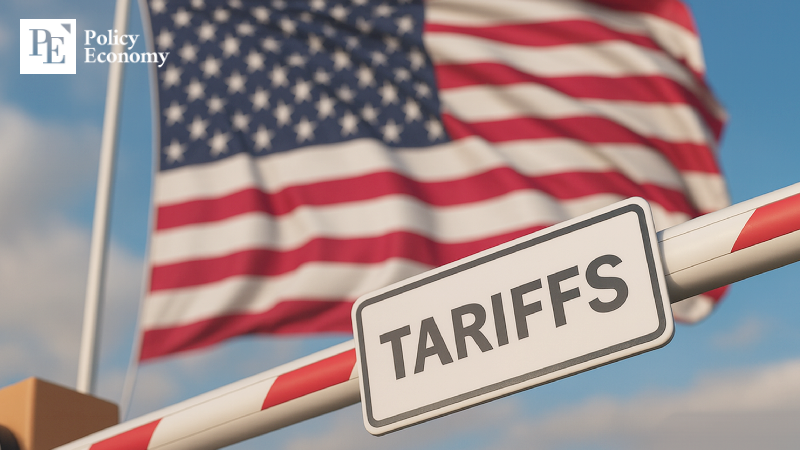
Donald Trump’s high-tariff reciprocity strategy has now reached the US Supreme Court, and both the legal community and financial markets increasingly see the administration as likely to lose. During recent oral arguments, the justices zeroed in on statutory interpretation and the possible infringement of Congress’s taxing authority, making clear their skepticism toward the Trump administration’s position. In response, the administration has rushed to wage a public campaign, floating a nationwide “tariff dividend” for all Americans. But most observers judge that, given the realities of tariff revenue and the fiscal and legislative framework, the plan has little chance of materializing.
Could the tilted playing field be about to flip?
According to legal sources, the US Supreme Court held oral arguments on November 5 on three lawsuits challenging Trump’s high-tariff policy. John Sauer, the deputy solicitor general tapped to defend the administration, told the Court that “the President holds broad authority over foreign trade, and tariffs are a critical tool for regulating imports.” With earlier courts having underscored that the power to levy taxes rests with Congress, the administration aimed to emphasize that the President nevertheless controls the regulation of foreign commerce.
Justice Neil Gorsuch seized on Sauer’s remark that foreign affairs fall within the President’s inherent powers. “So are you saying Congress can, whenever it wishes, delegate sweeping authority over foreign trade, including the imposition of tariffs, to the President?” he asked. “If that is so, what would prevent Congress from delegating all foreign-trade powers—and by the same logic, even the power to declare war—to the President?” Sauer replied that he was not arguing the President can declare war, but trailed off without offering a clear answer.
The day’s docket combined suits brought by US importers who say they were harmed by the tariffs with a case filed by Democratic-led state governments. Taken together, the cases amount to a critical test of the entire high reciprocal tariff strategy Trump has pushed in his second term. The Supreme Court’s decision to hear all three matters together was widely read as a signal that it sees the dispute not as a narrow commercial case, but as a constitutional confrontation over where presidential authority ends and legislative power begins.
Lower courts had already sided decisively with the plaintiffs. On May 28, the Court of International Trade ruled unanimously that the International Emergency Economic Powers Act (IEEPA) does not grant the President “unlimited authority” to impose retaliatory high tariffs on the entire world. Then on August 29, the DC Circuit, in a 7–4 decision, upheld that view, holding that while the statute recognizes certain import-restriction powers, it cannot be read as ceding Congress’s taxing power to the President. Both courts acknowledged that trade deficits and drug inflows are serious problems, but rejected efforts to stretch IEEPA to cover situations far beyond the “extraordinary and unusual threats” that Congress had in mind.
All eyes then turned to the Supreme Court. For years, observers have described it as a “tilted playing field” favoring conservatives: six of the nine life-tenured justices are considered conservative, leading many to assume a ruling advantageous to the Trump administration. Yet this round of arguments took a markedly different turn, with the justices directing pointed questions at Sauer. Even Gorsuch, a Trump appointee and a stalwart conservative, challenged the administration’s invocation of “inherent presidential authority.” SCOTUSblog noted that “the Court reacted skeptically to Trump’s tariff claims” and that “a majority of justices appeared to share the plaintiffs’ view that the tariffs exceed the scope of presidential power.”
Given the stakes, the Supreme Court has signaled it will move quickly. If it affirms the lower courts, the Trump administration will be obligated to refund all of the revenue collected from the high tariffs. That would deal a political blow to the core of Trump’s economic and trade agenda less than a year into his second term. Despite the Court’s conservative tilt, the tenor of the first hearing has prompted a prevailing assessment in Washington that “on paper the lineup may favor the administration, but the way the case is unfolding offers little room for comfort.”
Legitimacy sidelined as the administration races to frame public opinion
As momentum in the courtroom appears to shift toward the plaintiffs, the Trump administration has scrambled to wage an aggressive public-relations battle. Trump has repeatedly used his social media accounts to declare that “anyone who opposes tariffs is a fool,” while touting a “tariff dividend” plan that would pay at least USD 2,000 per person to all Americans except high earners. He also insists that tariffs are driving US economic strength and serving as a funding source to pay down the nation’s USD 37 trillion debt. The White House appears intent on recasting the controversy as a clash between “a strong President” and “forces trying to block tariffs.”
Trump has tied this narrative directly to the Supreme Court. “Has the Court not heard about this? What on earth is going on?” he asked bluntly, using the purported successes of his tariff policy to pressure the judiciary. Even as he recognizes that the lawsuits hinge on how IEEPA is interpreted and how far Congress can delegate taxing authority, he continues to frame tariffs as both a national-security necessity and a policy that “puts cash back into Americans’ hands.” By repeating the story that his high tariffs have made the United States the wealthiest and most respected country in the world, he is working simultaneously to galvanize his base and seize control of the broader narrative.
But many analysts argue that the tariff dividend, even if politically appealing, faces severe institutional and fiscal constraints. Treasury Secretary Scott Bessent said in a media interview that “nothing has been finalized” regarding the proposal and conceded that it “would require legislation.” He also raised the issue of refunds if the Supreme Court rules against the government. Describing such refunds as a “windfall” for importers, he added that he does not expect the Court to “invite that kind of chaos.” The fact that policymakers are discussing both a dividend and potential mass refunds at the same time underscores how little detailed planning has actually been done for how tariff revenue would be used.
Tariffs’ staying power weakens as markets look for supply-chain relief
Contrary to the administration’s hopes, global markets are increasingly pricing in a strong likelihood that the plaintiffs will prevail. Major trading platforms put the odds that Trump’s tariffs survive at roughly 23 percent, while 77 percent of investors on Polymarket answered “no” when asked whether the Supreme Court will uphold the tariff policy. These assessments reflect not merely sentiment but concrete cost-benefit calculations by industries directly exposed to global trade flows and pricing structures, as well as the experience of heightened supply-chain uncertainty during the past ten months of the tariff regime.
The yawning gap between Trump’s rhetoric and market views is especially visible in his shifting claims about potential “refunds.” On November 7, within the span of about ten hours, he raised his estimate of the refund amount from USD 2 trillion to USD 3 trillion, calling such a payout “a disaster for national security.” Actual figures tell a very different story: Treasury data show that since Trump’s second inauguration, total tariff collections amount to about USD 89 billion. His USD 2–3 trillion numbers inflate the working estimates by more than a factor of 30, sharply undercutting their weight as a measure of fiscal risk.
From this perspective, markets are increasingly treating a Supreme Court ruling in favor of the plaintiffs—and the nullification of the tariffs—as a baseline scenario. If the tariffs are struck down, refunds on the order of USD 100 billion are viewed as manageable, especially in light of expectations among shipping and logistics companies that supply chains would stabilize. Combined with the dominant positioning on prediction platforms, this has led global markets to focus less on whether the tariff policy can be sustained and more on the legal and institutional constraints that are likely to shut it down. With legal realities expected to trump the administration’s political messaging, markets have effectively moved on to preparing for “the post-defeat scenario.”
Niamh O’Sullivan is an Irish editor at The Economy, covering global policy and institutional reform. She studied sociology and European studies at Trinity College Dublin, and brings experience in translating academic and policy content for wider audiences. Her editorial work supports multilingual accessibility and contextual reporting.
Similar Post