[Tariff Shock] Trump’s Blades Return to America, Leaving Corporations and Consumers Strained Under Escalating Duties

Siobhán Delaney is a Dublin-based writer for The Economy, focusing on culture, education, and international affairs. With a background in media and communication from University College Dublin, she contributes to cross-regional coverage and translation-based commentary. Her work emphasizes clarity and balance, especially in contexts shaped by cultural difference and policy translation.
Authored On
Modified
Trump’s tariffs largely borne by U.S. firms and consumers
89% of U.S. CEOs expect earnings hits over next three years
R&D and capital investment frozen; compliance costs alone reach hundreds of billions of dollars
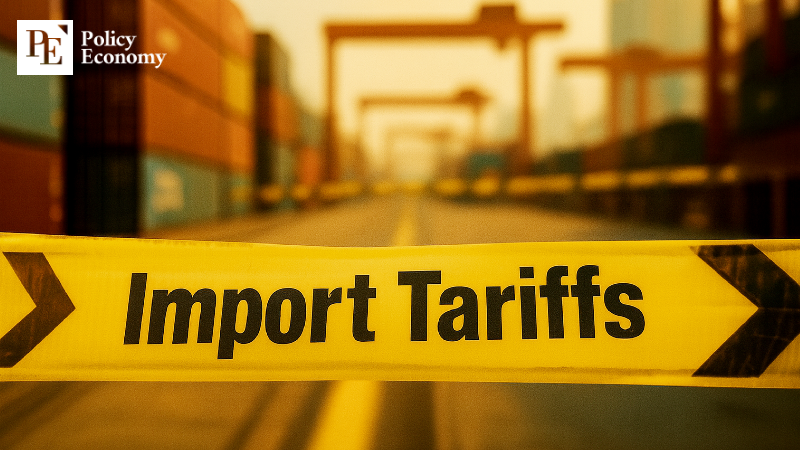
The Trump administration’s overhaul of the tariff regime into a differentiated, country-specific high-rate structure is exerting broad pressure on U.S. companies, consumers, and trading partners, delivering a multifaceted shock to the global economy. The intricate tariff system—akin to shredding the once unified tariff architecture—has intensified cost burdens and managerial uncertainty for U.S. firms, distorting investment, production, and pricing strategies. A substantial share of these costs is being passed through to consumer prices, adding to inflationary pressure. Across major trading partners such as Japan, declining exports to the U.S. and production disruptions are taking root, with tariff shocks now cascading through national economic indicators.
Unable to Invest in Product Innovation, Hiring, or Growth
On the 17th (local time), Gary Shapiro, Vice President and CEO of the Consumer Technology Association (CTA), noted in an interview with Politico that the “maze-like and erratic” tariff policy of President Trump is inflicting substantial damage. “This year has exhausted most U.S. CEOs. The scale of time executives have spent on dealing with Trump’s tariffs has been enormous,” he said, adding that “they focused not on innovation but on figuring out how to navigate tariffs.” CTA represents 1,300 member companies ranging from major brands like Amazon, Walmart, and AMD to numerous SMEs and startups.
Politico reported that “President Trump has shredded America’s tariff code by replacing the decades-old system of uniform duties—imposed on nearly all imports except a few countries—with a far more complex system in which tariff rates differ widely based on the origin of imports.” In practice, the Trump administration replaced the long-standing structure—under which most countries paid relatively uniform duties—with an intricate system in which tariff rates vary drastically by origin. For instance, industrial products previously subject to roughly 5% duties are now taxed at 15% if imported from the EU or Japan, 20% from Norway and several African nations, 24–25% from Southeast Asian countries, and more than 50% for products from India, Brazil, and China.
This complexity and uncertainty have thrown U.S. firms into disarray. From Wall Street to Main Street, companies are paying enormous costs simply to comply with the elaborate tariff regime. CEO surveys show tariffs emerging as the dominant concern. In a recent KPMG survey, 89% of CEOs said tariffs would significantly affect their earnings and operations over the next three years. Some 86% of respondents indicated they would raise prices for products and services as needed. PwC also found that many companies are spending 30–60% of organizational time on tariff-related discussions.
Moreover, the hundreds-of-billions-of-dollars tax relief expected over the next decade from U.S. tax cuts is projected to be largely offset by tariff burdens. Matthew Alessi, a director at the Milken Institute, observed, “The disruption companies are experiencing is comparable to the early days of the COVID-19 crisis,” explaining that “firms are postponing long-term strategic decisions—such as new factories, equipment investments, and expanded R&D—due to tariff uncertainty.” According to S&P Global, U.S. firms are expected to shoulder at least USD 1.2 trillion in additional tariff-driven costs this year, with roughly two-thirds ultimately passed on to consumers.
Inflation, Divergent Consumption, and Public Discontent
Tariffs already reflected in consumer prices are raising the financial burden on Americans. A study by Harvard professor Alberto Cavallo, which examined 359,148 product prices across U.S. on- and offline retailers, found that since the tariffs took effect in April, imported goods have risen 4% on average and domestic goods 2%. Cavallo noted that “most tariff-related costs are being borne by U.S. companies, with gradual pass-through to consumer prices.” While export firms are also absorbing part of these costs—as price increases lag tariff rates—the research team concluded that foreign exporters, supported by a weaker dollar, have been increasing dollar-denominated sale prices to U.S. buyers. Cavallo added that “companies are gradually raising prices over time to soften the shock from cost increases.”
The steepest price increases have appeared in products not produced domestically, such as coffee, and in goods imported from countries facing high-rate tariffs, such as Türkiye. Prices also rose for imports from China, Germany, Mexico, Türkiye, and India. The research team noted an ongoing tug-of-war among exporters, importers, and consumers over who absorbs the roughly USD 30 billion in monthly tariff expenses. Continued cost pass-through to U.S. firms and consumers risks further elevating domestic inflation.
Tariffs are also amplifying consumption bifurcation. For instance, McDonald’s saw its Q2 revenue rise 5% year-on-year, but foot traffic among its core low-income customers declined by double digits. High-income customer visits increased, nearly offsetting the losses. Price increases have been the primary driver: menu prices had already surged due to the liquidity boom during the COVID-19 pandemic, and high-rate tariffs pushed the cost of imported raw materials and ingredients further upward.
A similar pattern is visible in air travel and lodging. Delta Air Lines’ Q2 economy-class revenue fell 5% from a year earlier, while premium-class revenue rose 5%. Wealthier consumers expanded their discretionary spending as lower-income households tightened theirs. Market research firm CoStar found that revenue at high-end hotel chains rose 2.9%, while budget hotel revenue fell 3.1%.
These trends are aggravating America’s core structural issue—income inequality. The U.S. Gini coefficient for pre-tax income stands at 0.49, the highest level since the early 20th century. This is 0.09 points higher than the 0.4 level of the 1970s, and reminiscent of the 1920s preceding the Great Depression. Some economists warn that extreme inequality can trigger conflict or economic crises. Coupled with political polarization, income inequality threatens democratic stability. Both tariffs and the One Big Beautiful Bill Act (OBBBA) are expected to worsen inequality. According to the Budget Lab at Yale, combined effects of tariffs and OBBBA would reduce household income for the bottom 10% by 7%, while increasing household income for the top 10% by 1.5%.
Japan Slips Into Negative Growth Amid Export Decline
U.S. trading partners are also taking heavy damage. In Japan, the tariff shock is now clearly reflected in economic data. On the 17th, Japan’s Cabinet Office reported that real GDP for Q3 fell 0.4% from the previous quarter, or at an annualized pace of 1.8%. This marks Japan’s first negative growth in six quarters, since Q1 last year.
A sharp decline in auto and auto-parts exports—driven by higher U.S. tariffs—was the primary factor. In July, Japan negotiated a tariff agreement with the U.S. that included a USD 550 billion investment fund and lowered passenger-vehicle tariffs from 27.5% to 15%. Yet even this rate is inflicting material damage on Japan’s economy.
Stefan Angrick, Japan economist at Moody’s Analytics, said the momentum created early this year by front-loaded purchases in anticipation of Trump’s tariff hikes has dissipated. He added that the decline in exports is forcing Japanese firms—especially automakers—to shift into cost-cutting mode, potentially dampening job creation, reducing investment, and constraining wage growth, with spillover effects across the broader economy.
Other U.S. trading partners are also sustaining significant losses. A Reuters review of corporate disclosures from more than 60 major global companies released between mid-July and late September estimated that these firms face USD 21–22.9 billion in tariff-related losses this year, and about USD 15 billion in 2026. These figures are slightly higher than Reuters’ estimates from May, with automakers seeing the sharpest surge in burdens. Toyota (USD 9.5 billion) and Ford (USD 3 billion), along with European manufacturers like Volkswagen and Stellantis, are all expected to incur multibillion-dollar losses. Companies are increasing U.S. investments or relocating production to mitigate tariff exposure, but these measures also entail substantial cost.
Siobhán Delaney is a Dublin-based writer for The Economy, focusing on culture, education, and international affairs. With a background in media and communication from University College Dublin, she contributes to cross-regional coverage and translation-based commentary. Her work emphasizes clarity and balance, especially in contexts shaped by cultural difference and policy translation.
Similar Post