TSMC’s U.S. Profit Plunges 99% in Months—Will Profit Pressure Reshape the Foundry Race?

Aoife Brennan is a contributing writer for The Economy, with a focus on education, youth, and societal change. Based in Limerick, she holds a degree in political communication from Queen’s University Belfast. Aoife’s work draws connections between cultural narratives and public discourse in Europe and Asia.
Authored On
Modified
TSMC’s U.S. Unit Faces Mounting Costs, Struggles to Stay Profitable
Additional U.S. Investment Likely to Deepen Losses — Who Will Shoulder the Cost?
As Samsung and Intel Push to Gain Ground, TSMC’s Era of Unrivaled Dominance May Be Ending
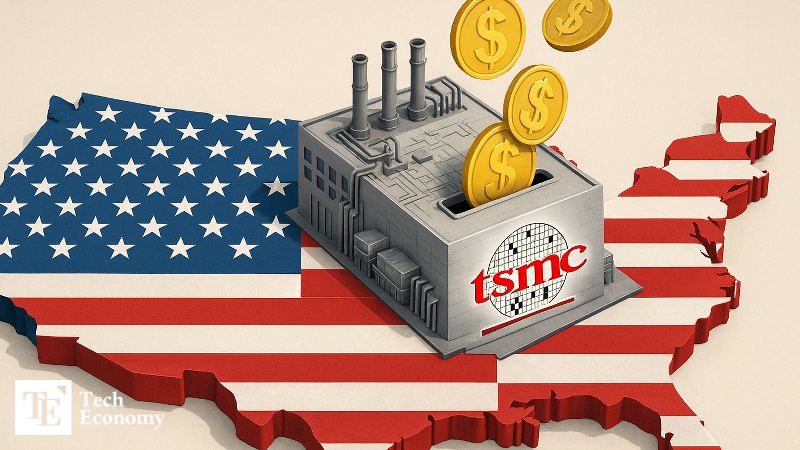
TSMC’s Arizona plant — once touted as a symbol of America’s semiconductor revival — is now grappling with a profitability shock. Construction, labor, and operational expenses have soared to several times the cost of running equivalent facilities in Taiwan, sharply denting the unit’s financial performance. With chip manufacturing gradually shifting back to the United States, analysts warn that continued cost pressure could eventually crack TSMC’s long-standing dominance in the foundry market.
TSMC’s U.S. Fab Turns Into a Costly Burden
According to Ctee on the 17th, TSMC’s Arizona subsidiary is expected to post only about $1.27 million in profit in the third quarter of 2025. This represents a 99% drop from the roughly $131 million it earned in the previous quarter. In contrast, TSMC’s consolidated net profit for the same quarter reached about $14 billion, up 39% year-on-year, with an operating margin of 50.6%. While the company’s fabs in Taiwan continue to maintain strong profitability, the U.S. operation is barely staying near the break-even point.
High operating costs are considered the primary reason for TSMC’s struggles in the United States. The Arizona Fab 1 was originally scheduled to begin operations in 2024, but intense conflict with the Arizona Building and Construction Trades Council delayed the timeline to 2025. Since 2023, the union has accused TSMC of “using low-wage, unskilled Taiwanese workers to take U.S. jobs,” pressuring the company throughout the construction process. TSMC argued that skilled technicians from Taiwan were essential to install advanced equipment, but the company eventually agreed to prioritize local hiring in line with political expectations around “job creation.” About half of the roughly 2,200 employees at the Arizona site are reportedly from Taiwan.
This shift toward local hiring may act as a barrier to TSMC’s growth. An industry insider noted that TSMC built its lead in advanced-node foundry technologies because its employees were willing to work overtime and step directly into manufacturing lines when necessary. U.S. workers hired locally tend to lack that experience and operate under different work norms, creating an unavoidable gap compared with veteran staff from Taiwan.
High utility costs in the United States add further pressure. TSMC has repeatedly stated that the cost of building and operating a fab in Arizona is four to five times higher than in Taiwan. Labor, construction, electricity, and water expenses are all significantly higher, and installing and maintaining EUV tools requires additional regulatory procedures and more expensive service contracts. Depreciation from heavy capital spending and a slow initial ramp-up are also undermining the Arizona fab’s profitability.
TSMC Continues Expanding Its U.S. Investment Despite Falling Profitability
Despite the continued decline in profitability, TSMC has been steadily increasing its investment in the United States. The company initially announced a $12 billion investment in 2020 to build a foundry line in Arizona, later increasing the amount to $65 billion. In March of this year, TSMC said it would invest at least $100 billion more in the United States over the next four years. The move is widely viewed as a response to tariff pressure from U.S. President Donald Trump, who stated that “chips made in Taiwan could face tariffs of 25%, 30%, even 50%, but chips made here won’t be subject to tariffs.”
Last month, TSMC Chairman Mark Liu said during an earnings call that the company would acquire land near its Phoenix-based Fab 21 to expand manufacturing capacity in response to strong AI-related demand. TSMC plans to build a gigafab capable of producing more than 100,000 wafers per month on the newly purchased site. Liu emphasized that the expansion is intended to support local demand from customers in AI, high-performance computing (HPC), and smartphones. Major U.S. clients such as Apple, NVIDIA, and AMD are pushing for greater local production to reduce geopolitical risks.
As investment increases, the profitability of TSMC’s U.S. subsidiary is expected to deteriorate further. A market analyst noted that Arizona inevitably carries a substantial “U.S. premium,” and someone will eventually have to absorb the cost. The burden could fall on TSMC shareholders or U.S. taxpayers, or it could be passed on to consumers if companies like Apple and NVIDIA raise the prices of next-generation chips. Some observers also speculate that TSMC may use its worsening profitability data to request additional subsidies or tax incentives from the U.S. government.
Samsung and Intel Step Up Their Pursuit
Risks emerging from TSMC’s U.S. operations are increasingly seen as a factor that could accelerate the company’s loss of market competitiveness. In a recent report, the Semiconductor Industry Association (SIA) noted that “the center of chip manufacturing in the AI era is gradually shifting from Taiwan to the United States.” This suggests not only a geographical shift in production but a broader transition in industrial leadership shaped by technology, security, and policy. For TSMC—already facing difficulties in the U.S. market—this is a damaging signal.
Samsung and Intel, meanwhile, are moving quickly to exploit the opening. Samsung has succeeded in commercializing its 3-nanometer GAA (Gate-All-Around) process, marking the start of what many describe as a “post-TSMC era.” The company began mass production a year earlier than TSMC and is now in discussions with NVIDIA on co-developing AI chips. Intel, once focused mainly on CPUs, is also repositioning itself by attracting external customers such as NVIDIA and Qualcomm to revive its foundry business. Backed by substantial subsidies under the CHIPS Act, Intel is gaining a policy advantage over TSMC.
Experts warn that if this trend continues, TSMC’s long-standing dominance in the foundry sector may soon show cracks. Brian Wu, an analyst at CLSA in Hong Kong, said that this does not mean “the TSMC era is over,” but the company can no longer be considered “invincible.” He noted that Samsung is targeting TSMC’s weakness in technological speed, while Intel is leveraging policy support. By 2026, the global foundry market could be reshaped to roughly 54% for TSMC, 23% for Samsung, and 12% for Intel. According to Counterpoint Research, as of the second quarter of this year, TSMC holds a 71% share of the global foundry market, compared with 8% for Samsung. Intel’s share is estimated at around 1–2%.
Aoife Brennan is a contributing writer for The Economy, with a focus on education, youth, and societal change. Based in Limerick, she holds a degree in political communication from Queen’s University Belfast. Aoife’s work draws connections between cultural narratives and public discourse in Europe and Asia.
Similar Post