Chinese EVs Face Mounting “Safety Risk” Concerns as Repeated Fires Shake Consumer Sentiment

Stefan Schneider brings a dynamic energy to The Economy’s tech desk. With a background in data science, he covers AI, blockchain, and emerging technologies with a skeptical yet open mind. His investigative pieces expose the reality behind tech hype, making him a must-read for business leaders navigating the digital landscape.
Authored On
Modified
Fundamental vulnerabilities in the EV industry laid bare
Beijing pledges tighter certification and oversight
A growing view that lower-income buyers bear the risk
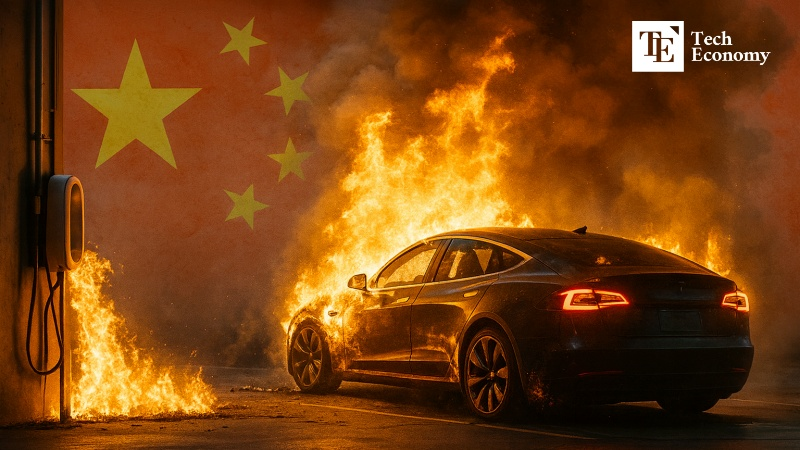
China’s fast-growing electric-vehicle market is confronting a widening trust deficit as a string of battery-related fires exposes fundamental vulnerabilities across the industry. A series of high-profile incidents involving leading brands such as BYD, Xiaomi, and Li Auto has amplified public unease, prompting questions about whether the industry’s rapid expansion has outpaced necessary safety safeguards. As these accidents accumulate, a sharper narrative is taking hold among consumers: choosing a Chinese EV increasingly feels like accepting safety risks in exchange for lower prices.
Fire Incidents Even in “Grade-A Safety Battery” Models
According to the South China Morning Post (SCMP) on the 18th, a broad safety debate is unfolding across China as concerns grow over the battery reliability of major domestic EV brands. Some consumers are reportedly reconsidering purchases altogether. Recent cases include a Xiaomi EV in Chengdu that burst into flames after a high-speed collision, killing the driver; a Li Auto vehicle in Shanghai that was engulfed within 10 seconds while driving on a rough road; and a BYD model that emitted smoke while parked in an indoor garage, prompting a fire-department response.
These incidents have become a catalyst for questioning whether China’s EV boom has outpaced the industry’s ability to validate battery-safety technologies. The China Passenger Car Association (CPCA) reported that new-energy vehicle retail sales reached 1.4 million units last month, up 17% year-on-year, with cumulative sales reaching 10.3 million this year. Although this growth is often held up as a “success story,” the rising number of battery-related fires at precisely this stage is broadening the gap between market expansion and safety perception.
Even models equipped with lithium iron phosphate (LFP) batteries—considered relatively safer—have caught fire, adding to consumer anxiety. China’s best-selling EV, the Geely Xingyuan, promoted its Aegis short-blade LFP battery as a “Grade-A safety” feature. But when a vehicle suddenly caught fire and emitted multiple explosions while driving in Suzhou, the incident severely damaged public perception. Although some analysts pointed to static electricity or flammable materials as potential causes, the scale of the fire alone inflicted lasting reputational harm.
The issue escalated further after a cargo vessel carrying 800 EVs caught fire, forcing both automakers and shipping firms into emergency response. As these large-scale accidents multiply, concerns are expanding beyond individual vehicle designs or specific battery suppliers to the idea that EVs inherently carry elevated fire risks across transport, storage, and charging stages. The cumulative effect is a growing worry that China’s high-speed EV expansion has embedded a structural weakness that could hinder the sector’s global credibility.
Risk Signals Rising Faster Than Regulation
Beijing has vowed to introduce a strengthened certification and oversight regime by July next year, aiming for what it has called a “zero fire and explosion era” for EVs. The revised national standard, “Safety Requirements for Electric-Vehicle Power Batteries (GB38031-2025),” mandates far stricter safeguards. Under previous rules, battery systems only needed to provide a five-minute warning before thermal runaway; the new framework requires containment mechanisms that prevent the pack from catching fire even after thermal runaway begins.
Although the proposal is seen as a world-first attempt to regulate internal battery reactions directly, it remains unclear whether EV and battery makers can meet the new conditions. Requirements such as underbody impact tests to minimize collision damage and short-circuit durability after more than 300 rounds of fast charging pose high hurdles, particularly for manufacturers with limited technical capacity. With regulatory tightening outpacing on-the-ground capabilities, consumer trust has shown little improvement despite policy announcements.
A lack of official data deepens skepticism. According to diplomatic and industry sources in China, there were roughly 300 EV fires between last August and this June—about one per day—affecting a wide spectrum of brands and battery types. Many incidents occurred during charging or even while parked. Yet Chinese authorities continue to avoid releasing any comprehensive official statistics, instead offering generic statements about “strengthening standards” or “improving oversight.”
This opacity fuels suspicion that “one fire per day” may itself be an understatement. With no public data on incident frequency, battery-type risks, or manufacturer-specific trends, both domestic consumers and overseas markets view government statements as politically filtered rather than evidence-based. As long as reliable information remains absent, every new regulatory update risks reinforcing—not easing—the perception that the government is filling a data vacuum with slogans instead of transparent disclosures.
“Low-Cost, High-Risk” Image Solidifies
These doubts increasingly translate into a harsh consumer narrative: buying an EV feels like “risking your life for a cheaper car.” Repeated fires, explosions, unintended acceleration claims, and even fatal accidents feed into a negative storyline that spreads quickly through social media, overwhelming any safety assurances from automakers. Even in China—where the entire EV boom has been driven by value-for-money economics—the sentiment that “EVs trade safety for price” is becoming widespread.
The Xiaomi case illustrates this shift. The October crash in Chengdu pushed Xiaomi shares down as much as 8.7% intraday. It was the fourth major Xiaomi EV accident this year, following a March autonomous-driving crash that killed three people and a June multi-vehicle collision involving 16 cars and motorcycles. In the Chengdu incident, witnesses reported that the doors would not open and the windows could not be broken, amplifying fears that the vehicle’s structure reduces survival chances in an accident.
Experts stress that this is not merely a Xiaomi problem. The accumulation of explosions, fires, casualties, and the growing disconnect between domestic sales and global exports all point to a deeper pattern: China’s EV industrial policy has prioritized speed and volume over quality and safety. Without a pivot toward safety-driven competition, analysts warn that Chinese EVs risk becoming trapped in an “inexpensive but high-risk” image similar to low-end motorcycle markets. For Chinese EVs to establish a global standard, competitive strength must shift from price to safety and technological reliability. Otherwise, the current trajectory increases the likelihood of backlash as the industry expands abroad.
Stefan Schneider brings a dynamic energy to The Economy’s tech desk. With a background in data science, he covers AI, blockchain, and emerging technologies with a skeptical yet open mind. His investigative pieces expose the reality behind tech hype, making him a must-read for business leaders navigating the digital landscape.
Similar Post
















