Humanoid Robots and the Division of Labor: Between Commercial Reality and Futuristic Fantasy

Matthew Reuter is a senior economic correspondent at The Economy, where he covers global financial markets, emerging technologies, and cross-border trade dynamics. With over a decade of experience reporting from major financial hubs—including London, New York, and Hong Kong—Matthew has developed a reputation for breaking complex economic stories into sharp, accessible narratives. Before joining The Economy, he worked at a leading European financial daily, where his investigative reporting on post-crisis banking reforms earned him recognition from the European Press Association. A graduate of the London School of Economics, Matthew holds dual degrees in economics and international relations. He is particularly interested in how data science and AI are reshaping market analysis and policymaking, often blending quantitative insights into his articles. Outside journalism, Matthew frequently moderates panels at global finance summits and guest lectures on financial journalism at top universities.
Authored On
Modified
Technical Bottlenecks in Humanoid Robotics
Commercialization Hurdles Amidst Lofty Expectations
Early-Stage Operational Structures Still Dependent on Human Oversight
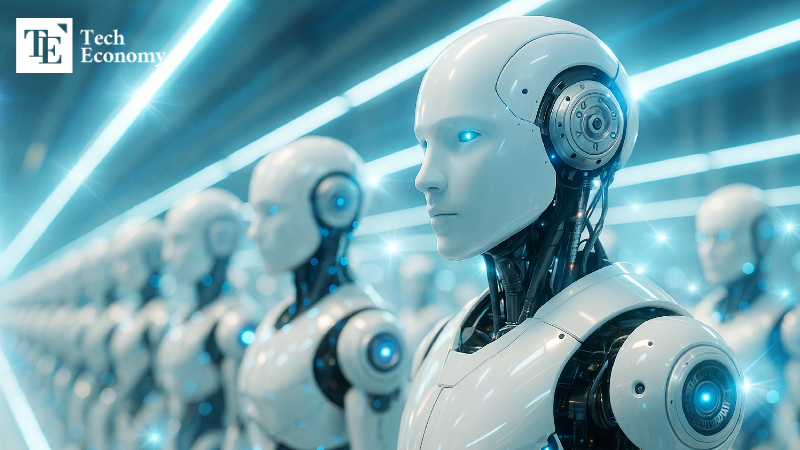
As humanoid robots equipped with artificial intelligence (AI) begin to enter industrial sites and service sectors, analysts warn that the global economy may be heading toward an era dominated by capital ownership rather than wage labor. Some even predict the collapse of the wage-based system that has sustained capitalism for over two centuries. However, experts caution that such projections overlook persistent technological bottlenecks — including limited power capacity, battery and precision component shortages, and the ongoing failure to replicate human tactile sensitivity. Despite accelerating experimentation, the path toward true commercialization remains steep.
Deployment Across Chinese and Russian Industries
According to reports from ABC News Australia and aviation outlet View from the Wing, humanoid robots are already being deployed in manufacturing and service environments, prompting debate about structural shifts in labor and the erosion of white-collar employment. Chinese robotics firm UBTECH recently began supplying hundreds of its humanoid “Walker S2” units to automakers and logistics companies, including BYD, Geely, and Volkswagen’s joint venture plants. Around 500 robots are slated for installation within the year. The Walker S2 is capable of autonomously replacing its own battery, enabling continuous 24-hour operation without human assistance.
In Russia, Pobeda Airlines, a subsidiary of Aeroflot, introduced “Volodya” — a humanoid robot built on Unitree’s G1 model — aboard a Boeing 737 flight bound for Moscow on November 23. The robot greeted passengers, checked boarding passes, and held short conversations as it moved through the aisles. Although incapable of performing safety duties or handling emergencies, industry observers view this as the first step toward what they call “silent automation.” Technologists predict that while robots will initially perform repetitive tasks, they will soon move into areas requiring higher cognitive functions as their data repositories grow.
UBTECH has also begun preliminary work to integrate humanoid robots into electric vehicle assembly lines in partnership with Geely. In Amazon’s logistics centers — which announced plans last month to lay off roughly 30,000 employees, or 10% of its workforce — humanoid robots had already been sorting parcels for two years, signaling the onset of a long-anticipated wave of automation.
ABC News forecasts that the current humanoid price range of $50,000–$100,000 will drop below $10,000 once mass production begins. The report suggested that household, educational, caregiving, and manual labor robots could become as commonplace as smartphones. View from the Wing added that white-collar jobs may face greater displacement than blue-collar ones, citing the aviation industry as an example where back-office staff are likely to be replaced by humanoids before cabin crew are.
Early-Stage Technology, Stalled Corporate Initiatives
Despite optimism, experts agree that numerous technical hurdles make commercialization unlikely in the near term. When Elon Musk first unveiled plans for Tesla’s “Optimus” in 2021, expectations were high that humanoid development had become accessible. Yet the following year’s prototype disappointed audiences — with industry voices deriding it as “graduate-student level work.” Compared with Boston Dynamics’ Atlas and earlier models such as Honda’s ASIMO, Optimus showed no significant advantage, dampening early enthusiasm.
Even as technical feasibility improves, major corporations remain reluctant to advance humanoid programs. Once-celebrated projects like Sony’s ASIMO, Toyota’s Partner, and KAIST’s HUBO have all stagnated, with little sign of follow-up development.
Figure AI, a robotics startup founded by former Tesla engineers, raised $1 billion but ultimately abandoned its humanoid project due to technical constraints. Tesla, too, has failed to demonstrate tangible progress with Optimus. While Musk initially pledged to produce 5,000 units by the end of the year, actual output has reportedly remained in the hundreds. The recently unveiled Master Plan 4 offered no clear timeline for factory deployment.
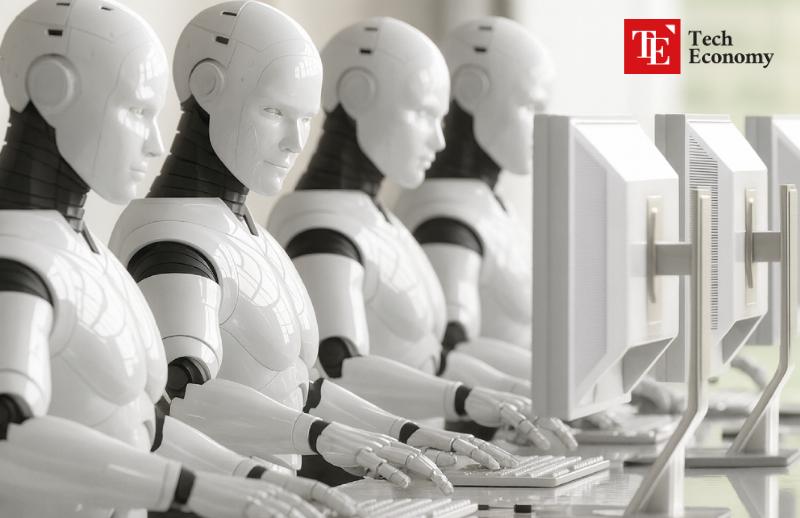
Gap Between Market Hype and Technological Maturity
Experts identify the high cost and power demand of AI-optimized embedded GPUs as one of the biggest obstacles. Nvidia’s AGX Thor chip, commonly used in industrial robotics, costs around $3,400 and consumes 130 watts of power. Even older Orin chips require roughly one second of computation per motion — a lag that prevents smooth responsiveness to environmental changes. Current operation modes remain heavily dependent on human supervision.
Further limitations arise from component-level issues such as insufficient battery capacity causing frequent downtime, limited output of high-precision screws required for robotic joints, and the difficulty of producing tactile sensor-equipped robotic hands for fine tasks. Though the humanoid robot market could reach $170 billion within five years, analysts agree that corporate efforts alone are insufficient to usher in the humanoid era.
This explains why many experts remain skeptical of widespread commercialization. Rodney Brooks, a robotics pioneer from MIT, argued in a recent essay that “billions of dollars are being wasted on humanoid startups,” calling their training methods — where robots mimic human motion through video — a “fantasy of imagination.” He emphasized that human fingertips contain around 17,000 tactile receptors that robots cannot yet replicate, noting that the lack of accumulated tactile data represents a fundamental limitation. “Machine learning advanced in voice and image recognition because of decades of data accumulation,” he wrote. “Robotics lacks that foundation.”
Even in China, which has recently surged ahead in humanoid robotics, a “humanoid bubble” debate is spreading. Fu Sheng, CEO of mobile app developer Cheetah Mobile, criticized the sector as “not only a bubble but one harmful to the industry,” arguing that companies are “focused solely on showmanship” and that “founders who don’t make humanoid robots can’t attract funding, while nobody is working on the essential groundwork.”
Lin Zilong, head of southern China operations at Unitree, echoed this sentiment. “Market understanding of the humanoid industry is extremely shallow,” he said. “Because outsiders dominate the discourse, expectations are inflated. The industry is still at a toddler’s stage — maybe three or four years old — yet people expect PhD-level performance.” Lin added that Unitree’s humanoids are sold mainly for research or exhibition purposes, not for true commercial use. “There is no genuine commercialization of humanoid robots yet,” he concluded.
Matthew Reuter is a senior economic correspondent at The Economy, where he covers global financial markets, emerging technologies, and cross-border trade dynamics. With over a decade of experience reporting from major financial hubs—including London, New York, and Hong Kong—Matthew has developed a reputation for breaking complex economic stories into sharp, accessible narratives. Before joining The Economy, he worked at a leading European financial daily, where his investigative reporting on post-crisis banking reforms earned him recognition from the European Press Association. A graduate of the London School of Economics, Matthew holds dual degrees in economics and international relations. He is particularly interested in how data science and AI are reshaping market analysis and policymaking, often blending quantitative insights into his articles. Outside journalism, Matthew frequently moderates panels at global finance summits and guest lectures on financial journalism at top universities.
Similar Post