Global expansion efforts by LG CNS face a “trust in quality” barrier as its Indonesia project proceeds

Niamh O’Sullivan is an Irish editor at The Economy, covering global policy and institutional reform. She studied sociology and European studies at Trinity College Dublin, and brings experience in translating academic and policy content for wider audiences. Her editorial work supports multilingual accessibility and contextual reporting.
Authored On
Modified
Preceding quality controversies hinder trust
Corporate value hinges on overseas expansion results
Korean IT management and response capabilities under scrutiny
LG CNS has begun a project to migrate a major Indonesian conglomerate’s enterprise resource planning (ERP) system to the cloud, but industry sentiment in Indonesia remains lukewarm, drawing attention to underlying causes. Errors and delays that surfaced during the development of a government system in the past led to public criticism from local authorities, elevating trust concerns. Combined with negative foreign-investor sentiment referenced from its listing period, the company’s broader ambitions to expand IT services abroad now appear somewhat diminished.
Internal credibility issues over IT quality
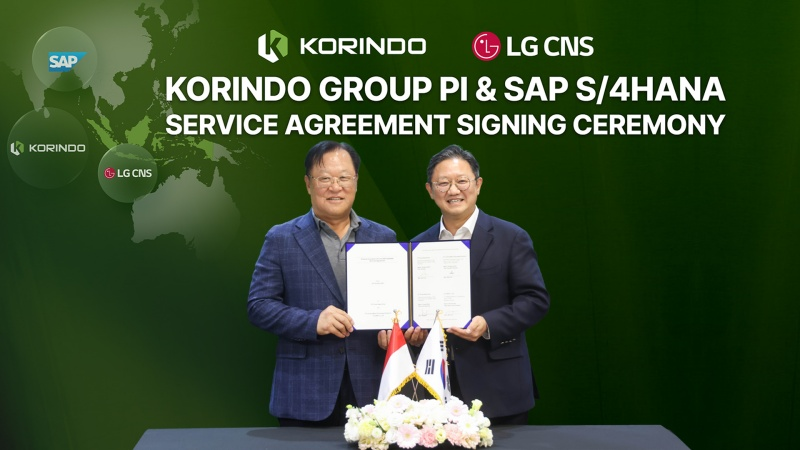
According to industry sources on the 25th, LG CNS began work earlier this month to migrate the on-premise SAP ERP system of Indonesia’s KORINDO Group to a cloud-based ERP. Headquartered in Jakarta, KORINDO operates across palm oil, heavy industries, finance, shipping, logistics, wind power, and renewable energy. LG CNS stated that the cloud transition would reduce infrastructure management burdens and introduce global-standard business processes.
Local reactions, however, have been subdued. During LG CNS’s development and operation of Coretax, the Indonesian Directorate General of Taxes’ central tax-administration system, repeated errors and functional failures occurred. Login delays, filing errors, and data-synchronization failures led Indonesia’s Minister of Finance, Yudi Sadeva, to issue strong public criticism. He said at a press briefing that “the level of Korean developers is equivalent to vocational-school programmers” and even raised the possibility of terminating the contract.
He further criticized the structure in which external vendors retained system control, asserting this caused improvement delays, and the Finance Ministry stated that it would obtain the source code and begin making direct modifications. These assessments have placed considerable pressure on the KORINDO ERP transition as well. Practical issues from previous large-scale public projects are now seen as influencing corporate clients’ decisions more heavily than LG CNS’s claims of efficiency. Many in the industry believe quality and trust must be restored before any efficiency narrative gains traction.
Within LG Group, many say the company expected these outcomes. One internal source noted that the company’s self-developed internal chat system had long suffered from functional inconvenience and stability issues, accumulating employee complaints, and was ultimately replaced with Microsoft Teams. This has been interpreted as a sign that a company hoping to export IT services globally was not able to satisfy even its own affiliated firms. With Coretax errors, public criticism, structural debates over control, and internal-system failures overlapping, LG CNS now finds its new project beginning from a weakened foundation of technical trust.
“Overseas expansion” as core strategy
Given that LG CNS emphasized global expansion as a key part of its business strategy at the time of its stock-market debut, these evaluations are all the more damaging. The company stated in its IPO filing that of the approximately 352 million USD it expected to raise, roughly 226 million USD would be allocated for acquiring overseas IT-specialist firms. Selecting Japan’s NTT Data as a peer group also underscored its intent to follow global market models and revenue structures.
Overseas sales trends likewise reinforced the centrality of global expansion. LG CNS’s overseas revenue share rose from 12.4% in 2021 to 14.7% in 2022 and 18% in 2023. As of the third quarter last year, the company had generated about 486 million USD in overseas sales alone. Given this momentum, analysts widely agreed that post-IPO corporate valuation would hinge on overseas performance.
The company’s Indonesia AI data-center contract has also been used as evidence of its global expansion. In August, LG CNS secured a 68.5 million USD AI data-center project through its joint venture with Indonesia’s Sinar Mas Group. Scheduled for completion in 2026, the facility is designed to host more than 100,000 servers, with power-intake capacity expanding from 30MW to 220MW. This strengthened LG CNS’s narrative of infrastructure-building capabilities and joint-venture-based overseas business models.
The company also committed to improving its financial structure and actively pursuing acquisitions from 2027, specifically in finance, public-sector digital transformation, AI/software, and smart-engineering fields. These plans went beyond aspirational expansion and approached the level of a concrete managerial roadmap. Seen in this context, the trust issues surfacing in Indonesia cast doubt on the very growth model the company presented during its listing.

Core capabilities questioned, limiting overseas expansion
Recently, concerns raised by global investors during the IPO have resurfaced as well. During January’s book-building, LG CNS attracted 2,059 institutional investors and recorded a 114:1 subscription ratio. Yet foreign institutions accounted for only 3% of orders, and just 15 institutions requested lock-up commitments. In major IPOs, foreign participation typically hovers around 10%, making this a clear signal that overseas investors doubted LG CNS’s growth prospects.
Foreign hesitation is rooted in skepticism toward the profitability limitations of Korean system-integration firms and uncertainty about LG CNS’s technical and operational capabilities in serving global clients. Despite operating development hubs in Vietnam, Indonesia, and India, and launching ERP products in the U.S. and Japan, many institutions concluded that “as an SI-origin company, it lacks the levers needed to support sustained profitability.” This indicated that trust gaps existed even before the company fully engaged in global expansion.
The issue is not confined to LG CNS. Repeated security incidents and response failures across Korea’s IT sector have raised broader questions about whether Korean firms meet global expectations for management and response frameworks. Recent hacking cases exposed delays in disclosure and sluggish initial responses. KT recognized a server breach but responded only after deadlines had passed, while Yes24 provided false guidance after a ransomware attack until Korea Internet & Security Agency contradicted its statements.
These cases shared a common trait: damage was amplified more by concealment and delayed action than by technical failures. Government surveys showed that only 19.6% of companies reported security incidents and just 32.3% took follow-up actions; only 3% operated dedicated security teams. Many SMEs delayed investment due to budget constraints. Consequently, concerns have grown that Korean firms still fall short of global security-governance standards. The challenges LG CNS faces thus illustrate not only a company-specific failure but a broader shortfall in the Korean IT industry’s capabilities.
Niamh O’Sullivan is an Irish editor at The Economy, covering global policy and institutional reform. She studied sociology and European studies at Trinity College Dublin, and brings experience in translating academic and policy content for wider audiences. Her editorial work supports multilingual accessibility and contextual reporting.
Similar Post