India Accelerates Its Tech Push, Absorbing Talent Shut Out by U.S. Visa Barriers

As one of the youngest members of the team, Tyler Hansbrough is a rising star in financial journalism. His fresh perspective and analytical approach bring a modern edge to business reporting. Whether he’s covering stock market trends or dissecting corporate earnings, his sharp insights resonate with the new generation of investors.
Authored On
Modified
India Expands Support for Advanced Industries, Including Electronics and AI
U.S. H-1B Fee Hike Seen as a Boost to India’s Push for Its Own Talent Pipeline
“Bring Talent Home, Not to America” — Signs of a Shift in the Global Hiring Landscape

India is accelerating its push to become a self-sustaining technology hub. With large-scale government support laying the foundation for advanced industries, the country is moving to pull back talent that has been constrained by U.S. visa barriers and integrate it into its own ecosystem. Analysts warn that if this trend continues, it could trigger a major realignment in the global hiring market, which has long revolved around the United States.
India Accelerates Its Rise as a Technology Hub
According to the IT industry on the 25th, India is stepping up efforts to build an independent tech ecosystem, backed by aggressive government spending. On the 21st, the Ministry of Electronics and Information Technology (MeitY) approved 17 additional projects under the Electronic Components Manufacturing Scheme (ECMS). This follows the first-round approval last month of seven projects worth $915 million, marking back-to-back policy actions within a month. The latest approvals amount to $1.18 billion.
The ECMS is an incentive program designed to expand India’s domestic electronic-components base—the foundation of manufacturing. It aims to move the industry beyond final-product assembly toward core component production, increasing the share of India’s internalized supply chain. The government expects the initiative to deliver $10.78 billion in induced production and create 11,808 direct jobs, far surpassing the scale of the facilities themselves.
India also approved $1.2 billion last year for its national AI initiative, the IndiaAI Mission, marking the world’s third-largest government-led AI investment after the United States and China. MeitY plans to provide 19,000 GPUs—including 13,000 NVIDIA H100 units—for research, supporting the development of six large-scale AI models. Local companies are ramping up model development with this support: Sarvam AI plans to release a 70-billion-parameter multilingual model with inference and speech capabilities by year-end, while Soket AI Labs is building a 120-billion-parameter model and Gan.ai is developing a 70-billion-parameter system.
Will India Absorb Its Own Displaced Talent?
As India rapidly builds out the foundations of its advanced-industry ecosystem, efforts to secure skilled workers are also accelerating. Tata Electronics—the electronics arm of India’s largest conglomerate, Tata Group—signed an MOU with the National Institute of Electronics & Information Technology (NIELIT) in Kohima to develop hands-on semiconductor training programs. The partnership focuses on cultivating talent for back-end processes such as assembly, testing, marking, and packaging (ATMP). The strategy is aimed at building a stable domestic talent pipeline and reducing reliance on overseas labor.
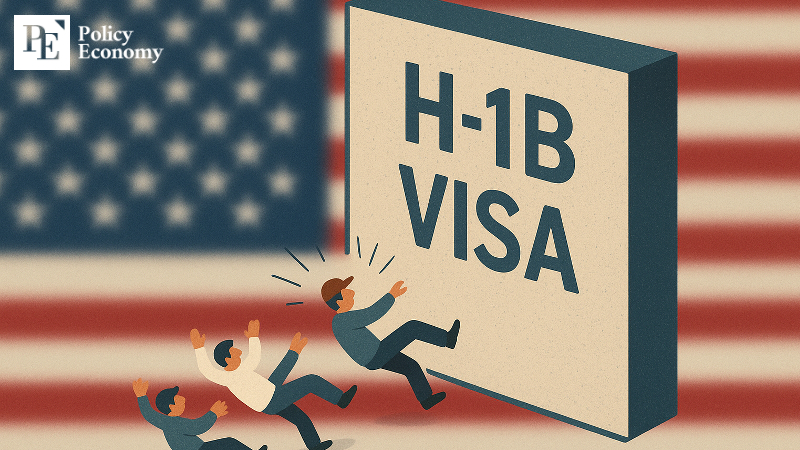
A major reason India is now able to pursue stronger talent retention is the shift in the U.S. H-1B visa pipeline. In September, President Donald Trump signed an executive order raising the H-1B visa fee for foreign skilled workers to $100,000, up from the previous cost of roughly $1,500—a dramatic tightening of access. The rule applies to visa petitions filed after 12:01 a.m. Eastern Time on September 21 by applicants outside the United States who do not already hold a valid H-1B.
The country hit hardest by the fee hike is India. The H-1B program is designed to bring foreign STEM talent into the U.S., and Indians dominate its usage: of 399,395 H-1B holders last year, 283,397—about 71%—were Indian nationals. One market analyst noted, “For many Indians, the H-1B has long been a realistic gateway to the American Dream. Income earned in the U.S. often flowed back into real-estate and other investments in India, contributing to the country’s economic boom.” With the higher fees sharply restricting the movement of high-skilled Indian STEM workers into the U.S., the analyst added, “the Indian government and domestic companies are now moving aggressively to absorb this talent and strengthen their own technological competitiveness.”
U.S. Industry and Academia Could Face Major Strains
The sharp increase in H-1B visa fees may ultimately backfire on the United States. Indian workers form one of the core pillars supporting the U.S. labor market, especially in IT. According to Freedom of Information Act (FOIA) data, Indians held more than 80% of “computer-related” jobs in 2015—a share industry observers say has changed little over the past decade.
Indian talent is also deeply embedded in U.S. healthcare. In 2023 alone, more than 8,200 H-1B visas were approved for workers in general medical and surgical hospitals. India is the largest source of international medical graduates in the United States, accounting for about 22% of all foreign-trained physicians. Given that international doctors make up as much as one-quarter of all U.S. physicians, roughly 5–6% of America’s doctors are Indian H-1B holders. If these workers disappear from the system, labor shortages in healthcare could quickly worsen. U.S. tech startups and universities may also face new challenges attracting STEM talent.
Another risk for the United States is the shifting global talent landscape. As more workers blocked by U.S. visa barriers move to Canada, Europe, Australia, and elsewhere, a new competitive and collaborative hiring dynamic is emerging. The United States—long the top destination for global talent thanks to opportunity and openness—now faces growing competition. Rival economies are accelerating “post-America” recruitment strategies by offering faster visa processing and clearer paths to permanent residency.
As one of the youngest members of the team, Tyler Hansbrough is a rising star in financial journalism. His fresh perspective and analytical approach bring a modern edge to business reporting. Whether he’s covering stock market trends or dissecting corporate earnings, his sharp insights resonate with the new generation of investors.
Similar Post