“Drop U.S. Chips”: China Accelerates Semiconductor Self-Reliance, Pulling Nvidia Into a High-Stakes Power Clash

Aoife Brennan is a contributing writer for The Economy, with a focus on education, youth, and societal change. Based in Limerick, she holds a degree in political communication from Queen’s University Belfast. Aoife’s work draws connections between cultural narratives and public discourse in Europe and Asia.
Authored On
Modified
China Moves to Push Out U.S.-Made AI Chips Like Nvidia’s
China’s AI Chip Industry Advances Quickly, but Supply Remains Unstable
Trump Signals Tighter Export Controls — Nvidia Braces for a Major Market Loss
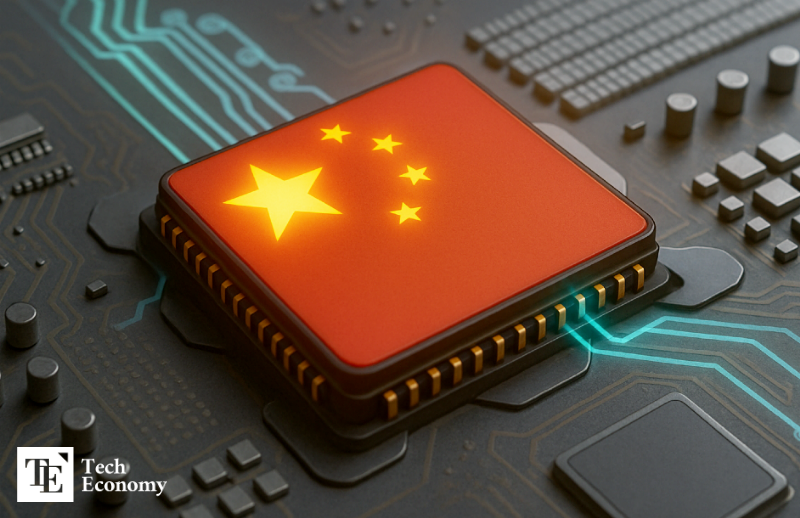
China is accelerating its push for semiconductor self-reliance. After requiring new data centers to use domestic AI chips, Beijing has now urged major tech firms—including ByteDance, the parent company of TikTok—to scale back their reliance on Nvidia hardware. The shift reflects China’s confidence in the rapid quantitative and qualitative growth of its own AI-chip industry.
China Urges ByteDance to Curb Use of Nvidia Chips
On Nov. 26, U.S. tech outlet The Information reported that Beijing has asked ByteDance to stop using Nvidia’s AI chips. Instead, the government has pushed the company to adopt hardware made by domestic suppliers such as Huawei and Cambricon. Sources told the outlet that ByteDance has been the largest buyer of Nvidia chips in China this year and has stockpiled compute capacity in preparation for tighter U.S. export controls.
Beijing has long sought to reduce reliance on U.S. semiconductors. When Washington reauthorized shipments of Nvidia’s H20 to China in July, Chinese authorities warned local firms against using the chip, citing security concerns. In September, regulators instructed ByteDance and Alibaba to halt orders and testing of the China-only “RTX Pro 6000D” and deployed customs officials to block Nvidia chip imports at major ports.
Most recently, Reuters reported on Nov. 5 that the government issued a directive requiring state-funded AI data centers to use only domestic AI chips. The rule goes far beyond the previous guideline— which required existing facilities to use at least 50% Chinese chips—by forcing new and early-stage projects (less than 30% complete) to remove all foreign AI chips already installed. China currently has 400–500 data centers under construction, supported by roughly $100 billion in government funding.
China’s AI Chip Market Gains Momentum
Beijing appears confident that its domestically developed AI-chip technologies—nurtured amid U.S. pressure—have reached a meaningful level of maturity. Chinese chipmakers are now posting unprecedented growth and expanding their presence in the global market.
Hygon reported $1.06 billion in revenue in the first half of this year, up 45.21% from a year earlier, with net profit rising 40.78% to $234.9 million. Cambricon, long plagued by losses, saw its first-half revenue surge 4,347.82% to $563.4 million, while net profit reached $203 million, marking a clear return to profitability.
Technological capability is also improving rapidly. Industry analyses suggest Huawei’s Ascend 910C delivers inference performance at roughly 60% of Nvidia’s H100, while offering exceptional price efficiency: it costs about 30% of Nvidia’s A100 yet delivers around 80% of its performance. Huawei is now developing the next-generation Ascend 910D, which some analysts say could potentially outperform the H100.
However, supply remains tight. The Wall Street Journal reported on Nov. 12 that the Chinese government is directly involved in chip production at SMIC, prioritizing supply for Huawei. While Beijing is steering AI developers toward Huawei’s 910C for both training and inference, production still falls well short of market demand. Government intervention in the supply chain is aimed at better balancing demand and accelerating industry development.
Nvidia Warns: “Our China Revenue Is Now 0%”
Nvidia is openly expressing alarm as it loses access to one of its largest markets amid the escalating U.S.–China tech rivalry. Speaking with reporters after a keynote address at the APEC CEO Summit in Gyeongju on Oct. 31, CEO Jensen Huang said, “Just a few years ago, we held a 95% market share in China. Today, our China revenue is effectively 0%,” adding that he hopes the situation will improve. As Beijing tightens restrictions on foreign-made chips, domestic suppliers such as Huawei and Cambricon stand to gain—further complicating Nvidia’s path back into China.
Huang issued another stark warning on Nov. 5 at an AI event in London, saying that “China will surpass the United States in AI,” a comment made in the context of comparing U.S. state-level AI regulations with China’s heavy subsidies. The remark sparked strong reaction, as it came shortly after President Donald Trump said in a CBS interview on Nov. 2 that he intends to prevent any country outside the U.S. from possessing the most advanced chips.
Decisions on Nvidia’s China exports now rest directly with President Trump. In an interview with Bloomberg on Nov. 24, U.S. Commerce Secretary Howard Lutnick said export approvals “will be made at the president’s desk,” noting that Trump “is considering a wide range of advice” and “understands President Xi better than anyone.” Lutnick acknowledged that Huang has “valid reasons” for wanting to sell chips to China and that “many people agree with him,” but stressed the inherent tension between economic growth and national security. “The choice is whether to let China keep using our technology by selling chips, or to hold back and fully engage in the AI race,” he said.
Aoife Brennan is a contributing writer for The Economy, with a focus on education, youth, and societal change. Based in Limerick, she holds a degree in political communication from Queen’s University Belfast. Aoife’s work draws connections between cultural narratives and public discourse in Europe and Asia.
Similar Post
















