U.S. Peace Plan Illusions: Putin Draws Lines, Poland and South Korea Rethink Security

Niamh O’Sullivan is an Irish editor at The Economy, covering global policy and institutional reform. She studied sociology and European studies at Trinity College Dublin, and brings experience in translating academic and policy content for wider audiences. Her editorial work supports multilingual accessibility and contextual reporting.
Authored On
Modified
Russia maintains a hard line on territorial issues
Ukraine signals alignment with Washington’s direction
Security anxieties grow within U.S.-dependent alliances
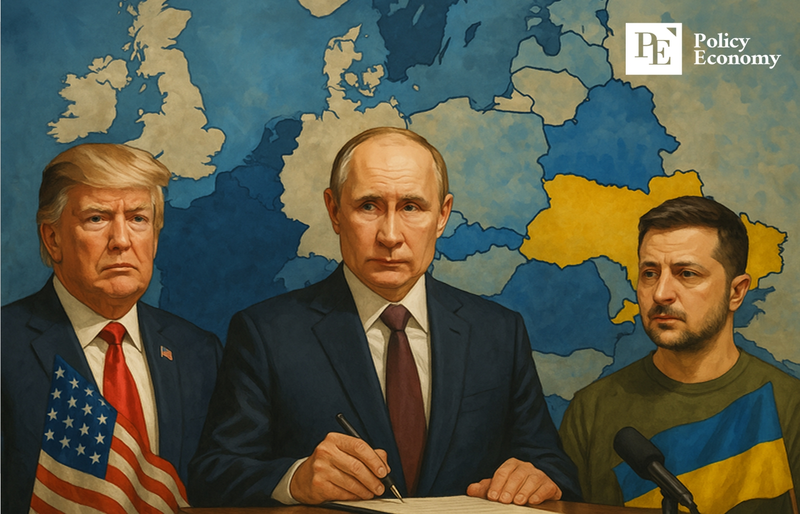
The United States’ proposed peace plan for Ukraine has produced unexpected ripple effects. Washington and Kyiv appear ready to move forward after substantial coordination, but Moscow has dismissed the document as little more than a “list of questions,” raising the bar for any agreement. As disclosures from confidential channels revealed that some elements closely resembled Russia’s own demands, unease among U.S. partners has deepened. The development is feeding broader skepticism about a U.S.-centric global order and is likely to prompt countries to reassess their national security strategies.
Russia demands fulfillment of “preconditions”
According to the Financial Times on the 27th (local time), Russian President Vladimir Putin told reporters after the Collective Security Treaty Organization (CSTO) summit in Bishkek, Kyrgyzstan, that the recently disclosed 28-point U.S. peace proposal for Ukraine could not be regarded as a treaty. He said the document was “not even a draft, just a list of questions,” acknowledging that Washington had outlined a framework for discussions but emphasizing that it was not yet adequate as a basis for an agreement.
Putin argued that the proposal fails to meet Russia’s core conditions. Moscow has repeatedly insisted that Ukraine must withdraw from territories Russia considers its own under international law—namely Crimea, the Donbas regions of Luhansk and Donetsk, and additional areas currently under Ukrainian control—before it will enter substantive negotiations. “If Ukrainian troops withdraw from the areas they control, we will also halt fighting,” Putin said, while reiterating that without such withdrawals, Russia would continue pursuing its military objectives.
U.S. Special Envoy Steve Witkoff plans to visit Russia early next week to pursue an agreement on the American proposal. However, with Russia elevating territorial recognition as a prerequisite, the likelihood of meaningful progress remains slim. Russian political analyst Tatiana Stanovaya wrote on X that Putin “sees no compelling reason to revise his goals or withdraw his key demands,” adding that he appears more confident than ever about the war’s trajectory and is prepared to wait until all his terms are met.
The unfolding situation is also expected to affect global energy markets. On the 25th, crude prices fell more than 1 percent after news that the U.S. peace plan had been delivered to both Russia and Ukraine. West Texas Intermediate (WTI) futures for January delivery closed down 1.51 percent at USD 57.95 per barrel on the New York Mercantile Exchange, while Brent crude for February delivery slipped 1.4 percent to USD 62.48 on ICE Futures Europe. But with Russia signaling no recognition of progress, analysts expect renewed short-term volatility.
Dual messaging despite early coordination signals
Market expectations for a potential ceasefire briefly rose after indications that Ukraine had agreed to substantial portions of the U.S. proposal. On the 23rd, Washington and Kyiv issued a joint statement announcing that they had established a “peace framework” aimed at ending the nearly four-year conflict. The statement said any future agreement must “fully safeguard Ukraine’s sovereignty and ensure a sustainable and just peace.” Ukrainian President Volodymyr Zelensky stressed that “many changes” were underway and that the Trump administration was beginning to heed Ukraine’s position.
Despite the polished diplomatic language, the actual coordination was far from smooth. President Trump complained publicly that “Ukraine never expresses gratitude for U.S. efforts,” and pressured Kyiv by setting Thanksgiving Day (the 27th) as an informal deadline for agreement. In response, Ukraine added language to the joint statement expressing “deep appreciation for America’s continued and unwavering commitment to ending the war and saving lives,” in an effort to placate Trump.
Reports later emerged that the draft peace framework included provisions for Ukraine to concede large parts of the Donbas to Russia, reduce its armed forces to around 600,000 troops, and pursue security guarantees from the United States and Europe in lieu of formal NATO membership. U.S. Secretary of State Marco Rubio said the proposal contained “26 or 28 articles” and that narrowing the remaining gaps would be the next challenge, suggesting that negotiations over fine details remain unresolved. Washington’s draft appears to have become the basis for an ongoing, largely invisible tug-of-war.
A phone call obtained by Bloomberg between the lead U.S. and Russian negotiators revealed that back-channel discussions had begun far earlier than publicly known. In a five-minute call last month between Steve Witkoff and Yuri Ushakov, Putin’s special envoy, Witkoff emphasized he had been given “significant discretion” by President Trump and proposed that the two envoys craft a peace plan together—one that would include transferring all of Donetsk to Russia in exchange for concessions elsewhere. The ideas discussed were subsequently formalized into a 28-point document that received Trump’s approval before later becoming public.
That these talks occurred before Ukraine’s formal agreement has complicated interpretations further. Even though Washington and Kyiv emphasized substantial progress, Russia had evidently received and reviewed the materials much earlier. From this perspective, Putin’s dismissal of the U.S. proposal as “just a list of questions” appears aimed at shaping a more advantageous negotiating environment. His sharp divergence between public and private messaging reflects a familiar dual-track tactic that has increasingly defined the current diplomatic landscape.
U.S. diplomatic credibility under strain
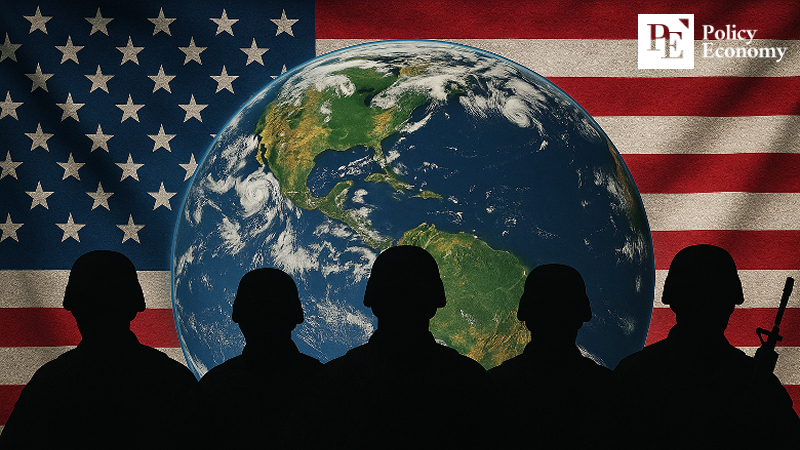
The global community is now scrutinizing the implications. Many observers view the U.S.-led peace proposal as evidence that “the era of America as an absolute security guarantor” may be fading. Polish political columnist Stewart Dowel wrote in a commentary for TVP World that the plan “undermines Pax Americana and places Poland in danger,” adding that Poland “can no longer rely solely on Washington.” While the United States and Russia discuss a new balance of power over Ukraine, Poland—another directly affected party—finds itself informed of outcomes rather than included at the negotiating table.
Since 1989, Poland has cultivated an image as a “loyal ally” by sending troops to Iraq and hosting U.S. forces and missile-defense systems. Yet it was excluded from the core peace discussions, in stark contrast to the United Kingdom, France, and Germany—the so-called E3—who sat alongside Ukraine to present counterproposals to Washington. For Poland, a front-line state whose security strategy has long assumed U.S. military strength and NATO expansion, the proposal represents a dividing line between being “inside” or “outside” the room—and raises deeper questions about the post-Cold War order itself.
South Korea, too, must reassess its defense posture. Despite demonstrating alliance contributions through participation in the Vietnam War, Iraq reconstruction, and deployments in Afghanistan, Seoul must now examine how its security framework might evolve amid U.S.–China rivalry and simultaneous crises involving North Korea and the Taiwan Strait. CNN recently highlighted the growing debate in South Korea over potential “independent nuclear armament,” noting that as North Korea’s capabilities advance, many South Koreans question whether the United States would risk its own homeland to defend Seoul. The report concluded that alongside alliance-based deterrence, the belief is spreading that South Korea must be prepared to “shoulder the worst-case scenario on its own.”
This ultimately leads back to a fundamental question: Can Washington’s security umbrella still be fully trusted? The assessment emerging from Eastern Europe—that “the era of a single guarantor is over”—is increasingly becoming a concrete strategic premise rather than an abstract notion in East Asia as well. The U.S. role in the Ukraine peace effort, and the controversies surrounding it, are prompting allies to see Washington less as an absolute guarantor and more as an actor whose commitments may shift with its interests.
Niamh O’Sullivan is an Irish editor at The Economy, covering global policy and institutional reform. She studied sociology and European studies at Trinity College Dublin, and brings experience in translating academic and policy content for wider audiences. Her editorial work supports multilingual accessibility and contextual reporting.
Similar Post