[AI Semiconductor] Divergent Calculus over the H200: Trump Unlocks the Gate as Xi Bolts the Door

Matthew Reuter is a senior economic correspondent at The Economy, where he covers global financial markets, emerging technologies, and cross-border trade dynamics. With over a decade of experience reporting from major financial hubs—including London, New York, and Hong Kong—Matthew has developed a reputation for breaking complex economic stories into sharp, accessible narratives. Before joining The Economy, he worked at a leading European financial daily, where his investigative reporting on post-crisis banking reforms earned him recognition from the European Press Association. A graduate of the London School of Economics, Matthew holds dual degrees in economics and international relations. He is particularly interested in how data science and AI are reshaping market analysis and policymaking, often blending quantitative insights into his articles. Outside journalism, Matthew frequently moderates panels at global finance summits and guest lectures on financial journalism at top universities.
Authored On
Modified
Conditional U.S. Approval for Nvidia’s H200 Exports to China, with 25% of Revenue Paid to Washington
China Bars Foreign Chips from State-Funded Data Centers, Targets 82% Self-Sufficiency by 2027
Beijing Pushes Huawei and Domestic Champions, but Concerns Persist over Technology Gap and Dependency
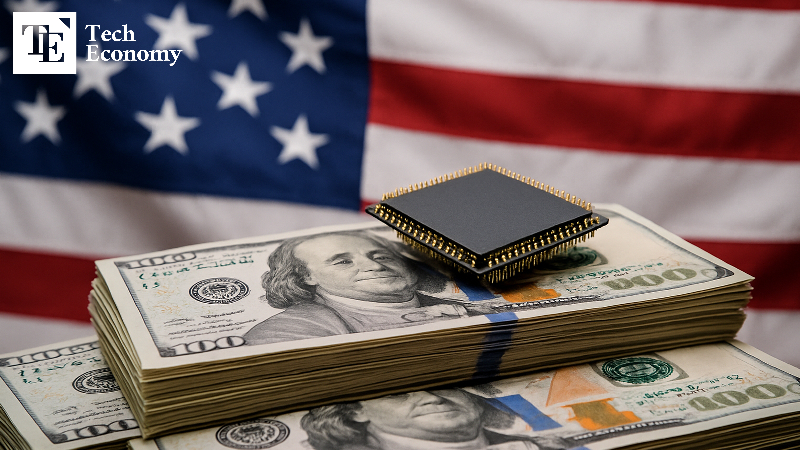
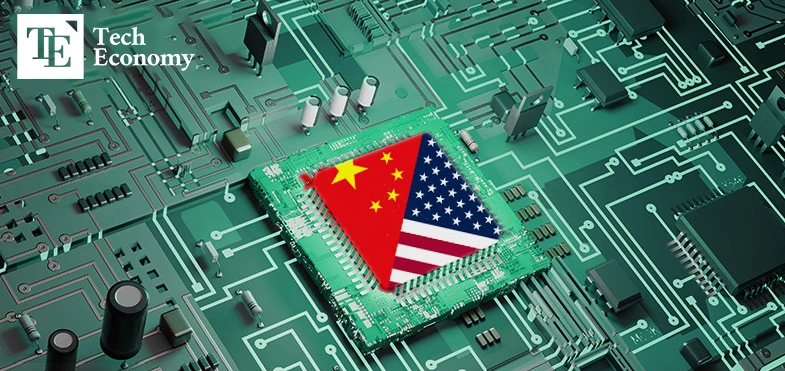
The administration of U.S. President Donald Trump has conditionally authorized exports of Nvidia’s H200 artificial intelligence (AI) accelerator to China, marking a new phase in the U.S.–China contest for semiconductor supremacy. Washington’s calculus is to reopen the export channel while taking a quarter of the sales revenue for itself, but Beijing has responded coolly, formalizing a policy of disengagement from Nvidia by directing state-funded AI data centers to exclude foreign chips. Even Nvidia CEO Jensen Huang has expressed skepticism about the practical impact of the regulatory ease, underscoring the increasingly tangled strategic equations on both sides.
Trump’s Pragmatism: Opening the Gate While Pocketing the Gains
On the 8th (local time), Reuters reported that President Trump would allow Nvidia to export its H200 chip to China on the condition that 25% of the associated revenue be paid to the U.S. government. The move is interpreted as a compromise that softens the stringent China-focused export controls instituted under former President Joe Biden while securing economic benefits for the United States. The H200 significantly outperforms the existing China-only H20 model, though it still lags one generation behind Nvidia’s flagship Blackwell series. Blackwell and the next-generation Rubin line remain under full export prohibition, meaning that the latest announcement constitutes a narrowly framed opening for previous-generation chips.
This policy shift is seen to reflect concerns within the U.S. semiconductor industry. Huang, who has visited Washington repeatedly to warn senior government officials of the risk of losing the China market, had long advocated for export relief. Yet once the pathway reopened, he struck a cautious tone, noting that “it is unclear whether China will accept a performance-limited chip.” When the United States eased restrictions on the H20 this July, Chinese companies avoided adoption due to security concerns and self-reliance priorities, resulting in negligible revenue impact.
Nvidia has already been treating China revenue as effectively “zero” in earnings reports and conference calls. Analysts argue that the latest arrangement resembles a “free call option” for the company. Nvidia has projected third-quarter revenue of USD 57 billion and fourth-quarter revenue of USD 65 billion, assuming zero sales to China; thus any resumption of Chinese orders would translate directly into upside. Conversely, even if China maintains its import freeze, Nvidia’s business model and investment plans would remain intact. Wall Street has described this as an asymmetric setup—limited downside but open-ended upside.
Still, the weight of the China market is far from trivial. Prior to sanctions, China accounted for 20–25% of Nvidia’s data center revenue, a share that has since fallen to the mid–single digits. Huang himself stated in August earnings and a November interview that he estimates the Chinese AI chip market at USD 50 billion this year, with annual growth of about 50% expected over the next several years. Yet he emphasized repeatedly that Nvidia’s official guidance assumes zero China revenue. Having architected its business strategy under the premise of forfeiting a massive market, any restoration of H200 shipments could reverberate beyond quarterly numbers and reshape Nvidia’s medium-term growth trajectory.
Political opposition in Washington is another variable. Republican Senator Pete Ricketts and Democratic Senator Chris Coons recently co-sponsored the SAFE CHIPS Act, which would compel the Commerce Department to deny export licenses for AI chips exceeding currently allowed performance thresholds to China, Russia, Iran, and North Korea for 30 months. The bill effectively seeks to impose legislative guardrails against further executive-branch easing. Although H200 exports have been approved, the outcome of congressional deliberations could limit the policy’s longevity.
Meanwhile, despite strong U.S. controls, circumvention and smuggling attempts have already surfaced. The Department of Justice announced that “Operation Gatekeeper” had intercepted a smuggling network attempting to funnel high-performance GPUs such as the H100 and H200 to China, seizing more than USD 50 million worth of chips. According to the FBI and Homeland Security Investigations (HSI), the group used Hong Kong- and China-based shell companies and falsified shipping documents to evade restrictions. Regardless of the political debate over export policy, an on-the-ground tug-of-war between enforcement and evasion is unfolding.
China’s Strategic Gambit: Mandatory Domestic Chips in State-Funded Infrastructure
The broader challenge is that China has already calibrated its timeline to a future without Nvidia. According to Reuters, in early November Beijing ordered that foreign AI chips be banned from all new state-funded AI data centers and that Nvidia products be phased out from existing facilities. The directive signals Beijing’s intent to purge Nvidia from national digital infrastructure and substitute domestic technology.
China’s wariness of U.S. chips stems not only from self-reliance ambitions. For months, Chinese cybersecurity authorities and state media have suggested that downgraded U.S. chips such as the H20 could contain backdoors or remote-disable mechanisms. Nvidia has strongly denied these accusations, but distrust runs deep over whether critical national infrastructure should rely on hardware from a strategic rival. This suspicion has now crystallized into a formal mandate: foreign chips are off-limits in state-funded deployments.
China’s self-sufficiency targets are explicit. Morgan Stanley forecasts that China’s AI GPU self-sufficiency rate—34% last year—will surge to 82% by 2027. Major local governments in Beijing and Shanghai are pushing for 70–100% domestic sourcing by 2027, pressuring state-owned enterprises and big tech firms to prioritize domestic chips. The biggest beneficiary is Cambricon, often dubbed “China’s Nvidia.” The company aims to produce roughly 500,000 AI accelerators in 2026, more than triple the estimated 142,000 units for 2025, in an attempt to fill Nvidia’s vacuum. Its Siyuan 590 and 690 chips reportedly deliver around 80% of the performance of Nvidia’s A100.
However, the self-reliance drive does not guarantee efficient allocation. Local governments and state-owned enterprises often respond to central directives by inflating capacity and output to meet targets, regardless of real market demand. This risks the classic pitfalls of planned-economy overinvestment—excessive projects, inadequate yield and performance maturity, and prioritization of quotas over operational viability.
Technology Gap: A Structural Reality that Could Prolong an Uneasy Coexistence
Skepticism about China’s semiconductor ambitions remains widespread. Bloomberg and other international outlets report that despite massive subsidies, China’s chip sector continues to face structural roadblocks in advanced equipment and design. Actual yield rates and profitability lag official claims, and there are mounting concerns over overcapacity and financial fragility. Equipment procurement is the most acute bottleneck: essential materials such as wafers and photoresists, as well as lithography and etching tools, are monopolized by the United States, Japan, and the Netherlands. As long as export controls persist, China will struggle to secure stable yields at sub-7-nanometer advanced nodes.
Huawei is pushing to close the gap with its latest AI chip, the Ascend 910C. Industry estimates suggest it delivers roughly 800 TFLOPS (FP16) with 3.2 TB/s memory bandwidth—around 60–80% of Nvidia’s H100. Yet its 7-nanometer yield reportedly hovers near 40%, far below that of Nvidia’s H100/H200, which are mass-produced on TSMC’s 4-nanometer process.
Cambricon’s Siyuan 590 and 690 face a similar dilemma. While the Siyuan 590 is believed to reach about 80% of the performance of Nvidia’s A100, SMIC’s yield for the corresponding process reportedly remains around 20%. Performance may be converging, but manufacturing scalability remains a narrow bottleneck.
Performance gaps also persist at the system level. IEEE Spectrum and other technical media note that Chinese AI chips still fall short of Nvidia’s H100 and B200 in both compute benchmarks and ecosystem maturity. Even if Chinese chips match raw compute throughput, Nvidia maintains a significant lead in system-wide efficiency—power optimization, networking, and especially the CUDA software ecosystem.
The result may be the entrenchment of a dual-track architecture: domestic chips dominating public-sector and security-sensitive domains, while Nvidia remains indispensable for cutting-edge commercial services and research. This bifurcation will cause volatile demand swings in high-bandwidth memory (HBM), lithography machines, and etching equipment, forcing Korean, Japanese, and Dutch suppliers into a precarious balance between opportunity and risk. This is why analysts expect Chinese AI firms to continue exhibiting a dual approach—denouncing reliance on Nvidia in public while still seeking H200 and other U.S. chips behind the scenes.
Matthew Reuter is a senior economic correspondent at The Economy, where he covers global financial markets, emerging technologies, and cross-border trade dynamics. With over a decade of experience reporting from major financial hubs—including London, New York, and Hong Kong—Matthew has developed a reputation for breaking complex economic stories into sharp, accessible narratives. Before joining The Economy, he worked at a leading European financial daily, where his investigative reporting on post-crisis banking reforms earned him recognition from the European Press Association. A graduate of the London School of Economics, Matthew holds dual degrees in economics and international relations. He is particularly interested in how data science and AI are reshaping market analysis and policymaking, often blending quantitative insights into his articles. Outside journalism, Matthew frequently moderates panels at global finance summits and guest lectures on financial journalism at top universities.
Similar Post