Humanoid robot shipments set to soar 700%, opening a dual market of China’s volume strategy vs. advanced nations’ tech race

Stefan Schneider brings a dynamic energy to The Economy’s tech desk. With a background in data science, he covers AI, blockchain, and emerging technologies with a skeptical yet open mind. His investigative pieces expose the reality behind tech hype, making him a must-read for business leaders navigating the digital landscape.
Authored On
Modified
Component cost cuts push production past mass-manufacturing threshold
Gaps in technical maturity and software capability remain limiting factors
Premium high-spec markets show recurring barriers to entry
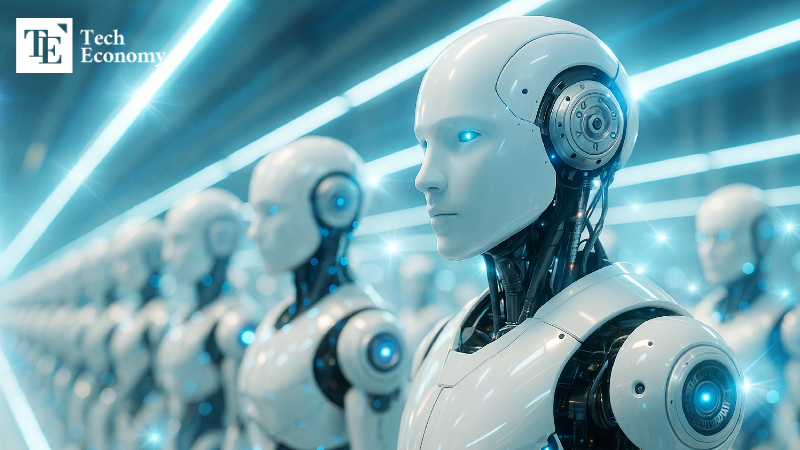
China has driven down the cost of key humanoid robot components to unprecedented levels, establishing a large-scale manufacturing regime. With global humanoid shipments expected to grow more than 700 percent next year, Chinese companies are entering a phase in which low-cost models effectively dominate the early market. As momentum builds around the possibility that the early market will become locked into a China-style volume-production model, global companies are being pushed to differentiate through high-tech, high-value segments.
Seeking early-stage market share through price competitiveness
TrendForce, a global market research firm, said in a report released on the 9th (local time) that 2026 will mark “a commercial inflection point for humanoid robots,” projecting that next year’s shipments will exceed 50,000 units — a year-on-year increase of more than 700 percent. The firm added that China is rapidly expanding the introduction of humanoids across manufacturing, logistics, and service industries, positioning the technology as a strategic sector. Chinese manufacturers, it noted, are restructuring the early market’s price dynamics on the back of cost reductions and supply-chain efficiencies.
China’s production ramp-up is already being validated at the level of individual companies. Agibot has surpassed 5,000 units in production across its key lineups, including general-purpose humanoids, and has accumulated separate product runs of 1,700–1,800 units each for industrial, general-purpose, and compact specialized models. UBTech is targeting output of 5,000 units next year and 10,000 units the year after, while WeishiKeji is extending mass-production capabilities gained from quadruped robots to its humanoid line. These companies share a pattern: they have reduced up-front costs and consolidated supply chains by attracting investment from domestic manufacturers and platform operators.
These cost-reduction effects form the core basis of China’s pricing advantage. Zhang Lei, chief scientist at China’s national–regional joint humanoid innovation center, noted that the price of electric joints — once in the range of roughly 7,000–8,500 USD per unit in 2018 — has fallen to about 70–85 USD today. He added that annual production costs are now decreasing by around 20 percent year after year due to these structural shifts. Lower prices expand real-world applications, accelerating data accumulation and algorithm improvement, thereby reinforcing Chinese humanoids’ growing market share.
The Chinese government is backing the sector through subsidies, tax incentives, and a wide array of support programs. The Ministry of Industry and Information Technology (MIIT) has declared humanoid robots the next major innovation wave after smartphones and electric vehicles, and is building a nationwide mass-production system by establishing at least eight robot innovation centers. Local governments are escalating their own competition: Shanghai aims within the year to cultivate 10 top-tier robot brands, 100 benchmark applications, and an industry scale of about 141.6 billion USD. Zhejiang Province plans to build an annual production system of 20,000 units by 2027, generating roughly 2.8 billion USD in direct revenue.
Immature algorithms limit performance in complex real-world tasks
Yet the benefits of cost reductions and aggressive industrial policy have sharpened the visibility of the Chinese robotics sector’s technical limits. Despite rapidly establishing multi-thousand-unit production lines, core capabilities required for humanoids to work safely alongside humans — judgment, control, and safety — remain underdeveloped. For example, Unitree’s “G1,” unveiled in April, was praised for low cost and flexible motion but criticized for requiring users to program individual actions manually. The gap between controlled demonstration and real operational ability remains pronounced.
Software poses an additional bottleneck. The BBC has stated that today’s humanoids struggle even with “basic reasoning required to understand and complete complex tasks.” For robots to function safely in dynamic environments such as restaurants, homes, and hospitals, they must autonomously adjust for changes in object mass, positional errors, and unpredictable human behavior. As the BBC noted, motion replication may work in closed manufacturing lines, but robots interacting with humans must operate with sophisticated error-tolerant judgment systems.
Fundamentally, the deciding factor for technological maturity is balance in research and development. Sangbae Kim, professor of mechanical engineering at MIT, observed that the robotics industry is increasingly “pushing ahead with development while putting research on hold,” warning that the field must return to foundational science and core technologies. To progress beyond systems that work only under narrow conditions, robots require deeper capabilities in physical feedback, sensory modeling, and reasoning engines.

Repetition of China’s limitations in the EV race
China’s ultra-low-cost, high-volume strategy in humanoids suggests looming market polarization. Chinese firms are replicating patterns previously seen in the electric-vehicle sector, where subsidies, regional manufacturing clusters, and integrated supply chains allowed China to flood global markets with low-priced EVs — yet repeatedly exposed limits in high-spec, high-value segments. China failed to surpass Tesla and Western competitors in core areas such as EV build quality, battery safety, and in-vehicle software.
A similar dynamic is emerging in humanoids. While Chinese firms have expanded mass-production lines and reduced costs, they have yet to secure mastery in advanced robot control, perception, and safety systems. Market analysts increasingly expect humanoids to divide into “China-led, low-cost mass markets” and “premium markets defined by complex, high-end capabilities.” China aims to absorb demand in emerging economies and commercial settings with rapidly expanding low-cost lineups, but experts argue that in advanced regulatory environments — where safety, reliability, and quality standards are paramount — such low-cost models face significant barriers to entry.
Some analysts even warn that humanoids may experience more extreme polarization than EVs. Unlike electric vehicles, humanoids rely not only on battery and drivetrain quality but also on high-precision control systems that must operate flawlessly in human-centric environments. These technical requirements mean that scale alone will not secure competitive advantage, and that markets for high-skill humanoids are likely to be dominated by a small group of elite technology firms. Price gaps and capability gaps across the market are expected to widen rapidly.
Stefan Schneider brings a dynamic energy to The Economy’s tech desk. With a background in data science, he covers AI, blockchain, and emerging technologies with a skeptical yet open mind. His investigative pieces expose the reality behind tech hype, making him a must-read for business leaders navigating the digital landscape.
Similar Post
















