U.S.–Europe Ties at “Worst Ever,” an 80-Year Transatlantic “Values Alliance” Careening Toward Rupture

Anne-Marie Nicholson is a fearless reporter covering international markets and global economic shifts. With a background in international relations, she provides a nuanced perspective on trade policies, foreign investments, and macroeconomic developments. Quick-witted and always on the move, she delivers hard-hitting stories that connect the dots in an ever-changing global economy.
Authored On
Modified
The New International Order Map Drawn by Trump’s Second-Term NSS
“EU at the Stage of Civilizational Erasure,” a Withering Broadside
Washington Formalizes Self-Interested Isolationism
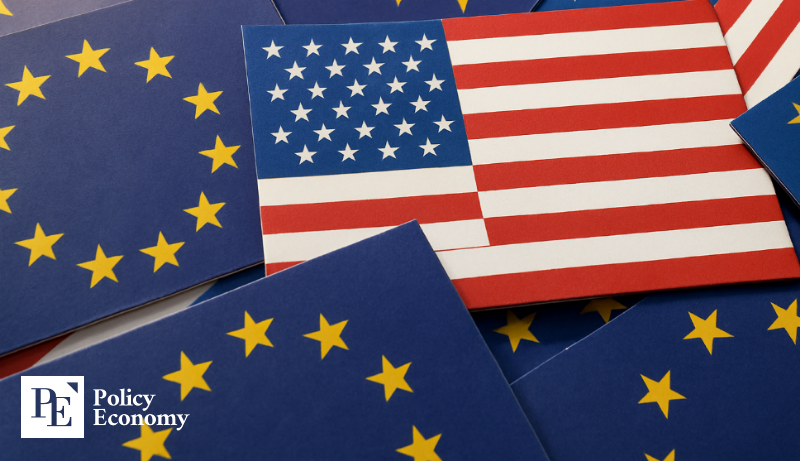
The second administration of U.S. President Donald Trump has triggered shockwaves by branding the European Union (EU)—in its newly released National Security Strategy (NSS)—as a bloc facing “civilizational erasure” and as a rival force that drains U.S. national interests. The move amounts to an official dismantling of the “values alliance” that has underpinned the Western world for 80 years since World War II. As the tripartite pillars of security, diplomacy, and shared values simultaneously wobble, Europe now confronts a double bind: a defense vacuum and political isolation. The moment is being read both as an extension of Trump-style coercive diplomacy and as the detonation point where Europe’s long-neglected internal vulnerabilities collide with an external shock.
“Europe as an Enemy Undermining Freedom,” White House Codifies Hostility
The Washington Post (WP) reported on the 11th (all dates local) that U.S.–European relations are spiraling into their worst phase on record in the wake of the Trump administration’s hostile security-strategy rollout. In the new NSS released on the 5th, the administration declared that Europe—America’s long-standing ally—faces a “grave prospect of civilizational erasure.” The core thrust of the NSS’s Europe section is that Europe has lost its defining values and is veering onto a misguided path, and that the United States must lead to steer it back onto a corrected trajectory.
The Trump administration devoted a section of the NSS—framed around “restoring Europe’s greatness”—to a scathing indictment of European states. In Washington’s view, Europe’s national identities are being eroded by open immigration policies and excessive regulation, while the continent’s global presence is slipping to an “unrecognizable” level. The NSS states, “We want Europe to remain European,” urging a recovery of civilizational pride and the dismantling of failed, stifling regulation. It also warns that, if current trends persist, it is uncertain whether Europe will remain a reliable ally.
This is effectively an expanded version of Vice President J.D. Vance’s remarks at the Munich Security Conference in February, when he lectured Europe’s democracies by saying it was anti-democratic for Germany’s mainstream parties to refuse a coalition with the far-right Alternative for Germany (AfD). The NSS says the growing influence of “patriotic European parties” is “a major reason for optimism,” adding that it will “encourage resistance” within European countries to what it calls the current misguided drift. It then states that America’s objective is “to help Europe correct its present course.”
Such a strategy of fracturing Europe is one Russia has long pursued against the Western camp. Some experts therefore argue that the United States is borrowing from Moscow’s playbook. U.S. historian Timothy Snyder said in an interview with The New York Times (NYT) that “the new NSS resembles the format found in Russian national security documents,” adding that it is “tilting in Russia’s ideological direction.” Russia has indeed welcomed the shift. Maria Zakharova, spokeswoman for Russia’s Foreign Ministry, commented that she hopes it will have the effect of “snapping Europe’s ‘war forces’ to attention.”
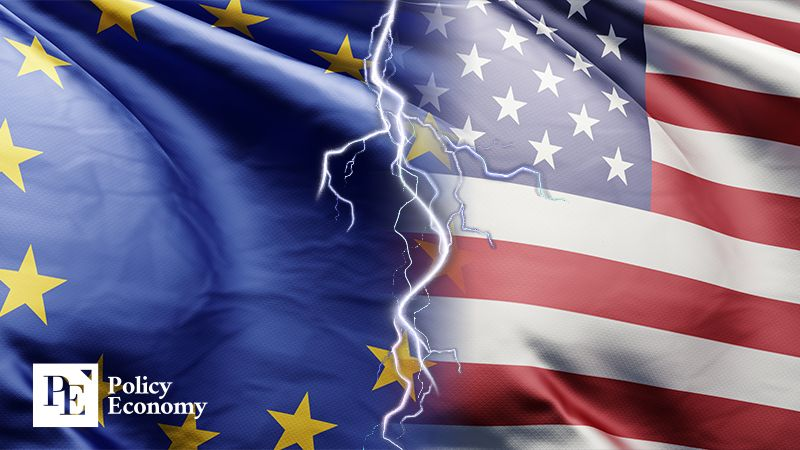
From Ally to Liability
Experts say the NSS formalizes a long-held view inside the Trump administration: that Europe is free-riding on U.S. strategic assets. Under an America First rubric, support for Europe is seen as little more than a fiscal burden—an assumption widely shared across Trump’s hardline base, the MAGA (Make America Great Again) camp. Senior figures close to Trump, including Vice President Vance and Defense Secretary Pete Hegseth, have repeatedly reinforced this argument in public.
The widening rupture has already surfaced on the Ukraine front. The United States dismissed Europe-led calls for “Ukraine’s complete victory” as “unrealistic expectations.” The message is effectively a declaration that Washington will no longer help Ukraine reclaim its territory. The United States, which once played the central NATO role in deterring Russia, now appears to be stepping back—casting itself as a “judge” or “mediator” between Russia and the EU while pulling its own weight off the scale.
That shift collides head-on with pressure over defense spending. Hegseth pointed to South Korea, Poland, and the Baltic states as “model allies” for expanding defense budgets, saying the United States would grant them “special benefits.” Conversely, he issued an explicit warning toward Europe, saying that “allies that do not fulfill the role of collective defense will pay a price.” Trump has repeatedly assailed European leadership as “weak” and captive to political correctness, raising issue after issue—from Ukraine policy to failures in immigration control. That critique aligns precisely with the NSS’s diagnosis of Europe’s decline. This is why the new NSS is being viewed as a strategic inflection point: it effectively dismantles the traditional transatlantic framework and demands that Europe transform into a self-reliant bloc that “defends itself and pays for itself.”
Big Tech Regulatory Clash Escalates Into a “System War”
Analysts also say the latest message toward Europe is underpinned by an intent to shield U.S. Big Tech. Europe has long imposed tough sanctions on American firms under the Digital Services Act (DSA). It has also sought to curb the dominance of U.S. technology giants and safeguard Europe’s “digital sovereignty” through the world’s first comprehensive AI regulatory statute, the AI Act. Washington has framed these moves as unjust persecution of U.S. companies and as an assault on free expression—arguing that Europe is wielding unreasonable penalties against the United States to nurture its own digital industry.
With dissatisfaction toward Europe already intensifying, the EU’s recent penalty against X has poured fuel on the fire. On the 5th, the European Commission imposed a $139.75 million fine (about $139.77 million), ruling that X’s account verification markings and advertising policies violated the DSA. After roughly two years of investigation, EU regulators concluded that X had breached the DSA. Authorities argued that X deceptively designed its blue checkmark for verified accounts, failed to ensure transparency in its advertising repository, and did not provide researchers with necessary public data.
In response, Trump said at a White House event for farmers on the 8th, “I don’t understand how they can do that. I’ll speak after I receive a full briefing,” signaling potential countermeasures. He added, “Europe must be very careful in doing various things,” and claimed, “We want Europe to remain Europe, but Europe is heading in a bad direction.” Industry observers believe the United States is likely to respond by invoking Section 301 of the 1974 Trade Act to impose retaliatory tariffs on European products, or by restricting data transfers to isolate Europe’s digital industry.
Diplomatic experts broadly agree that this episode underscores how sharply the Trump administration is refashioning America’s traditional foreign policy. Some warn that deepening fissures within the transatlantic alliance—an architecture that has preserved European peace since World War II and projected Western values worldwide—could further intensify. Katja Bego, a senior research fellow at the U.K. think tank Chatham House, said, “European leaders have tried to patch over demographic-decline risk through ‘easy immigration expansion,’ and in that process, core state capacity—public safety, social integration, talent development—has been simultaneously weakened, leaving Europe vulnerable to external shocks,” adding, “European leaders must now assume that the orthodox transatlantic relationship with the United States is over.”
Anne-Marie Nicholson is a fearless reporter covering international markets and global economic shifts. With a background in international relations, she provides a nuanced perspective on trade policies, foreign investments, and macroeconomic developments. Quick-witted and always on the move, she delivers hard-hitting stories that connect the dots in an ever-changing global economy.
Similar Post