Xi Jinping says “China’s development will not stop,” shifting the center of gravity of diplomacy through accumulated technological power

Authored On
Modified
Emphasis on legitimacy, self-confidence, and principles
Technological great-power status feeds diplomatic confidence
China enters a phase of shaping rules in the international order
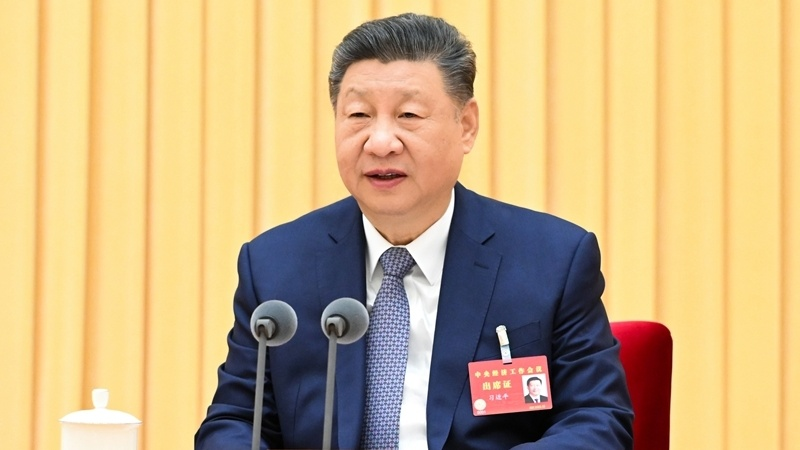
At a recent annual policy meeting, China framed external pressure and technology blockades as manageable challenges, outlining an approach that aligns domestic economic management with responses to international economic and trade dynamics. Rather than pursuing showy achievements or unrealistic targets, Beijing signaled a strategy centered on calculated choices and outcome-oriented decision-making. Underpinning this stance is China’s assessment that it has secured research leadership across multiple core strategic technologies.
Repeated emphasis on “moral resilience”
According to the South China Morning Post on December 14, Xi told the annual Central Economic Work Conference on December 10 and 11 that “our path so far has proven that development cannot be halted, even amid global uncertainty,” adding that “efforts to suppress China will never succeed.” While acknowledging external pressure such as semiconductor and advanced-technology restrictions imposed by the United States and its allies, the remarks underscored Beijing’s view that such measures cannot reverse China’s growth trajectory or strategic direction.
Xi’s reference to China’s response to U.S. trade friction as one of “moral resilience” follows the same logic. He said China chose to uphold principles rather than escalate retaliation or confrontation, arguing that this approach earned international respect. In this context, moral resilience does not imply displays of power, but a willingness to endure a prolonged contest without violating rules, positioning restraint itself as a diplomatic asset. The repeated use of the term in official discourse is widely interpreted as an effort to recast China not as a coercive actor, but as a “responsible stakeholder” in the global system.
This perception aligns with recent developments in U.S.-China relations. Earlier this month, the United States approved exports of Nvidia’s H200 artificial intelligence chips to China, and in its latest National Security Strategy redefined U.S.-China competition as economic rather than ideological or security-driven, explicitly prioritizing the pursuit of mutually beneficial economic relations. The de-emphasis of China’s political system and human rights issues marks a notable shift after more than three decades. Within China, this trend is broadly viewed as expanding the scope for extracting tangible gains through negotiation and transactional engagement with Washington.
Against this backdrop, the CEWC’s use of the term “struggle” is interpreted less as a call for escalation than as a reference to management and calibration. The conference stated that China must coordinate domestic economic operations with international economic and trade struggles, signaling an acceptance of friction as unavoidable but controllable. Xi also warned against exaggerated claims and unrealistic goals in the formulation of the 15th Five-Year Plan, reinforcing a preference for disciplined choices and results-driven governance over displays of strength in both diplomacy and economic policy.
Leadership in core strategic technologies
China’s evolving diplomatic posture is rooted in confidence that it has already attained great-power status in key technological domains. The shift reflects Beijing’s judgment that its research and development capabilities now command decisive advantages across a broad range of strategic technologies. According to the Australian Strategic Policy Institute’s Critical Technology Tracker 2025, China ranks first globally in roughly 90 percent of strategic technology research areas critical to national security and industrial competitiveness, including nuclear technology, small satellites, and artificial intelligence. By contrast, the United States led 94 percent of such fields in 1995, underscoring how dramatically the balance has shifted over the past two decades.
ASPI’s assessment is based on both the volume and impact of academic output. From 2020 to 2024, it analyzed millions of papers across 74 strategic technology categories, identifying the top 10 percent most-cited research in each field to gauge national research influence. China ranked first in 66 areas, or 89.2 percent of the total. Most of these technologies are classified as dual-use, applicable to both defense and industry, highlighting how technological self-reliance directly expands diplomatic and security options.
This helps explain why technology containment by the United States and its allies has not translated into decisive pressure. Across the AI ecosystem, China has achieved world-leading research competitiveness in generative AI, cloud and edge computing, computer vision, and power-grid integration technologies. Nature described the trend as evidence of how aggressively Beijing is pushing AI from the laboratory into real-world deployment, noting that while technology restrictions may function as short-term constraints, they have revealed their limitations as long-term deterrents.
Still, some observers caution that ASPI’s rankings do not equate to full technological maturity or commercial competitiveness in every field. China leads in research on advanced aircraft engines, for example, yet continues to lag behind U.S. and European manufacturers in performance and reliability. Even so, given that national strategic capabilities are built through decades of cumulative investment, few dispute that China has secured sufficient technological foundations to engage in diplomacy with greater flexibility in negotiation, coordination, and transactional exchange.
The next phase: shaping international standards
Building on technological self-reliance, China is moving beyond mere resilience against external pressure toward actively shaping international norms and standards through open-source initiatives and service openness. By distributing technology in a manner approaching a public good, Beijing implicitly frames unilateral blockades and sanctions as obstacles to global technological access rather than isolated bilateral disputes. Externally, this approach can be perceived as openness; internally, it supports the expansion of China’s own technology and industrial ecosystems.
China formally incorporated open source into its national strategy in the 14th Five-Year Plan in 2021, followed by a series of policy measures issued by the Ministry of Industry and Information Technology and the State Council. Established in 2020, the OpenAtom Foundation has become a central platform, with participation from Huawei, Alibaba, Baidu, and Tencent, advancing projects such as OpenHarmony and openEuler. Article 4 of the foundation’s charter explicitly affirms the comprehensive leadership of the Chinese Communist Party, underscoring that China’s open-source model differs fundamentally from purely private-sector approaches.
Since then, China’s open-source strategy has grown more sophisticated. In 2023, the China Academy of Information and Communications Technology led the development of a national standard titled Evaluation Method for Open Source Code Security in Software Products. The framework assesses code origin, quality, intellectual property rights, governance, and development capacity, extending oversight to metrics such as open-source code ratios, contribution volumes, vulnerability counts, patch rates, and license compatibility. The standard exemplifies China’s dual pursuit of openness and control, emphasizing regulated openness under state-led governance.
This open-source push is increasingly converging with China’s ambitions in artificial intelligence and global rule-setting. In July, Beijing unveiled the Global AI Governance Action Plan at the World Artificial Intelligence Conference in Shanghai, proposing cross-border open-source communities and international sharing of technical documentation and application programming interfaces under the principle that AI should be treated as a common public good for humanity. The move is widely seen as an attempt to directly influence the formation of international rules, positioning China not merely as a follower, but as a central player in the competition over global standards.
Similar Post