Ford Ends LG Energy Solution Battery Deal Amid EV Strategy Shift and Renault Europe Tie-Up

Aoife Brennan is a contributing writer for The Economy, with a focus on education, youth, and societal change. Based in Limerick, she holds a degree in political communication from Queen’s University Belfast. Aoife’s work draws connections between cultural narratives and public discourse in Europe and Asia.
Authored On
Modified
Ford–LG Energy Solution Scraps Battery Supply Deal Worth About $6.5 Billion
Renault Picked as Europe Partner, Set to Cooperate on EVs and Light Commercial Vehicles
Renault Chooses Envision AESC as Battery Supplier, With Limited Ties to LG Energy Solution
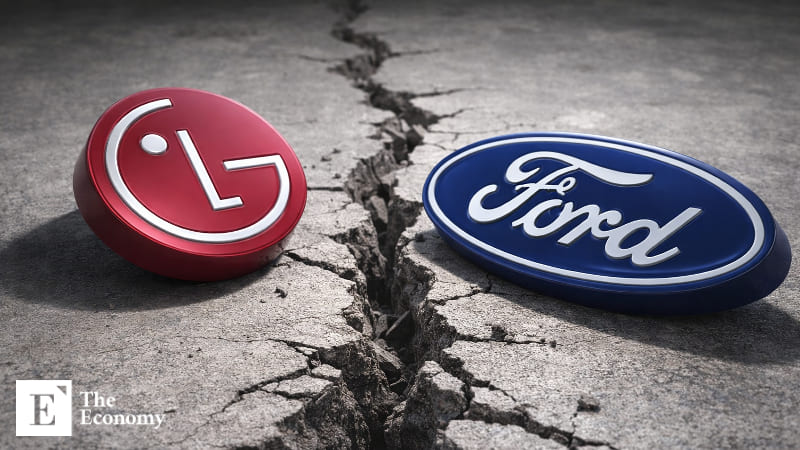
US automaker Ford is terminating its electric vehicle battery supply agreement with LG Energy Solution. As the prolonged market downturn persists, Ford is overhauling its EV strategy and unwinding a series of existing battery partnerships. Some analysts suggest that the move may have been influenced by Renault, the French automaker Ford has secured as a new partner for its push into the European market.
Ford Cuts EV Battery Supply Deals One After Another
On December 17, LG Energy Solution said that “the electric vehicle battery supply agreement between the company and Ford, disclosed on October 15, 2024, has been terminated,” adding that the decision followed Ford’s move to halt production of certain EV models. The two companies had previously signed long-term contracts covering 75 gigawatt-hours (GWh) over six years through 2032 and 34 GWh over five years from next year through 2030. All batteries were to be produced at LG Energy Solution’s Wroclaw plant in Poland and supplied to Ford’s Europe-bound EVs. The canceled portion covers the 2027–2032 contract, with a termination value of about $7.2 billion, equivalent to 28.5% of LG Energy Solution’s most recent annual revenue.
Ford has also recently drawn a line under its battery partnership with SK On. On December 11, SK On said it had “mutually agreed with Ford to independently own and operate the production facilities of BlueOval SK.” The two companies had originally invested $5.7 billion each in 2022 to establish the US battery joint venture BlueOval SK, with plans to begin phased mass production from August 2025 at three plants in Tennessee and Kentucky. Under the unwinding of the joint venture, Ford will own the Kentucky Plant 1 (37 GWh) and Kentucky Plant 2 (45 GWh), while SK On will take ownership of the Tennessee plant (45 GWh).
Behind these moves lies a sweeping revision of Ford’s EV strategy. The automaker is scaling back its EV business and shifting its focus toward hybrids and internal combustion engine vehicles, which offer relatively higher profitability. Ford has recently halted production of the F-150 Lightning electric pickup amid weak sales, and has said it plans to expand into lower-cost EVs and energy storage systems. As a result of the strategy overhaul, Ford is estimated to incur about $19.5 billion in pre-tax costs through 2027.
Joining Hands With Renault to Push Into Europe
A new partnership built to strengthen Ford’s push into Europe is also seen as having influenced the automaker’s decision to scale back its battery collaborations. Ford recently signed a strategic partnership with Renault Group aimed at boosting competitiveness in Europe’s EV market. Ford said it had reviewed a range of options for more than a year to shape its future strategy in Europe, and that Renault’s ability to successfully develop EV models such as the Twingo and Dacia in just two years was a decisive factor behind the deal.
The two models to be co-developed will be based on Ampere, Renault Group’s dedicated EV unit, and produced at Ampere ElectriCity in northern France. Under the partnership, Ford will leverage Renault’s EV assets and manufacturing capabilities, while Renault aims to improve production efficiency through collaboration with a major global automaker. The first of the two vehicles is scheduled to launch in Europe in early 2028.
Beyond the EV tie-up, the two companies have also signed a letter of intent to jointly develop light commercial vehicles (LCVs) in Europe. They plan to explore co-developing and co-producing certain LCV models to be sold under their respective brands. Ford noted, however, that the cooperation will play a complementary role rather than replace existing partnerships, as it is already producing a new Transporter-based model in Turkey through its partnership with Volkswagen.
Renault’s EV Battery Supply Chain
Renault had already selected Envision AESC (Automotive Energy Supply Corporation) as an EV battery partner back in 2021. AESC is a global battery technology company that develops and manufactures lithium-ion batteries for electric vehicles and energy storage systems. It was founded in Japan in 2007 as a joint venture between Nissan, NEC, and NEC Tokin. Since 2018, China’s Envision Group has participated as the key partner, holding roughly an 80% stake, which has led some to classify AESC as a Chinese-backed company.
In 2021, Envision Group outlined a plan to build a battery plant in northern France for Renault worth $2.4 billion, and to allocate more than half of the facility’s production capacity to Renault. The plant was completed in Douai, France, began full-scale operations in June this year, and is expected to produce enough EV batteries to be installed in up to 200,000 vehicles annually, including the Renault R5, currently the best-selling EV model in France.
LG Energy Solution, alongside China’s CATL, was selected as one of the key suppliers for Renault’s planned shift to LFP batteries starting in 2026, but there has otherwise been no clear, broader partnership between the two companies. One market expert said that if Ford had pursued Europe on its own, its contract with LG Energy Solution might have remained in place, but added that once Ford chose Renault as its core partner for Europe, it is difficult to rule out the possibility that Renault’s existing battery arrangements were prioritized over Ford’s contract with LG Energy Solution.
Aoife Brennan is a contributing writer for The Economy, with a focus on education, youth, and societal change. Based in Limerick, she holds a degree in political communication from Queen’s University Belfast. Aoife’s work draws connections between cultural narratives and public discourse in Europe and Asia.
Similar Post