US Allows Nvidia H200 Exports to China: Security Backlash Grows, Markets Doubt the Impact

As one of the youngest members of the team, Tyler Hansbrough is a rising star in financial journalism. His fresh perspective and analytical approach bring a modern edge to business reporting. Whether he’s covering stock market trends or dissecting corporate earnings, his sharp insights resonate with the new generation of investors.
Authored On
Modified
“Will Allow Nvidia H200 Exports to China” Trump’s Hardline Move
US Pushback Grows, While Self-Reliant China Responds Coolly
US Chip Export Strategy Seen as Losing Leverage Over China
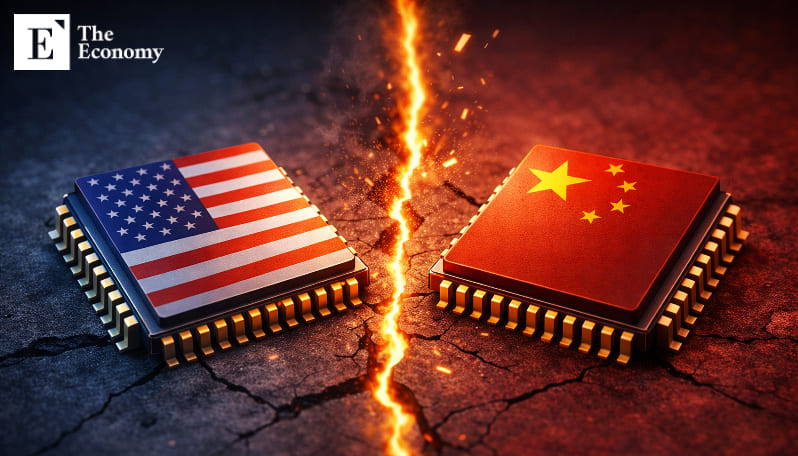
As US President Donald Trump moves to ease semiconductor export restrictions to China in an effort to slow Beijing’s push for chip self-sufficiency, reactions across Washington and the market are increasingly split. In the United States, critics warn the shift could heighten national security risks, while many in the market argue the revised export strategy is unlikely to deliver the kind of leverage it once did.
The Trump Administration Clears Nvidia’s High-End Chips for China
On December 18 (local time), Bloomberg reported that exports of Nvidia’s high-performance AI chip, the H200, to China have been approved, potentially giving the People’s Liberation Army (PLA) what could be a battlefield “game changer.” Earlier, on December 8, US President Donald Trump said on his social media platform Truth Social that he had informed Chinese President Xi Jinping the United States would allow Nvidia to ship H200 products to approved customers in China and other countries, provided US national security remains protected. The H200 offers six times the memory capacity, bandwidth, and AI inference performance of the China-specific H20. While it falls short of Nvidia’s latest “Blackwell” chips in advanced reasoning, it is considered well suited for large language models (LLMs) and scientific computing, significantly expanding China’s access to advanced semiconductor technology.
Trump said approval of H200 exports would be conditional on Nvidia paying 25% of sales proceeds to the US government. The so-called “security tax” is intended to bolster government revenue while keeping Chinese companies tied to US and allied technology ecosystems, thereby slowing China’s push for self-sufficiency. The South China Morning Post, citing analysts, described the decision as a dual strategy aimed at preserving US market share while delaying China’s technological independence. Chen Li, a senior analyst at the Economist Intelligence Unit (EIU), said the move reflects an effort to export older technology to curb innovation incentives in China while maintaining US market dominance.
However, conservatives and national security experts in the United States have voiced strong criticism of the decision. The Atlantic Council warned it is a “dangerous gamble” that could accelerate China’s military AI capabilities, while the Council on Foreign Relations cautioned that the move could erode America’s AI advantage. Opposition has also emerged in Congress. According to the Financial Times on December 12, Rep. John Moolenaar (R–Michigan), chair of the House Select Committee on the Strategic Competition Between the United States and the Chinese Communist Party, wrote to Commerce Secretary Howard Lutnick warning that approving sales of advanced chips to Chinese firms could weaken the strategic edge Trump achieved during his first term.
China’s Chip Self-Sufficiency Drive Shows No Sign of Fading
However, Chinese regulators are reportedly not welcoming the US move and are internally reviewing restrictions on purchases of the H200. On December 9, the Financial Times, citing sources, reported that the Chinese government is discussing a plan to require domestic companies to justify why H200 purchases cannot be substituted with domestically produced chips. Based on past cases, the measure is effectively read as a purchase ban. Counterpoint Research said that if China becomes dependent on Nvidia chips again, it would be accepting the blade of “political uncertainty” that could cut off supply at any time, adding that for the Chinese government, self-sufficiency is the only viable long-term strategy.
China’s strong push for semiconductor self-reliance is rooted in long-running US trade restrictions. The United States began restricting exports of Nvidia’s high-performance chips to China in October 2022, and expanded the scope in 2023 to include lower-performance chips. In April this year, as the Trump administration began waging a full-scale trade war with China, exports were effectively blocked even for Nvidia’s China-specific H20 chip.
Pressure on Chinese semiconductor and technology firms has also continued into recent months. According to Bloomberg, in October, US Deputy Defense Secretary Stephen Feinberg sent a letter to the chairs of the House and Senate Armed Services Committees saying eight Chinese companies—including Alibaba, BYD, Baidu, iOptolink, InnoLight, Hua Hong Semiconductor, RoboSense, and WuXi AppTec—may warrant inclusion on the Pentagon’s “1260H” list. The 1260H list is a type of blacklist under the National Defense Authorization Act, covering firms the Defense Department determines operate directly or indirectly in the United States and contribute to the modernization of the People’s Liberation Army or the Chinese Communist Party’s military capabilities. It remains unclear, however, whether any of the companies have actually been added to the list.
Signs of Nvidia Chip Smuggling Keep Emerging
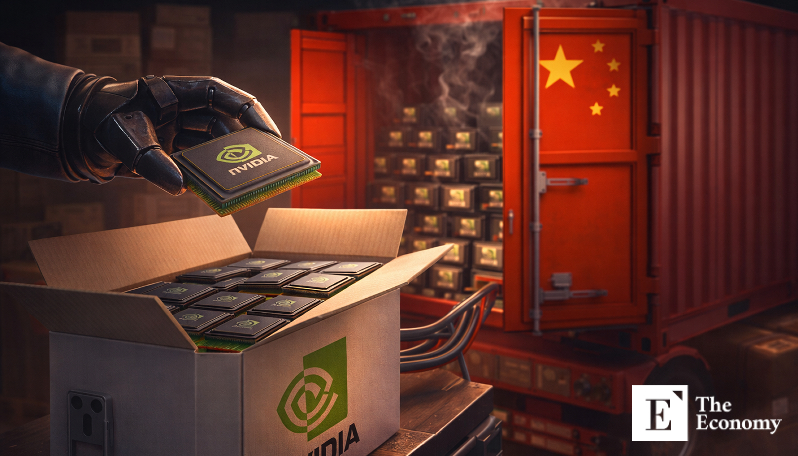
In the market, the prevailing view is that the United States’ semiconductor trade-control strategy is effectively losing its force. The argument is that because China has already begun delivering results in securing its own capabilities and building supply chains in response to US restrictions, Washington’s latest move is unlikely to bring about any meaningful change. Some also argue that because China has already been smuggling in advanced Nvidia chips and using them to develop its domestic semiconductor ecosystem, the significance of both export controls and any easing of them has effectively faded.
Speculation that China has been bypassing export controls to smuggle Nvidia chips has been raised repeatedly for some time. On December 10, The Information, citing multiple sources, reported that China’s DeepSeek has secured thousands of GPUs using Nvidia’s latest Blackwell architecture and is developing new models. Sources said Nvidia chips have flowed to DeepSeek over the past two years through indirect import routes that transit countries where purchases are permitted.
According to the report, DeepSeek secured non-Chinese data centers in Southeast Asia and procured Nvidia chips through authorized sales channels. Once the chips and servers were installed at those data centers, Nvidia, Dell, and Supermicro would dispatch staff to inspect the equipment and verify compliance with export rules. After the inspection was completed, DeepSeek reportedly dismantled the servers again and smuggled the components into China. The parts were said to have cleared Chinese customs through false declarations, then been reassembled and installed at Chinese data centers.
Last month, US federal authorities arrested four men on suspicion of illegally exporting Nvidia GPUs to China. Investigators said the group built a sophisticated black-market network that routed chips originating in Alabama through Malaysia and Thailand before delivering them to China, netting profits worth millions of dollars. According to the indictment, there were two successful exports: between October 2024 and January 2025, a total of 400 Nvidia A100 GPUs were shipped to China. A third and fourth shipment were thwarted by law enforcement, but the seized contraband reportedly included 10 Hewlett Packard Enterprise (HPE) supercomputers packed with large numbers of Nvidia H100 GPUs, as well as 50 Nvidia H200 GPUs.
As one of the youngest members of the team, Tyler Hansbrough is a rising star in financial journalism. His fresh perspective and analytical approach bring a modern edge to business reporting. Whether he’s covering stock market trends or dissecting corporate earnings, his sharp insights resonate with the new generation of investors.
Similar Post