China’s Capture of LCD Leadership Makes OLED Reversal a Matter of Time

Matthew Reuter is a senior economic correspondent at The Economy, where he covers global financial markets, emerging technologies, and cross-border trade dynamics. With over a decade of experience reporting from major financial hubs—including London, New York, and Hong Kong—Matthew has developed a reputation for breaking complex economic stories into sharp, accessible narratives. Before joining The Economy, he worked at a leading European financial daily, where his investigative reporting on post-crisis banking reforms earned him recognition from the European Press Association. A graduate of the London School of Economics, Matthew holds dual degrees in economics and international relations. He is particularly interested in how data science and AI are reshaping market analysis and policymaking, often blending quantitative insights into his articles. Outside journalism, Matthew frequently moderates panels at global finance summits and guest lectures on financial journalism at top universities.
Authored On
Modified
Core LCD Material Polarizers Pushed Out by China, Forcing ‘Strategic Retreat’
Samsung and LGD Even Ceding Plants Under ‘Red Tech’ Offensive
OLED Also at Risk as Chinese Players Gain Ground in Next-Generation Technologies
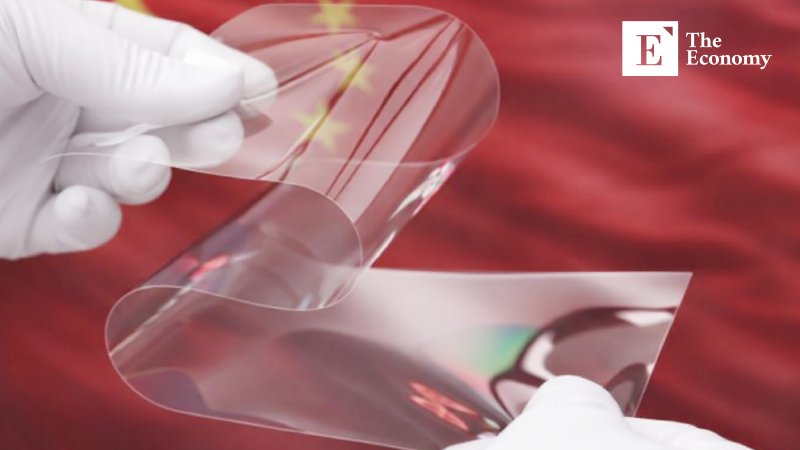
Alongside semiconductors, displays have long been regarded as one of South Korea’s core export industries, but the sector has been mired in prolonged turbulence. Chinese manufacturers have wrested control of key segments through aggressive low-price volume strategies, while technological gaps have narrowed significantly. After liquid crystal displays (LCDs) were effectively reorganized under Chinese dominance, unease is now spreading even to organic light-emitting diodes (OLEDs), which have become the business backbone of Samsung Display and LG Display.
Chinese Shanjin and Hengmei Control 56% of Polarizers
On the 18th, Taiwan-based Digitimes reported that China’s Shanjin Optoelectronics and Hengmei Group have established an oligopolistic structure by absorbing polarizer assets previously held by South Korean companies. Polarizers are essential optical films attached to the front and back of LCD panels to control the direction of light and are indispensable for virtually all display products, including smartphones, laptops, and televisions. Each LCD panel requires two polarizers, making them a core material in the display industry.
According to global market research firm Sigmaintell, Shanjin acquired LG Chem’s polarizer production lines in 2021 and has since secured more than 30% of global polarizer production capacity this year, rising to the top position worldwide. Hengmei, meanwhile, signed an agreement in September to acquire Samsung SDI’s polarizer film assets, lifting its market share to over 20%. Its share is projected to expand to 26% by 2026, solidifying its position as the world’s second-largest supplier. Combined, the two companies give China control of more than half of the global market.
LG Chem sold its polarizer business to Shanjin in September 2023 for approximately $199 million and divested its polarizer materials business to Hefei Xinmei Materials for about $614 million. Samsung SDI also decided in September to sell its polarizer film manufacturing facilities in Cheongju and Suwon, along with its entire stake in its Wuxi subsidiary, to Wuxi Hengxin Optoelectronic Materials for roughly $830 million.
SKC had already sold its film business to private equity firm Hahn & Co. in June 2022 for around $1.19 billion, while Kolon Industries is reportedly reviewing a sale of its polarizer film business amid persistent losses. Once commanding a 27% share of the global LCD polarizer market, LG Chem and other major South Korean players have now fully exited the segment. The primary driver has been the collapse in price competitiveness as Chinese firms flooded the market with low-cost polarizer films over recent years.
LCD Panel Market Effectively ‘China-Dominated’
China now dominates not only the supply chain but also the LCD panel market itself. Until the 2010s, the global display market was largely a South Korean stronghold. From 2004 to 2021, South Korea maintained the world’s top market share for roughly 17 consecutive years, driving export-led economic growth. With OLEDs still in their infancy, Samsung Display and LG Display firmly held the global LCD crown.
That dominance eroded as China’s BOE and TCL aggressively expanded production capacity. LG Display, which posted operating profits exceeding $1.48 billion in 2021, swung to losses of about $1.54 billion in 2022 and $1.86 billion in 2023, recording deficits of more than $1.48 billion for two consecutive years. In response, LG Display signed an agreement last year to sell its Guangzhou LCD panel and module plants to CSOT, the display subsidiary of TCL, effectively exiting large-sized LCD production. It now focuses solely on automotive and IT LCD panels. Samsung Display fully withdrew from the LCD business in 2022.
China’s LCD market share has continued to climb since then. According to Omdia, South Korea’s share of the global LCD market fell to 10% last year, ranking third behind Taiwan at 24.4%. China accounted for 63.4%, effectively commanding the market. With Taiwan and Japan also scaling back their LCD operations, the industry appears headed toward an outright Chinese monopoly. This trend has been driven largely by Chinese firms’ willingness to accept low-margin orders backed by government support. Given the relatively low technological barriers of LCDs, cost considerations have pushed device makers toward Chinese suppliers, directly undermining the profitability of competing firms.
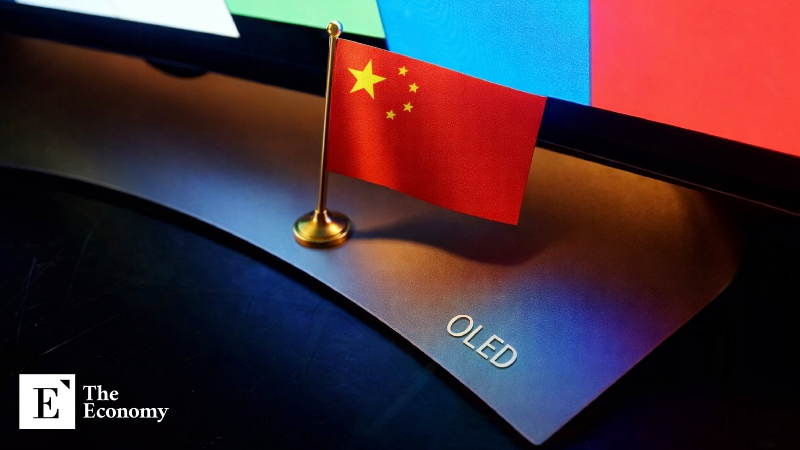
China’s Push From LCD Monopoly Toward OLED
As South Korean companies retreat from low-margin LCDs, they have concentrated resources on higher-value OLEDs. Yet China, having monopolized LCDs, is now setting its sights on OLEDs as well, intensifying concerns. The pace of China’s catch-up in OLEDs has recently accelerated. According to the Korea Display Industry Association and Omdia, South Korea’s global OLED market share fell from 73.6% in 2023 to 67.2% last year, a decline of 6.4 percentage points. Over the same period, China’s share rose from 25.7% to 33.3%, narrowing the gap substantially.
The expansion is especially pronounced in smartphone OLEDs. In 2022, South Korea held 75.3% of the global smartphone OLED market, far ahead of China’s 24.4%. By 2024, the gap had shrunk to just 8.9 percentage points. Chinese smartphone makers such as Huawei and Vivo have aggressively adopted domestically produced OLED panels, driving shipment volumes sharply higher. Mobile displays account for the largest share of overall OLED revenue, and similar trends are emerging in tablet and laptop OLED markets.
China’s aggressive capital spending is further accelerating market restructuring. Counterpoint Research projects that by 2027, China will account for 83% of global OLED capital expenditures, roughly six times South Korea’s projected 13%. With profitability already secured in large displays through LCD and mini-LED technologies, Chinese investment is expected to focus on OLED capacity for mobile and IT applications. Yoshio Tamura, vice president at Counterpoint Research, noted that Chinese companies are using massive government subsidies to develop advanced OLED technologies such as flexible OLEDs, adding that investment momentum is building around advanced RGB OLEDs based on low-temperature polycrystalline oxide (LTPO) technology.
LTPO OLEDs remain a segment led by South Korean firms, including Samsung Display and LG Display. Apple sources all LTPO OLED panels for its next-generation flagship iPhones—including standard, Air, Pro, and Pro Max models—from South Korean suppliers. These panels consume 10–15% less power than conventional OLEDs, driving adoption in premium smartphones. While LTPO OLEDs produced by China’s BOE reportedly failed to pass Apple’s quality tests, industry observers argue that the technological gap is narrowing. Nam Sang-wook, senior research fellow at the Korea Institute for Industrial Economics and Trade, warned that although China is still struggling with LTPO OLEDs, it is rapidly catching up across both small- and large-sized premium OLEDs. “If South Korean firms lose their technological edge, the market could be surrendered in an instant,” he said. “China is particularly threatening because it is also accumulating user experience through patriotic consumption.”
Matthew Reuter is a senior economic correspondent at The Economy, where he covers global financial markets, emerging technologies, and cross-border trade dynamics. With over a decade of experience reporting from major financial hubs—including London, New York, and Hong Kong—Matthew has developed a reputation for breaking complex economic stories into sharp, accessible narratives. Before joining The Economy, he worked at a leading European financial daily, where his investigative reporting on post-crisis banking reforms earned him recognition from the European Press Association. A graduate of the London School of Economics, Matthew holds dual degrees in economics and international relations. He is particularly interested in how data science and AI are reshaping market analysis and policymaking, often blending quantitative insights into his articles. Outside journalism, Matthew frequently moderates panels at global finance summits and guest lectures on financial journalism at top universities.
Similar Post